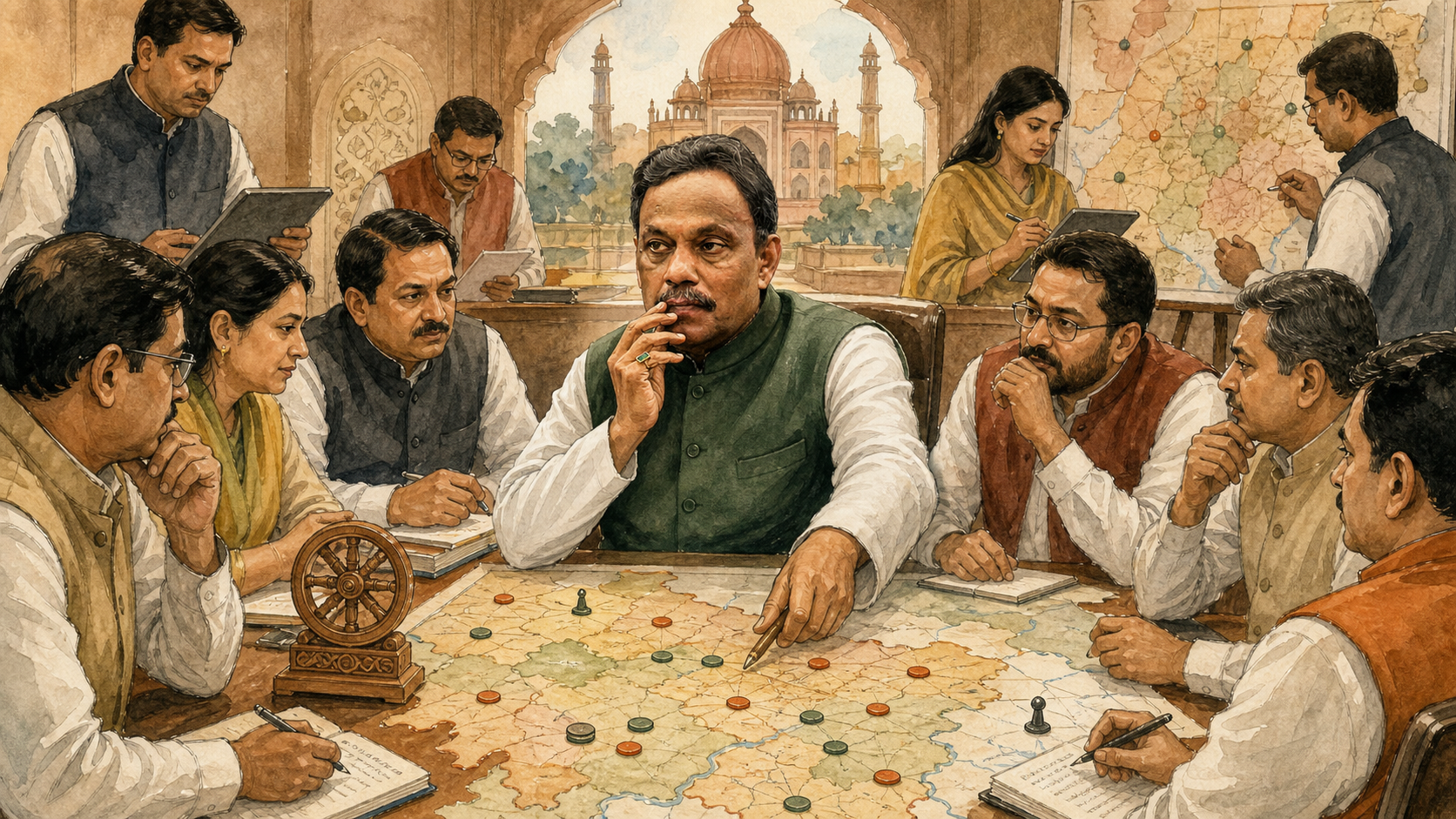
In the Mahabharata, a charioteer did not replace the warrior. He read the field, steadied the principal actor and turned uncertainty into direction. Used carefully, that is a useful metaphor for Vinod Tawde's new responsibility in Uttar Pradesh. On 18 August 2026, the Bharatiya Janata Party appointed the national general secretary and Rajya Sabha member as its Uttar Pradesh in-charge ahead of the 2027 Assembly election. Jagdish Ishwarbhai Patel was named co-in-charge. The appointment is now a confirmed organisational decision, not a speculative possibility.
The phrase "Parth Sarthi" should not be read as an extravagant claim that one strategist can deliver India's largest electoral state. It describes a role: helping the party's principal leaders, state organisation, allies and booth workers move in the same direction. Contemporary reporting on the appointment emphasised Tawde's reputation as a listener and coordinator who works across internal groups. Those qualities will be tested in a state where political scale magnifies every organisational weakness.
The charioteer, not the campaign's only face
Uttar Pradesh has 403 Assembly constituencies and 80 Lok Sabha seats. It is not one homogeneous political theatre. Western Uttar Pradesh, Awadh, Purvanchal, Bundelkhand and the urban-industrial belt have different social coalitions, economic concerns and local leadership structures. A message that works in one region may sound remote in another. Candidate selection, alliance management, caste representation, welfare communication and booth mobilisation must therefore be calibrated constituency by constituency.
Tawde's job is unlikely to be measured by the number of posters carrying his photograph. It will be measured by whether information travels from the booth to the leadership and decisions travel back without delay. A national in-charge must recognise local authority rather than compete with it. He must help the central leadership and the Uttar Pradesh government hear difficult feedback early, before a grievance becomes rebellion or a neglected constituency becomes a surprise on counting day.
An organiser shaped by several arenas
Tawde's official account of his political journey traces his organisational work to the Akhil Bharatiya Vidyarthi Parishad in 1980 and his entry into the BJP in 1994. He served as Maharashtra BJP general secretary and became president of the party's Mumbai unit in 1999. Legislative responsibility followed through the Maharashtra Legislative Council, where he became Leader of the Opposition, and later the Borivali Assembly constituency.
As a Maharashtra minister, he handled portfolios that included school education, higher and technical education, medical education, sports and youth welfare, culture, parliamentary affairs and minority development. That range is relevant to Uttar Pradesh because an election campaign must translate governance into everyday language. Education quality, examinations, youth opportunity, sport, culture and local administration are not abstract files. They shape the decisions of families and first-time voters.
At the national level, Tawde became a BJP national general secretary in 2021 and was appointed the party's Bihar in-charge in 2022. He entered the Rajya Sabha from Maharashtra in 2026. His assignments have included organisational and electoral coordination across states, as well as roles connected with presidential and vice-presidential campaigns. The common thread is not flamboyant mass politics; it is the patient work of aligning people who possess different incentives, seniority and local strengths.
Why the Bihar experience matters
The BJP's choice reflects the value it places on Tawde's Bihar experience. Bihar required coordination within a multi-party National Democratic Alliance, careful management of social coalitions and a campaign structure capable of adapting national themes to local realities. Uttar Pradesh is different in history, leadership and party organisation, so Bihar cannot be copied as a template. What can travel is the method: regular consultation, alliance discipline, early identification of friction and clarity about who owns each task.
A coordinator earns authority by resolving problems without creating fresh ones. That requires private conversations, credible follow-up and the ability to tell senior leaders when evidence contradicts assumption. Political organisations often receive abundant information but struggle to separate useful warning from factional complaint. Tawde's central contribution can be a trusted filter that verifies field reports and converts them into decisions.
Four tasks that will define the assignment
First, build a disciplined feedback system. Booth, mandal and district units should report voter concerns, organisational vacancies and constituency risks in a common format. Data should inform judgement rather than become a dashboard detached from workers. Regional reviews must end with named responsibilities and deadlines.
Second, balance continuity with renewal. The BJP has experienced leaders and an expanding generation of younger workers. Candidate and organisational decisions will have to respect performance, social representation, public credibility and succession. A strong in-charge creates space for emerging leadership without treating experience as a liability.
Third, connect governance with local evidence. Statewide achievements matter only when citizens can relate them to a road, school, hospital, job, police station or welfare service. Campaign communication should acknowledge implementation gaps and show how they will be corrected. Credibility grows when political messaging reflects what voters can see.
Fourth, keep alliances and internal groups in conversation. Seat-level ambitions are inevitable. The organiser's responsibility is to prevent negotiation from becoming public contradiction. Allies and party leaders need a predictable mechanism for raising concerns, receiving decisions and understanding the strategic reasoning behind them.
The difficult middle of politics
Indian elections are narrated through rallies, slogans and prominent faces. The decisive work often happens in the difficult middle: between government and organisation, leadership and cadre, policy and perception, data and instinct, ambition and accommodation. Tawde's career has largely developed in this middle layer. It is less visible than a rally stage but essential to campaign coherence.
This does not mean avoiding public leadership. An in-charge must communicate priorities and motivate workers. The distinction is that visibility should serve coordination rather than personal projection. The principal public mandate in Uttar Pradesh belongs to the state's established leadership and candidates. Tawde's role is to help that leadership operate through a stronger organisation and a more accurate picture of the electorate.
The limits of the metaphor
An outside strategist cannot substitute for local credibility. Uttar Pradesh has its own political vocabulary, caste equations, regional histories and networks built over decades. Tawde must work through the state unit, not around it. The appointment will succeed only if his mandate is clear, local leaders trust the process and the central organisation remains willing to revise assumptions when field evidence changes.
Nor should campaign management become an exercise in mathematical social engineering. Voters are citizens with overlapping identities and practical expectations. A durable majority is built through performance, representation, respectful communication and confidence in leadership. Booth arithmetic can identify where attention is needed; it cannot manufacture trust by itself.
How success should be judged
The BJP will naturally judge the assignment by the 2027 result. Before polling day, however, there are visible indicators of organisational health: fewer unresolved disputes, faster candidate preparation, complete booth committees, stronger participation by women and young workers, coherent alliance communication and campaign messages that reflect regional priorities. Progress on these measures would show that the chariot is moving as one organisation rather than as disconnected parts.
Vinod Tawde arrives in Uttar Pradesh with four decades of organisational and administrative experience and with the confidence of the BJP's national leadership. The appointment places him in one of the most demanding roles in Indian party politics. His opportunity is to demonstrate that political strategy is not merely the cleverness of a war room. It is the discipline of listening, deciding, explaining and following through.
That is why the "Parth Sarthi" comparison has force. A modern political charioteer does not seize every microphone or claim every victory. He helps leaders read the terrain, keeps the organisation balanced through difficult turns and ensures that thousands of workers understand the direction of travel. If Tawde can create that alignment in Uttar Pradesh, his most important contribution may be precisely the one that attracts the least personal spectacle.



