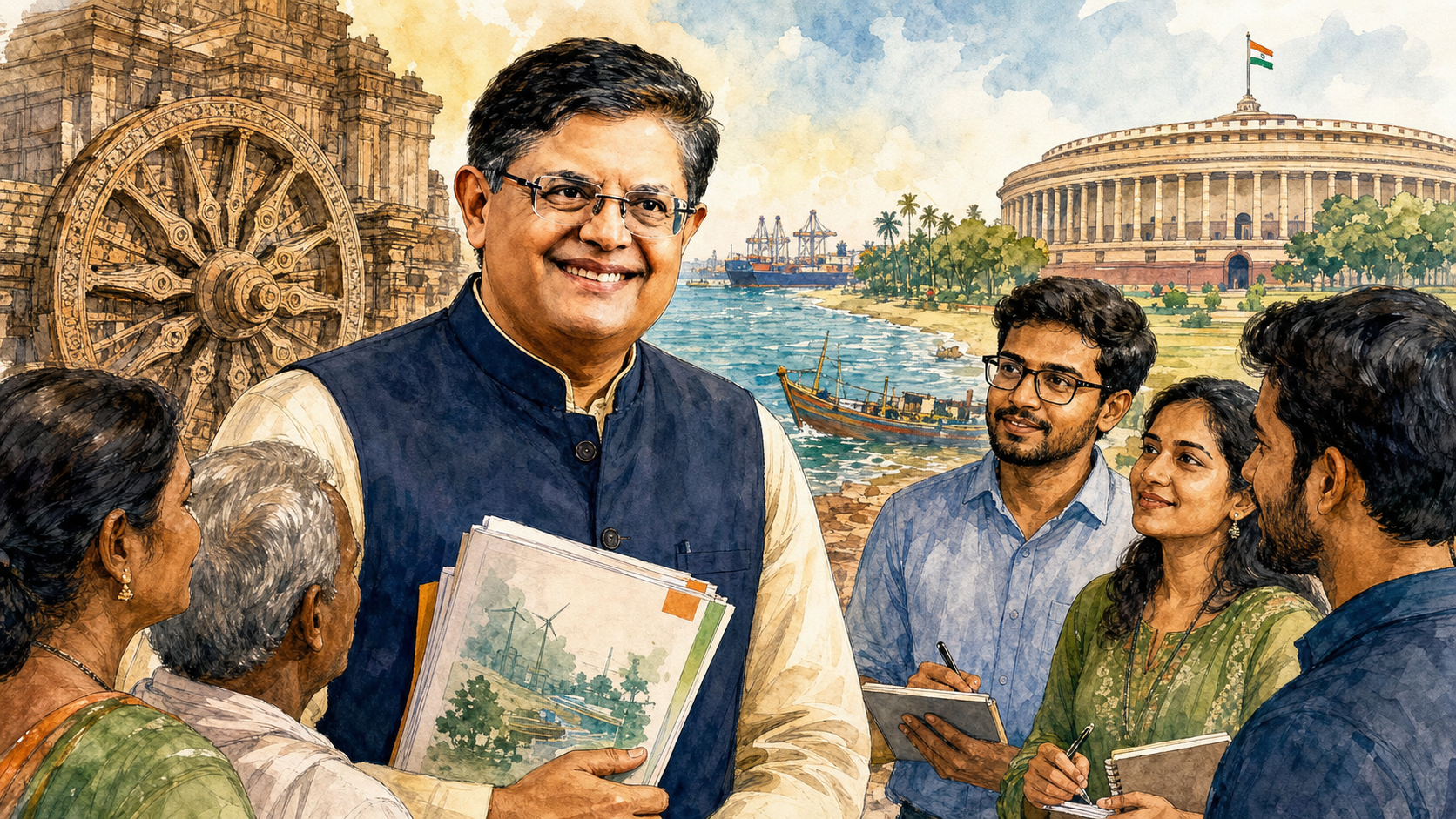
Baijayant “Jay” Panda’s public career is unusually easy to count and unusually difficult to reduce to a slogan. It spans two terms in the Rajya Sabha, three in the Lok Sabha, a transition between two major political parties, years in the corporate sector, and an enduring effort to place Odisha’s priorities inside India’s national policy conversation. His return to the Lok Sabha from Kendrapara in 2024 completed a political comeback, but it also opened a new phase: the experienced parliamentarian now operates at the intersection of constituency work, party organisation and national policy.
Lok Post Fact File
- Current role: Member of Parliament from Kendrapara, Odisha, and national vice-president of the Bharatiya Janata Party.
- Parliamentary journey: Two Rajya Sabha terms followed by three Lok Sabha terms, making him a five-term parliamentarian.
- Education: Engineering and management studies at Michigan Technological University.
- 2024 mandate: Won Kendrapara with 615,705 votes, defeating his nearest rival by 66,536 votes.
- Policy interests: Economic development, technology, data privacy, education, infrastructure and Odisha’s regional priorities.
An Engineer Enters Public Life
Panda’s path into politics did not begin in a traditional party office. He studied engineering and management, worked in the corporate sector and participated in industry organisations before moving into full-time public life. That background remains relevant because it helps explain the vocabulary he often brings to politics: institutions, systems, investment, infrastructure, measurable delivery and technological change.
India has many mass leaders and many policy specialists, but relatively few politicians who have spent sustained time in industry, Parliament, party organisation and public commentary. Panda’s career has moved across all four. This does not automatically make every position correct, but it gives his politics a recognisable method. He tends to frame governance as a design problem: identify a bottleneck, build institutional capacity, measure implementation and keep the citizen in view.
From the Rajya Sabha to Kendrapara
His parliamentary journey began in 2000 in the Rajya Sabha, where he served two consecutive terms representing Odisha. In 2009 he moved to the directly elected Lok Sabha and won Kendrapara, returning in 2014 for a second term from the constituency. Those years placed him on committees dealing with major areas of governance and gave him a national platform on issues ranging from economic reform to technology and institutional accountability.
The transition from the Biju Janata Dal to the BJP was the decisive political rupture in that journey. Panda resigned from the BJD in 2018 and joined the BJP in 2019. Party changes invite scrutiny because voters reasonably ask whether principles, strategy or circumstances drove the move. In Panda’s case, the more useful test is the long record that followed: he accepted organisational responsibilities, continued national advocacy and returned to contest Kendrapara under a new banner.
The 2024 Return
The 2024 result gave that transition electoral legitimacy. Panda received 615,705 votes in Kendrapara and defeated BJD candidate Anshuman Mohanty by 66,536 votes. It was not merely a return to Parliament after a gap; it was a return to a constituency he had represented earlier, now under the BJP flag and amid a wider political transformation in Odisha.
Kendrapara is also an appropriate place from which to understand his national profile. The constituency sits within a state whose development debate combines ports, industry, agriculture, climate vulnerability, migration, heritage and aspirations for better connectivity. A national politician representing this landscape cannot treat regional development as a side issue. Odisha’s coastline, mineral economy, disaster-management experience and cultural confidence all demand a voice in New Delhi that can translate local priorities into national programmes.
What the Parliamentary Record Shows
Political profiles often rely on speeches and reputation. Parliament provides a more measurable record. According to PRS Legislative Research, data for the 18th Lok Sabha through 13 August 2026 records 153 questions from Panda, above the national average of 120 for the period. His questions cover a notably wide field: railway-led economic growth, textile value chains, tourism projects, inland waterways, LPG infrastructure, telemedicine, farm-to-market integration, digital platforms for self-help groups, culture and research.
The same record should be read in full rather than selectively. PRS lists his attendance at 76%, below the national average of 85%, and three debate interventions during the period. The contrast is informative. His present parliamentary footprint is strongest in the question mechanism, where MPs can force ministries to place facts, targets and implementation details on the public record. That is valuable work, but it also leaves room for a larger role in debates as the term progresses.
This combination is consistent with an engineer-politician’s instinct: ask a specific ministry a specific question and create a traceable response. For citizens, however, the next step is translation. Parliamentary answers matter most when they become constituency follow-up, public dashboards, corrected implementation and visible outcomes.
Technology, Privacy and Institutional Reform
Panda has long engaged with questions that became central only later in India’s public debate, particularly technology governance and data privacy. His public work has also touched witness protection, institutional reform, malnutrition and the health costs associated with tobacco. The connecting idea is that economic growth alone is not enough; citizens need institutions capable of protecting dignity, rights and opportunity while adapting to technological change.
That perspective is increasingly important. India’s digital public infrastructure, artificial-intelligence adoption and platform economy are expanding faster than many older regulatory habits. Political leaders must understand both innovation and safeguards. Panda’s engineering background does not settle these debates, but it gives him a useful base from which to ask practical questions: who holds the data, what accountability exists, how can technology widen access, and what happens when systems fail?
A National Organiser With an Odisha Anchor
As a BJP national vice-president and spokesperson, Panda works beyond constituency boundaries. His organisational assignments have required coalition-building, election management and communication across states. This makes him part of a smaller category of leaders who must speak simultaneously to a local electorate and a national political organisation.
The opportunity is substantial. The BJP’s growth in Odisha has changed the state’s political structure, and experienced leaders now carry the burden of converting electoral expansion into durable governance. Panda can contribute by connecting New Delhi’s policy capacity with Odisha’s district-level needs while ensuring that the state’s distinctive political culture is not flattened into generic national messaging.
Public Communication as Democratic Work
Panda has written columns, participated in televised debates and published a collection of essays titled Lutyens’ Maverick. That public-facing habit is more than personal branding when used responsibly. Parliamentary democracy needs elected representatives who can explain not only what they support, but why; who can distinguish evidence from assertion; and who are willing to answer informed disagreement.
For a contemporary politician, communication now also includes listening. Constituents do not need another one-way broadcast channel. They need routes through which a question about a road, railway, hospital, cyclone shelter, school or digital service can enter a public workflow and receive a trackable answer. Panda’s next contribution could be to make this feedback loop a visible model for parliamentary constituencies.
The Measure of the Next Chapter
The most compelling part of Baijayant Panda’s profile is not that his career has been smooth. It is that it has included election, interruption, political realignment and return. Such a journey can produce either caution or clarity. His present role suggests an opportunity to use accumulated experience in service of a more transparent, technology-literate and development-focused politics.
The standard should remain demanding. Success must be measured through constituency outcomes in Kendrapara, effective advocacy for Odisha, stronger parliamentary participation and the quality of his contribution to national policy. A Lok Post profile is not a certificate; it is a record of public responsibility. Panda’s five terms give him unusual institutional memory. The next question is how decisively that memory can be converted into delivery.