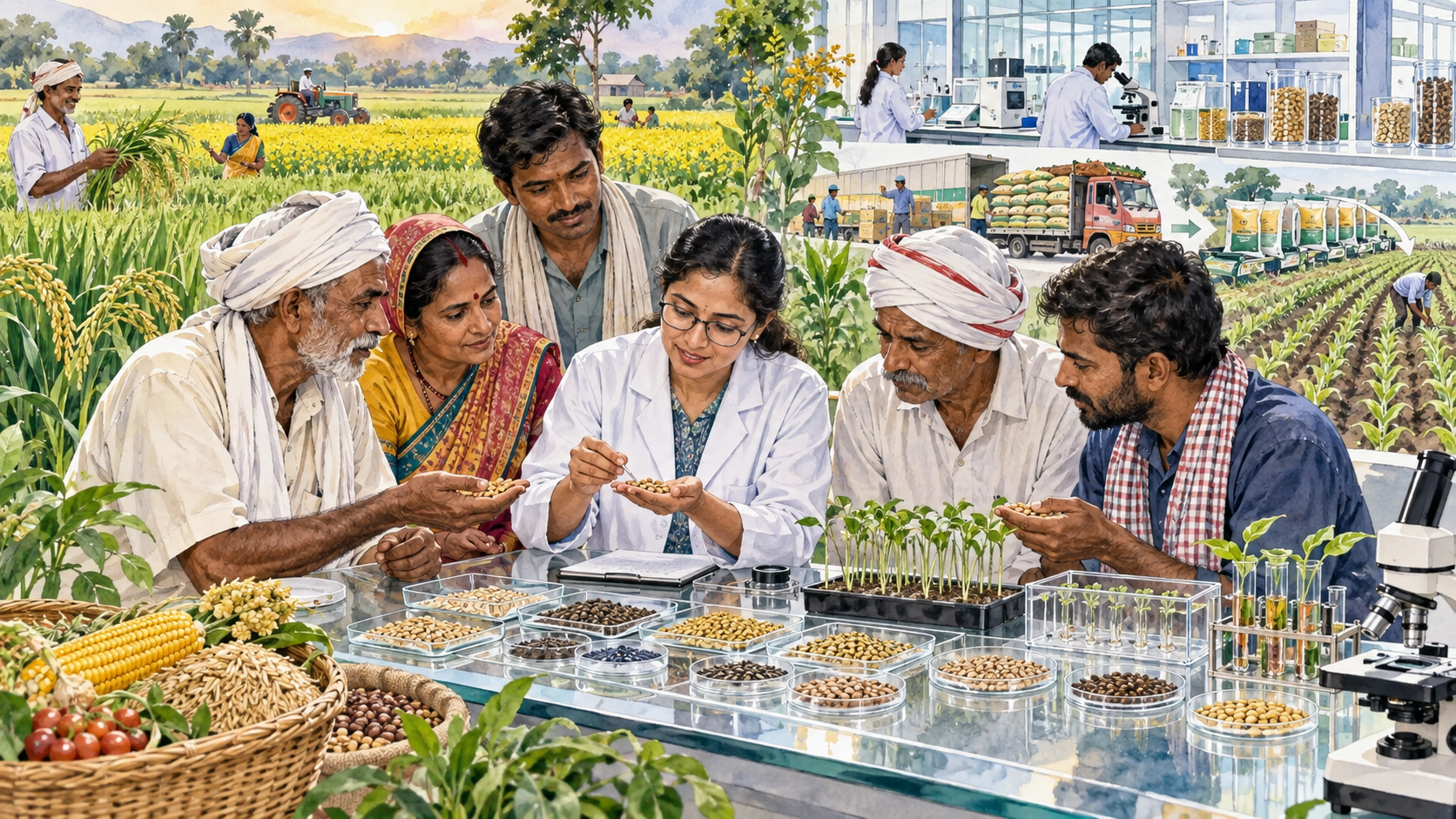
A farmer makes one of the season's biggest decisions before a crop is visible: which seed to trust. If that seed is fake, adulterated or below the promised standard, the loss is not confined to the price of a packet. Land preparation, irrigation, fertiliser, labour and months of opportunity can be wasted before the defect becomes undeniable. The Centre's proposal for a tougher Seed Act therefore addresses a problem that is both technical and deeply personal.
Union Agriculture and Farmers' Welfare Minister Shivraj Singh Chouhan is scheduled to meet national and state farmer organisations at Krishi Bhawan on September 10 before the draft legislation is finalised. According to the official consultation note, the proposed framework is expected to provide stringent action, including heavy penalties and imprisonment, against companies and traders involved in fake or substandard seed. It also aims for end-to-end traceability while safeguarding farmers' rights over traditional seeds.
Consultation before legislation
The decision to seek ground-level views before the parliamentary stage is important. Farmer groups from different regions encounter different crops, climates, distribution channels and customary seed practices. A cotton grower's risk is not identical to that of a small millet farmer who saves and exchanges seed locally. Good regulation must punish deliberate fraud without criminalising traditional, non-commercial practices or creating paperwork that only large companies can manage.
The announced participants include major national farmer organisations as well as representatives from Karnataka, Telangana, Maharashtra, Gujarat, Rajasthan, Bihar, Tamil Nadu, Jharkhand and Kerala. The breadth is useful, but the quality of the exercise will depend on whether their proposals are recorded, answered and reflected in the published draft.
Traceability can change enforcement
Today, a farmer who discovers poor germination may struggle to establish where a batch originated, how it was stored and who bears responsibility. A traceable chain can connect the producer, testing certificate, lot number, distributor and retail sale. That record makes targeted recalls and compensation possible. It can also protect honest companies from broad suspicion when a problem is limited to counterfeit packaging or improper storage downstream.
Technology should keep the system simple. A QR code or batch lookup can help, but farmers must also have an offline route through local agriculture offices and helplines. Digital verification should supplement clear packaging, accessible testing and accountable inspectors, not replace them. Data on failed batches, enforcement action and resolved claims should be published in a form that farmers and dealers can understand.
Penalties need a compensation pathway
Criminal penalties can deter organised fraud, but a farmer needs timely relief during the same agricultural cycle. The law should define evidence standards, rapid local testing and an appeal process. Where a verified defect caused crop failure, compensation must cover more than the packet price. At the same time, weather, soil conditions and agronomic practice can also affect germination, so decisions require credible science rather than automatic blame.
Independent and well-equipped seed laboratories will be central. Sample collection must preserve chain of custody, results should be time-bound and laboratories should face quality audits. Without testing capacity, a strict law risks becoming strong on paper and arbitrary in the field.
Protect choice and traditional knowledge
The government's stated commitment to traditional seed rights is essential. India's agricultural resilience rests partly on diversity maintained by farming communities. The final law should clearly separate commercial sale at scale from farmers saving, using, exchanging and developing traditional varieties. It should also ensure that traceability requirements do not force every farmer into dependence on a narrow set of suppliers.
For the Modi government's self-reliant agriculture agenda, seed quality is foundational. Better irrigation, credit and market access cannot rescue a crop that began with fraudulent input. A predictable seed market rewards research, improves farm productivity and protects household income.
Judge the reform by the farmer's remedy
The consultation is a promising beginning, not the final achievement. The eventual bill should be published with a plain-language explanation of how farmer feedback changed it. Rules, laboratories, enforcement staffing and grievance systems must be prepared before commencement.
A tough law will make headlines through penalties. A successful law will be known by something quieter: farmers can verify what they buy, honest seed businesses can compete fairly, traditional practices remain protected and a failed batch produces a fast remedy rather than years of dispute. That is the standard the September 10 consultation should help build.