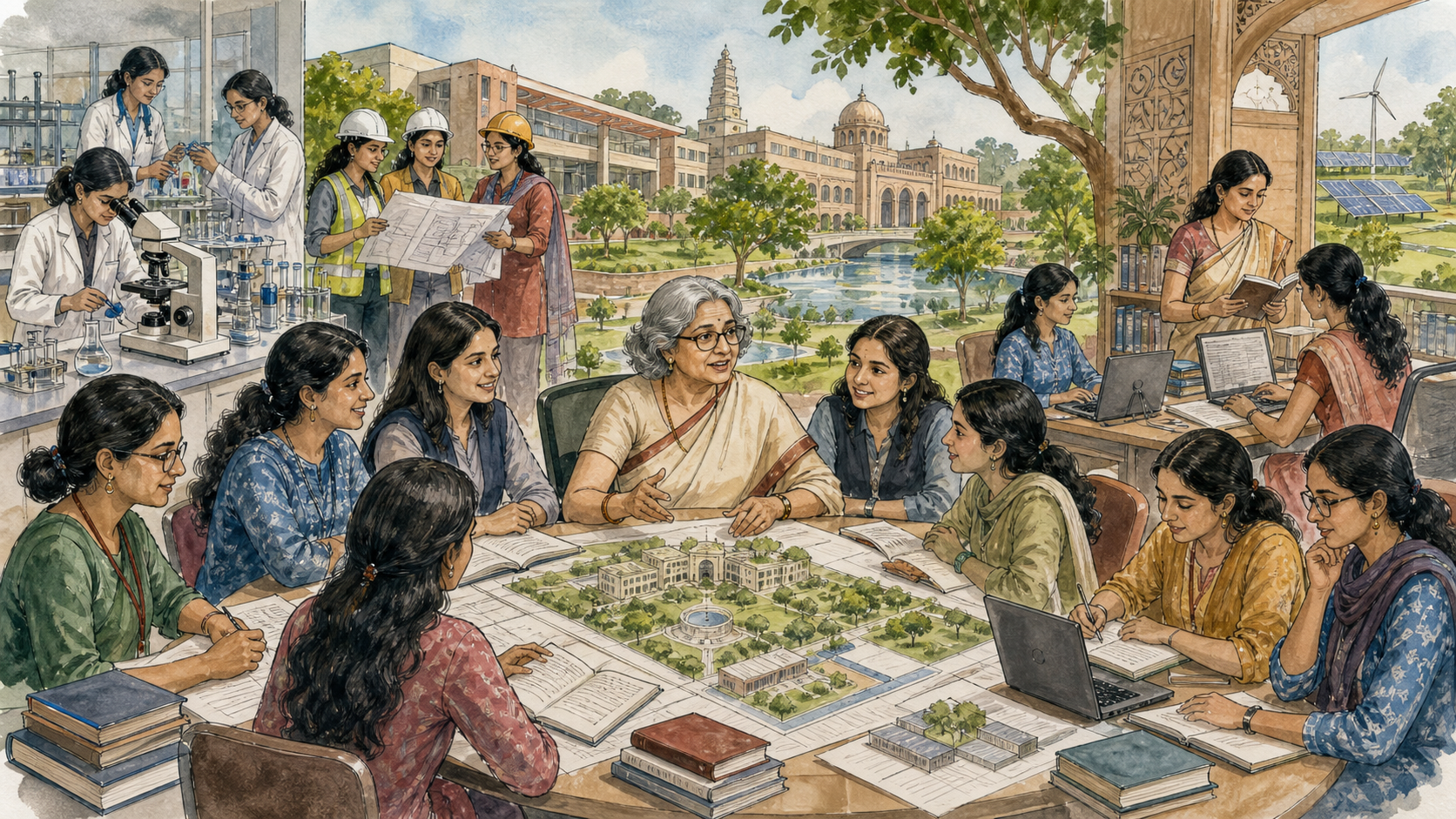
Bihar has announced that it will establish a women's university in which the vice-chancellor, professors, employees and students will all be women. The commitment appears in the Chief Minister's Secretariat release list dated 27 August 2026, alongside the government's statement that educated and self-reliant women are a foundation of a prosperous Bihar. The idea is bold because it extends representation beyond enrolment: women would lead the academic, administrative and institutional life of the university. The next challenge is to convert that symbolism into a credible university.
The announcement should be treated as the beginning of a public design process, not as a completed reform. Bihar must still clarify the institution's legal structure, location, funding, academic mandate, admissions policy, faculty recruitment and timeline. Those details will decide whether the project becomes a high-quality centre of learning or merely another campus carrying a powerful name. The government can strengthen confidence by publishing a concept paper and inviting comments from women academics, students, employers, civil-society organisations and universities across India.
Leadership across the institution
A university run by women can expand the pipeline of academic leaders. Women are present across Indian higher education, yet senior positions often narrow at the level of department heads, deans, registrars and vice-chancellors. Building a complete leadership ecosystem in one institution can create experience that later benefits universities across Bihar and the country. Recruitment must nevertheless be based on open competition, academic merit and integrity. Representation becomes durable when it is paired with transparent standards, not when appointments are insulated from scrutiny.
The governing bodies should include scholars from science, technology, social sciences, law, health, humanities and public administration. Students and non-teaching employees should also have structured representation. A university is not only its vice-chancellor; procurement, examinations, laboratories, libraries, hostels, grievance systems and finance offices shape daily trust. Women leading all these functions could generate valuable institutional knowledge about how rules, facilities and work cultures affect participation.
Access must extend beyond Patna
A state-level university will be meaningful only if students from districts, rural communities and lower-income households can reach it. Bihar should plan scholarships, affordable hostels, reliable public transport and digital application support from the start. Outreach should include government schools and colleges so that talented students learn about programmes before admission deadlines. Bridge courses can help students who have ability but have not had access to the same laboratories, English instruction or digital resources as urban applicants.
Safety should be designed as public infrastructure, not as a restriction on women's movement. Well-lit campuses, dependable transport, confidential complaint channels, trained counsellors, accountable security and responsive local policing are essential. Curfews or paternalistic controls cannot substitute for safe systems. A women-led institution has an opportunity to demonstrate that autonomy and safety reinforce each other when administrators listen to students and publish how grievances are handled.
Choose an academic mission with national value
The university should not be confined to subjects stereotypically associated with women. Bihar needs researchers and professionals in artificial intelligence, agriculture, climate resilience, public health, advanced manufacturing, law, economics, teacher education and urban planning. A strong liberal-arts foundation should sit alongside laboratories and professional programmes. Interdisciplinary centres could study problems with particular relevance to women, including maternal health, unpaid care, labour-force participation, financial inclusion, gender-based violence and the impact of climate shocks on migration.
Partnerships can accelerate quality but should not replace internal capacity. IIT Patna, central universities, medical institutions, agricultural universities and leading national research bodies can support joint courses, faculty exchanges and shared equipment. International collaboration may help build specialised programmes, provided agreements are transparent and aligned with the university's needs. The long-term objective must be a permanent faculty that publishes credible research, mentors students and competes for national grants.
Measure outcomes, not only construction
Governments often find it easier to monitor buildings than learning. Bihar should publish annual indicators covering faculty vacancies, student diversity, retention, graduation, research output, internships, employment, postgraduate progression and grievance resolution. Independent academic review every few years can assess curricula and governance. Data should be disaggregated by district and socio-economic background so that headline enrolment does not conceal unequal access or completion.
The financing model also requires clarity. A serious research university needs recurring funds for faculty, laboratories, libraries, maintenance and student support, not only a construction allocation. Multi-year budgeting protects academic planning from abrupt changes. Procurement should be transparent and sufficiently flexible for research equipment. Philanthropy and industry partnerships can add resources, but academic decisions must remain independent and conflicts of interest must be disclosed.
An institution that can influence the system
The university can serve as a policy laboratory for Bihar's wider higher-education network. Successful practices in mentoring, childcare, anti-harassment systems, digital administration and career services can be shared with other colleges. Faculty-development programmes can reach women teachers across the state. Research on school-to-college transitions can identify why students leave education and what interventions improve continuation. In that way, the benefit would extend far beyond those admitted to one campus.
Bihar's announcement deserves support because it imagines women not only as beneficiaries of education but as the people who design and govern it. The pro-development response is to demand that the idea receive the academic seriousness it deserves. A clear law, open recruitment, adequate funding, broad access and public measurement can make the university a national institution rather than a ceremonial project. If Bihar builds those foundations, the campus can demonstrate how representation, excellence and institutional accountability belong in the same sentence.