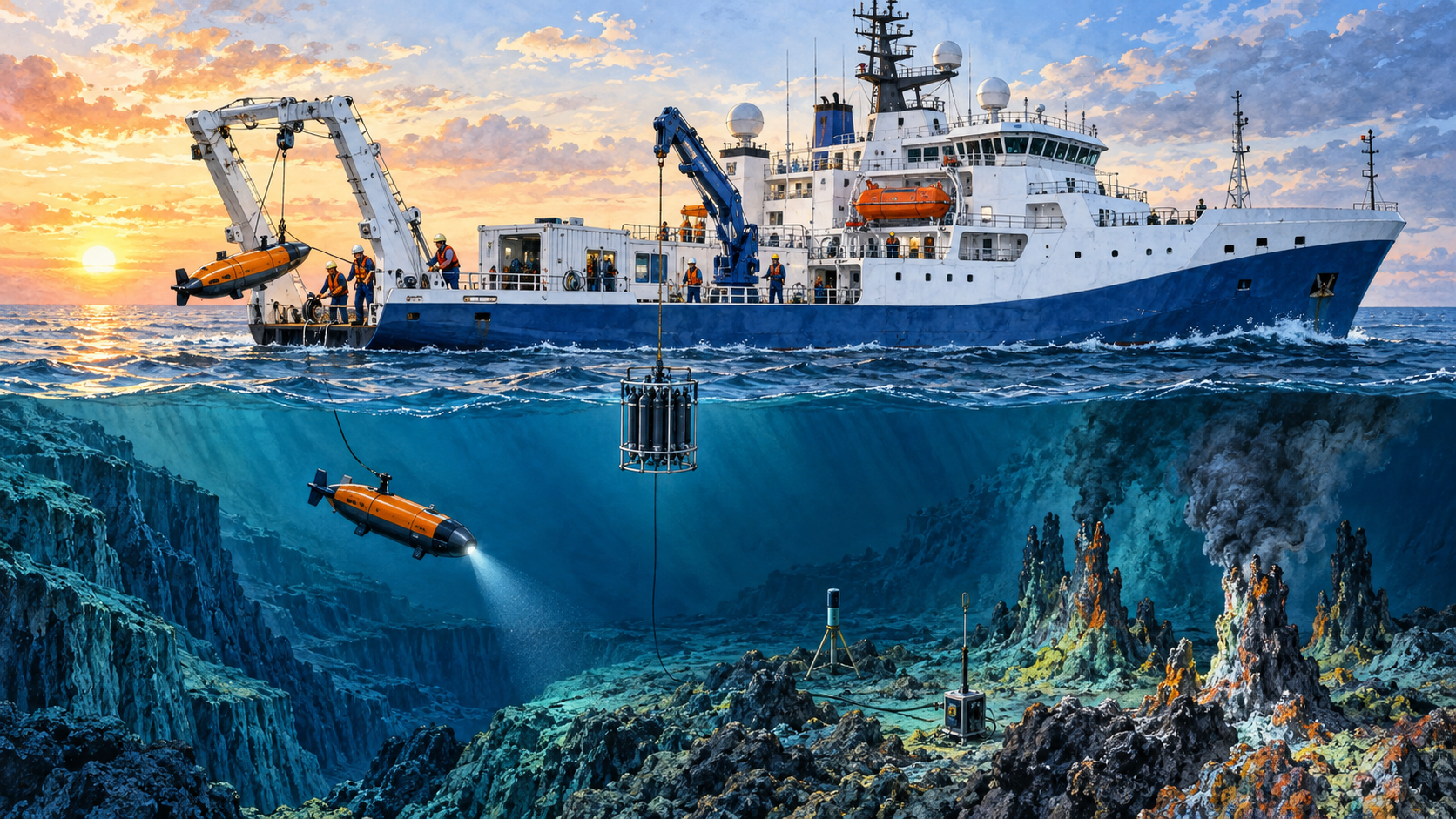
India has placed a new scientific platform in the water at Kolkata's Rishi Bankim Shipyard. The Ocean Research Vessel Sagar Manthan, designed and constructed by Garden Reach Shipbuilders and Engineers for the National Centre for Polar and Ocean Research, is intended to give Indian researchers a modern, domestically built platform for studying climate, seabed geology, ocean chemistry and extreme marine environments.
The launch on September 9 is a shipbuilding milestone, not the beginning of scientific operations. Superstructure work, equipment integration and extensive sea trials still lie ahead, with delivery scheduled for 2028. That distinction matters because the vessel's real achievement will be proven through safe operation and reliable data over a projected 30-year service life.
A ₹840-crore Deep Ocean Mission platform
The Ministry of Earth Sciences describes Sagar Manthan as an all-weather, multidisciplinary vessel being built for about ₹840 crore under the Deep Ocean Survey and Exploration component of India's Deep Ocean Mission. It is engineered for demanding environments including the Southern Ocean.
Its planned equipment includes dynamic positioning, multibeam bathymetry, multichannel seismic systems, sub-bottom profiling, weather radar and drop keels. It will be able to deploy remotely operated and autonomous underwater vehicles, collect water-column samples and support atmospheric observations. Together, those systems allow scientists to map terrain, examine geological structures and study interactions between ocean and atmosphere.
Why an indigenous vessel matters
India has long depended on research ships, including the 43-year-old Sagar Kanya acquired from Germany in 1983. Sagar Manthan represents a transition from procuring a complex platform abroad to designing and building it through an Indian defence public-sector shipyard. GRSE's work expands domestic knowledge in specialised hull design, low-noise operation, scientific integration and long-duration support.
This capability has value beyond one vessel. Research ships require maintenance, calibration, software integration and upgrades for decades. Domestic expertise can reduce downtime and foreign dependence while creating a base for future polar and oceanographic platforms. DD India's account notes that the ministry is considering additional vessels, including a polar research vessel.
Science beneath strategy
The oceans shape the monsoon, absorb heat and carbon, generate extreme weather and carry most global trade. Better observations can improve climate models, tsunami understanding and forecasts that protect coastal communities. Seabed surveys can also identify hydrothermal systems and critical-mineral environments, although exploration must proceed with strong ecological baselines and transparent safeguards.
Sagar Manthan is expected to support work along Indian Ocean mid-ocean ridges, including surveys related to polymetallic hydrothermal sulphide mineralisation. Scientific credibility requires that resource interest be accompanied by careful study of fragile deep-sea ecosystems. The vessel's ability to collect biological, chemical and geological data makes it possible to establish evidence before any future extraction decision.
The Indian Ocean knowledge gap
India's geography makes ocean science a national necessity. Fisheries, coastal infrastructure, cyclone preparedness, undersea cables, maritime security and climate policy all depend on better knowledge of surrounding waters. Satellite data provides wide coverage, but ships remain essential for direct measurement, instrument deployment and validation.
The new vessel can also function as a training platform. Young oceanographers, engineers and technicians need sea time with modern systems if India is to sustain a deep-ocean programme. Universities and research institutes should receive transparent access through peer-reviewed mission proposals, with datasets released for wider scientific use where security and conservation rules allow.
Long missions also demand unglamorous operational excellence: spare parts, calibration schedules, trained crews, laboratory safety and dependable satellite links. A national vessel-time programme could publish annual cruise plans and invite research proposals well in advance. This would keep expensive equipment productively deployed and allow different institutions to combine observations, reducing duplication while building long time-series datasets that are especially valuable for climate science.
Delivery is the next milestone
Reporting from the launch traces the project from contract signing in July 2024 to steel cutting in November 2024 and keel laying in April 2026. The pace is encouraging, but integration and trials are where a research vessel's complex systems must work together under real sea conditions.
Sagar Manthan gives physical form to Atmanirbhar Bharat in science: an Indian-built ship designed to answer questions India cannot afford to leave unanswered. When it enters service, its value will not be measured only by distance sailed. It will be measured by forecasts improved, seabed mapped, researchers trained and reliable knowledge returned from one of the planet's least understood domains.