A Watershed Moment in Bihar's Law Enforcement Discourse
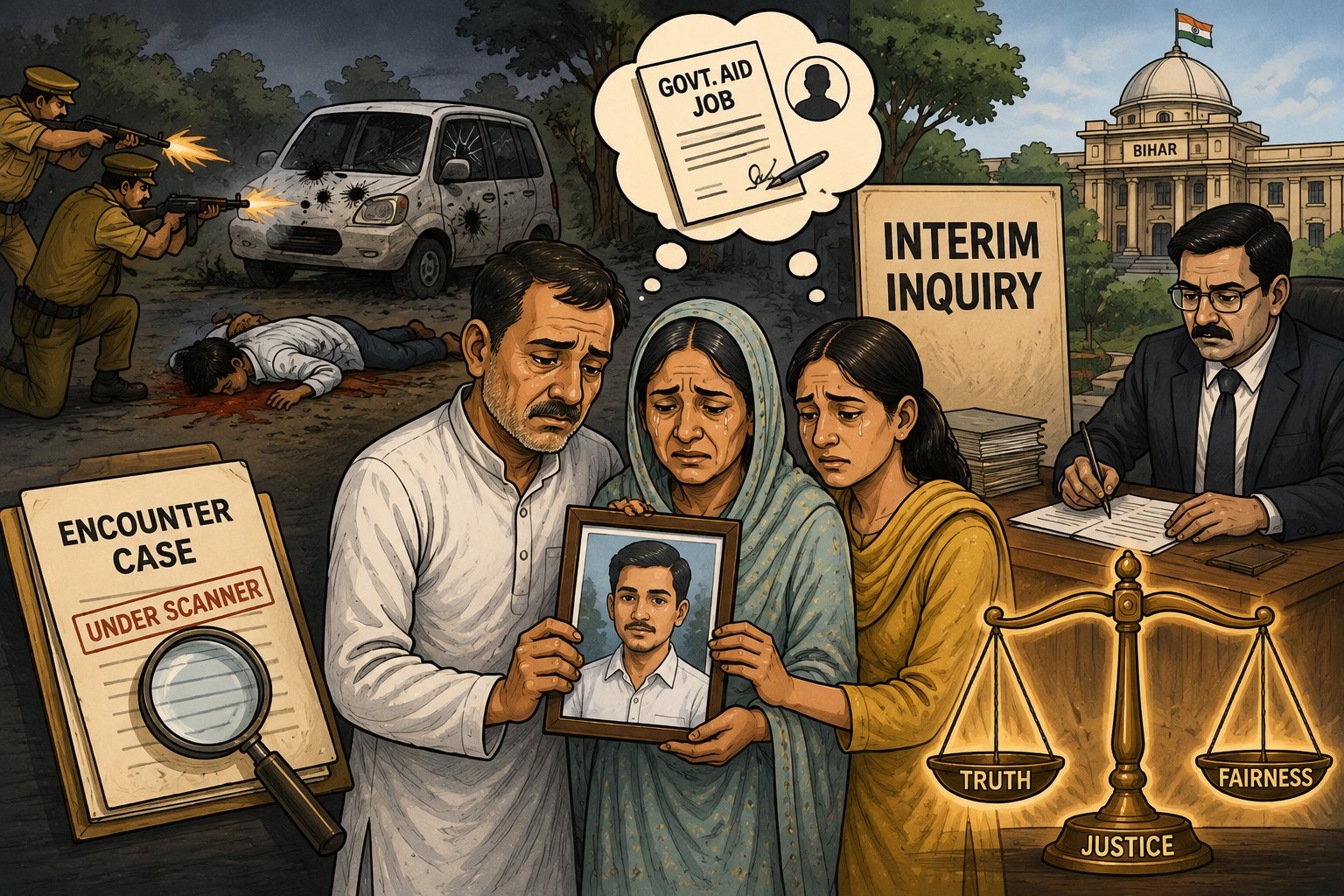
In recent months, the discourse surrounding law and order in Bihar has undergone a perceptible transformation. The police action involving criminal suspect Bharat Bhushan Tiwari has become the focal point of an escalating debate over the operational boundaries of law enforcement agencies and the administration of criminal justice. As the state administration sharpens its rhetoric against organized criminal syndicates, the episode has brought into sharp relief the perennial friction between swift administrative deterrence and the constitutional imperative of due process.
The incident, which occurred during a coordinated operation by specialized police units, resulted in Tiwari being neutralized following what authorities described as an unprovoked armed exchange. According to official police communications, law enforcement personnel had acted on precise intelligence regarding Tiwari's movements and illicit activities. Upon being intercepted, the suspect allegedly opened fire on the operational team, compelling officers to return fire in self-defense. The recovery of illicit firearms and ammunition from the scene formed the basis of the initial post-action report submitted to higher administrative echelons.
However, the aftermath of the operation quickly transitioned from a localized policing development into a statewide political controversy. The vocal public defense of aggressive police action by senior administrative figures, most notably Deputy Chief Minister Samrat Choudhary, has signaled a strategic realignment in how the state government intends to communicate its zero-tolerance posture toward habitual offenders and criminal networks.
Political Articulation of an Uncompromising Stance
For decades, the political narrative in Bihar has remained deeply intertwined with questions of public safety, gang activity, and administrative capability. Deputy Chief Minister Samrat Choudhary, holding significant sway within the governing alliance, has consistently articulated a robust law-and-order doctrine. In public addresses and media interactions following the Tiwari encounter, Choudhary reiterated that individuals who challenge the authority of the state through armed violence would face an unyielding administrative and operational response.
"The rule of law remains paramount, but those who wield illegal weapons against citizens and uniformed personnel cannot expect impunity. The administration will utilize every lawful instrument at its disposal to dismantle criminal networks that seek to undermine public peace," Choudhary stated during a recent press briefing in the state capital.
The state government's rhetoric reflects a deliberate effort to project an image of decisive governance. Supporters of this approach argue that standard criminal procedures often suffer from protracted delays, witness intimidation, and systemic bottlenecks within the lower judiciary, allowing hardened criminals to operate with relative ease even while facing active trials. From the perspective of the administration, assertive operational measures provide an immediate deterrent signal to inter-district criminal syndicates that have historically resisted administrative pacification.
Nevertheless, the opposition has characterized this operational pivot as an alarming drift toward executive overreach. Senior leaders from rival political factions have demanded comprehensive, independent inquiries into recent police encounters, accusing the ruling dispensation of attempting to replicate extra-procedural policing models seen in neighboring regions to generate political capital.
The Shadow of the Kinetic Policing Model
The intensifying rhetoric in Bihar cannot be viewed in isolation from broader regional shifts across northern India. In recent years, public administration in neighboring Uttar Pradesh has championed a model characterized by kinetic deterrence, immediate confiscation of alleged illicit properties, and frequent armed encounters with high-profile suspects. This approach has gained significant traction among certain segments of the electorate who perceive standard judicial avenues as slow and ineffective.
Analysts observe that Bihar's political leadership is navigating a delicate balancing act. While the electorate across semi-urban and rural constituencies frequently demands tangible, visible action against extortion, illegal sand mining, and armed extortion rings, the institutional infrastructure of Bihar's police force has historically operated under severe structural constraints. Bridging the gap between public demand for safety and institutional capacity through assertive policing presents both administrative opportunities and profound constitutional hazards.
Criminologists warn that relying on kinetic outcomes to project decisive governance risks institutionalizing shortcuts within the police machinery. When operational units perceive that aggressive encounters are politically rewarded and publicly celebrated, the rigorous standards required for evidence collection, forensic investigation, and professional courtroom prosecution can easily become secondary considerations.
Constitutional Boundaries and the Jurisprudence of Self-Defense
Under Indian criminal jurisprudence, the state does not possess the inherent power to extinguish life without following the procedure established by law, as enshrined in Article 21 of the Constitution. The legal validity of any police encounter rests entirely upon the narrow exception of the right of private defense provided under Sections 96 through 106 of the Indian Penal Code (and corresponding provisions under the Bharatiya Nyaya Sanhita).
The landmark judgment of the Supreme Court of India in People's Union for Civil Liberties (PUCL) v. State of Maharashtra (2014) established a comprehensive, 16-point mandatory protocol for investigating all encounter deaths. The directives explicitly require:
- The immediate registration of a First Information Report (FIR) whenever an encounter results in death.
- An independent investigation conducted by the Criminal Investigation Department (CID) or a police team from a different police station under the supervision of a senior officer.
- A mandatory Magisterial Inquiry into every death resulting from police firing, with a detailed report forwarded to the competent judicial magistrate.
- Immediate notification to the National Human Rights Commission (NHRC) and relevant State Human Rights bodies.
- Surrender of all weapons used by the operational team for mandatory ballistic examination.
"The sanctity of the constitutional framework cannot be compromised in the pursuit of immediate administrative outcomes. The right to a fair trial before an independent court is not an obstacle to justice; it is the very definition of justice in a democratic republic," observed a senior advocate practicing at the Patna High Court during a panel on institutional reforms.
Legal practitioners emphasize that compliance with the PUCL guidelines is not optional. When judicial or executive inquiries reveal discrepancies in the operational narrative, officers involved risk facing criminal prosecution under standard homicide provisions. The integrity of the police department depends on strictly maintaining this boundary between lawful self-defense and arbitrary execution.
Structural Challenges in Bihar's Criminal Justice System
Beyond the immediate controversies surrounding high-profile encounters, the debate touches upon deeper structural deficiencies within Bihar's law enforcement and justice delivery ecosystem. Decades of under-investment in forensic infrastructure, substantial vacancies across investigation wings, and an overwhelming case backlog in subordinate courts continue to hamper institutional efficiency.
Data compiled by administrative review bodies reveals that the police-to-population ratio in Bihar remains significantly below national averages and far behind international benchmarks recommended by the United Nations. Frontline police personnel frequently operate under grueling schedules with limited specialized training in modern investigation techniques, digital forensics, or crowd containment strategies.
Under these conditions, securing convictions for high-profile gang leaders through the courts requires prolonged, multi-year efforts. Witnesses in organized crime cases frequently turn hostile due to a lack of systematic witness protection programs. Consequently, the conviction rate for organized violent crimes in the state has struggled to keep pace with the volume of registered offenses, creating a governance vacuum that political rhetoric frequently seeks to fill.
The Road Forward: Balancing Deterrence and Institutional Reform
As the administrative and judicial investigations into the Bharat Bhushan Tiwari encounter proceed, the case stands as a critical litmus test for governance in Bihar. The challenge facing the state's leadership is to demonstrate that an uncompromising stance against criminality can coexist harmoniously with the rule of law.
Sustainable improvements in public safety cannot be achieved through executive declarations alone. Legal scholars, retired police administrators, and policy experts agree on several fundamental imperatives required for durable reform:
First, the state government must prioritize the institutional separation of law-and-order maintenance from criminal investigation, a long-pending reform mandated by the Supreme Court in the landmark Prakash Singh (2006) judgment. Dedicated investigation units, insulated from daily administrative pressures and adequately equipped with forensic support, are essential to building ironclad cases capable of securing convictions through established legal channels.
Second, the administration must invest heavily in modernizing trial courts, establishing dedicated fast-track courts for organized crime, and operationalizing comprehensive witness protection schemes. By accelerating the pace of judicial trials, the state can deliver swift, visible justice without compromising the constitutional protections guaranteed to every citizen.
Finally, public transparency remains the ultimate safeguard for institutional credibility. Ensuring that magisterial inquiries into encounter cases are conducted expeditiously, transparently, and independently will protect genuine police personnel who act in legitimate self-defense while deterring administrative lawlessness.
The debate ignited by the Tiwari case is not merely about a single police operation; it is about the foundational character of governance in Bihar. As the state seeks economic development, infrastructure investment, and social stability, the enduring credibility of its law enforcement institutions will depend not on the intensity of political rhetoric, but on its steadfast commitment to constitutional democracy.