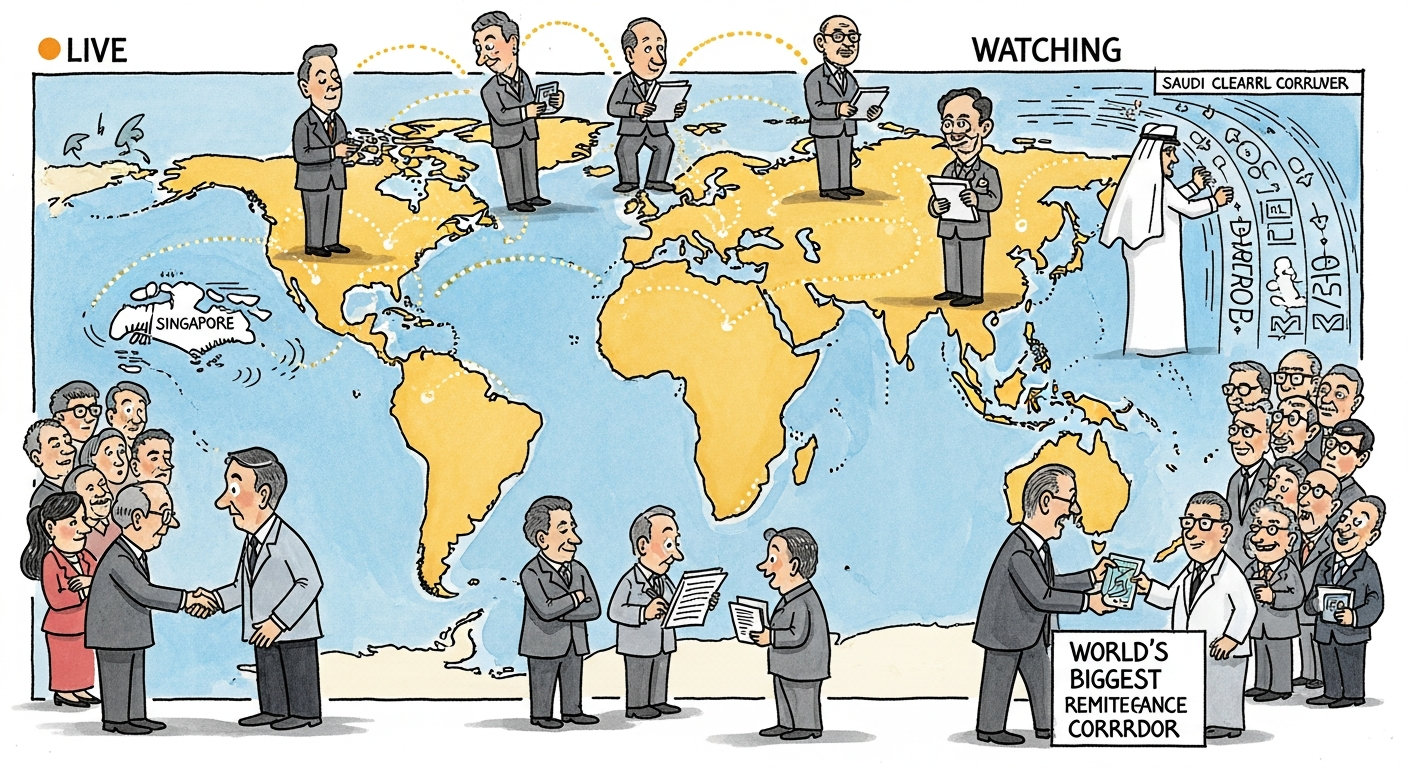
The map, current as of this week: live — Singapore, UAE, France (acceptance), Sri Lanka, Mauritius, Nepal, Bhutan. Signing — Saudi Arabia (pilot on the planet's largest remittance corridor), Qatar, Peru. Evaluating — a dozen-plus central banks across Africa and Southeast Asia studying the stack as a public good with a 1.4-billion-person reference deployment.
The diplomacy analysis names the offer: not America's proprietary rails with per-transaction economics, not China's sovereignty-freighted yuan architecture — an open third option that survived a war quarter carrying panic volumes.
The proof of concept is priced in basis points: the UAE corridor below 3 percent, the first Gulf lane ever under the World Bank threshold, with $1.2 billion a year for households when all six GCC corridors follow.
Standards are habits of dependence that outlast treaties. Every merchant QR in Colombo and terminal in Dubai makes the next integration cheaper — network gravity as statecraft.
Soft power used to be cinema. Increasingly it is whose infrastructure the world's mornings run on. The map grows on our tech desk.