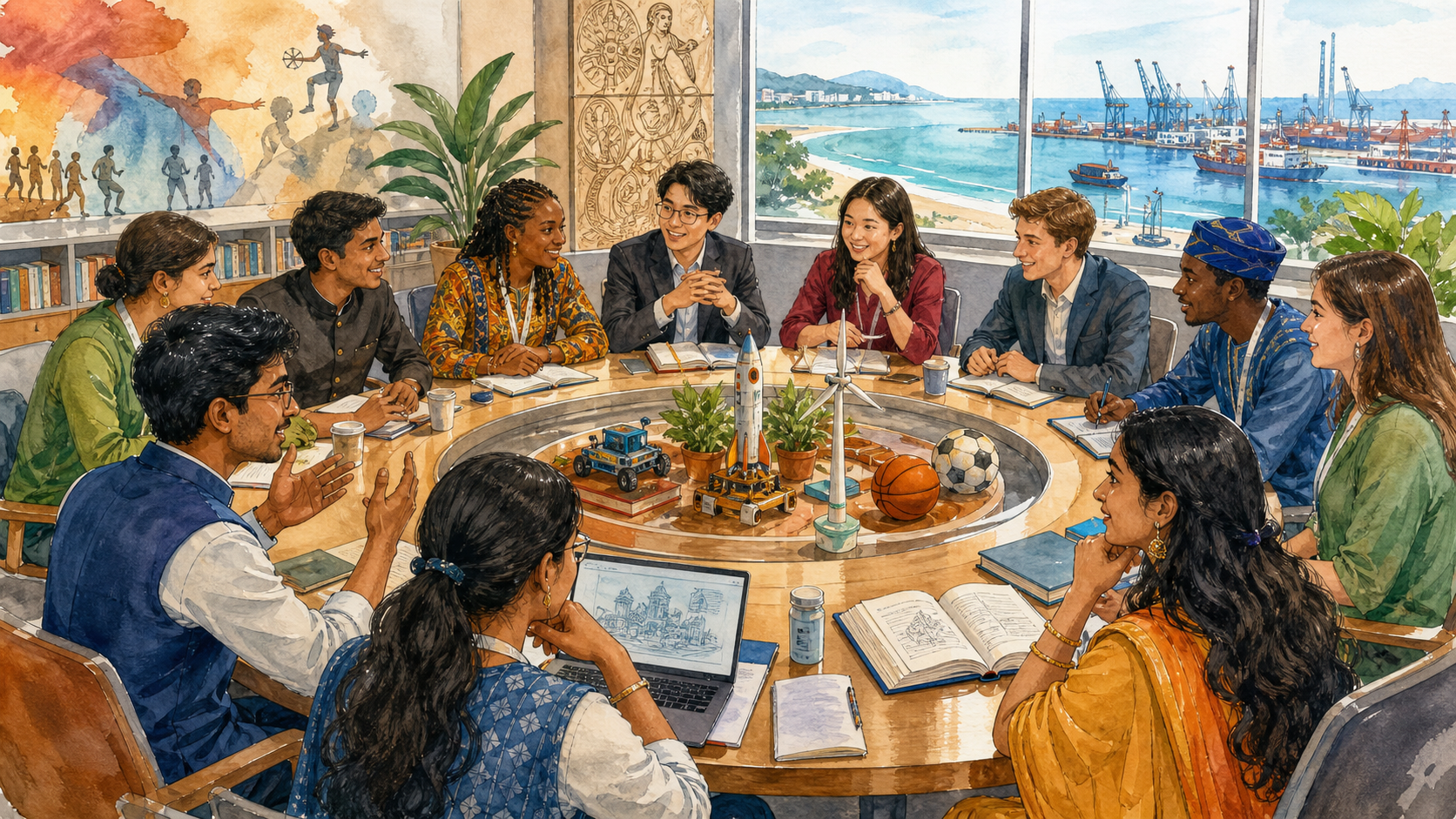
Diplomatic declarations are often judged by the prominence of the leaders who sign them. The BRICS Youth Ministers' Meeting in Visakhapatnam offered a different measure: whether a large international grouping can create practical pathways for students, volunteers, entrepreneurs, athletes and young professionals.
The meeting concluded on August 22 with a joint statement covering education, training, skills, entrepreneurship, science and technology, health, sport, sustainability, volunteering, poverty reduction, interfaith dialogue and youth inclusion. Akashvani News reported that the participants also discussed decision-making, youth-led initiatives, digital engagement and cross-border exchanges.
India's decision to place youth cooperation within its wider BRICS engagement is strategically sound. The grouping spans countries with different political systems and development models, but all must manage the same structural challenge: how to prepare a very large generation for economies being reshaped by artificial intelligence, climate pressures and changing supply chains.
From declaration to opportunity
The joint statement is broad because youth policy cannot be reduced to employment alone. A young person's prospects depend on education, health, civic confidence, access to technology and the ability to participate in public life. Treating these as connected fields allows countries to compare programmes and build exchanges around outcomes rather than ceremonial visits.
Union Youth Affairs and Sports Minister Mansukh Mandaviya said young people must be partners in shaping the future. He connected the meeting to India's Viksit Bharat 2047 vision and to Prime Minister Narendra Modi's call to develop one lakh young leaders without a political background. That objective deserves attention because leadership pipelines often favour inherited networks and metropolitan access.
Opening opportunities to people without political lineage can widen the range of experience available to public institutions. Engineers, teachers, founders, athletes, farmers, social workers and researchers approach problems differently. A country of India's scale needs leadership emerging from many professions and districts, not from a single social circle.
MY Bharat as a platform, not merely a portal
Mandaviya said more than 25 million young people have registered on the MY Bharat platform, which brings together volunteering, learning, leadership and civic engagement. The number is significant, but registrations should be treated as the beginning of participation rather than its proof.
The platform's value will depend on the quality of opportunities, their geographic spread and whether participants gain verifiable skills. A volunteer assignment should have a defined purpose. A learning module should be connected to competence. A leadership programme should expose participants to real public problems and measure what they delivered.
Inclusion must also be designed into the programme rather than assumed. Young people in smaller towns, tribal districts and low-income families may have talent but less time, connectivity or money to participate. Mobile-first access, local-language material, travel support and partnerships with colleges can prevent an international youth agenda from becoming an opportunity available mainly to metropolitan applicants.
BRICS cooperation can add value by allowing programmes to be compared across countries. Youth-led climate projects, digital-skills models, sports exchanges and startup networks can be evaluated and adapted. India can contribute its experience of operating digital public platforms at population scale while learning from partner countries in vocational training, sport and community participation.
Visakhapatnam's wider diplomatic signal
Hosting the meeting in Visakhapatnam also reinforces India's practice of taking global diplomacy beyond New Delhi. The coastal city represents industry, education, maritime connectivity and a young workforce. Such venues allow international engagement to become visible to regions that are central to India's growth but distant from the usual diplomatic circuit.
On the sidelines, Mandaviya held bilateral meetings with counterparts from South Africa and the United Arab Emirates. According to the official report, the discussions covered skills, entrepreneurship, digital engagement, sport and youth exchanges. Bilateral work is where a large joint statement can be converted into specific programmes with timelines and responsible institutions.
India should now push for a practical implementation dashboard. It could list exchange programmes, training opportunities, application windows, partner institutions and annual participation numbers. Public reporting would help young people find opportunities and would make it possible to distinguish progress from diplomatic language.
India can shape a more useful BRICS
BRICS has expanded in membership and ambition. Its credibility will increasingly depend on whether it produces benefits that citizens can recognise. Youth cooperation is a strong field for India to lead because it combines the country's demographic scale, digital capacity, startup culture and democratic experience.
The Visakhapatnam statement provides a wide framework. The more important work begins after the delegates leave: building exchanges that are open, selecting participants transparently, recognising skills and publishing results. If India drives that implementation with the same energy that it brought to the meeting, BRICS can become more than a forum of governments. It can become a network of young people building capabilities together.