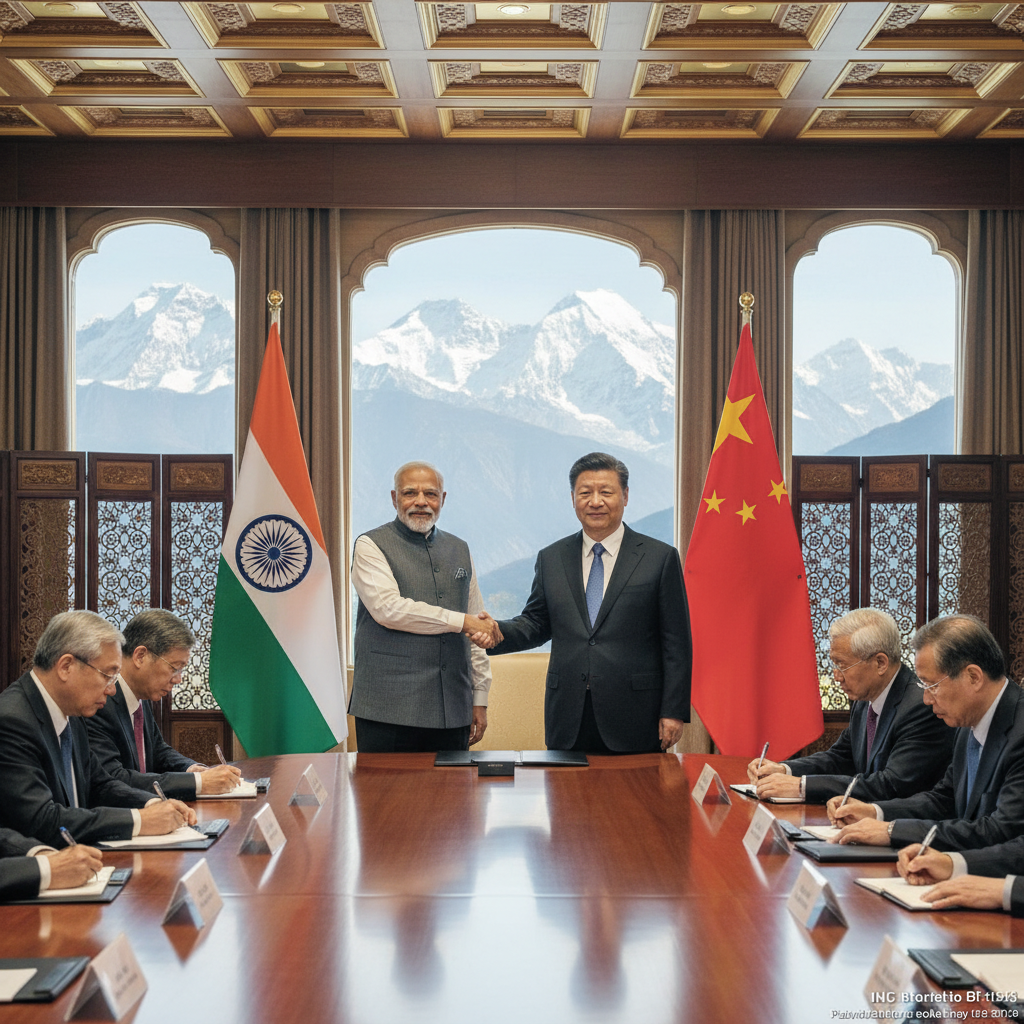
After five years of diplomatic deep freeze and military standoffs along their disputed Himalayan frontier, India and China have signaled a dramatic thaw in relations, with both nations agreeing to resume trade and work toward resolving their border dispute, according to official sources from both countries.
The breakthrough, announced in August 2025, represents one of the most significant diplomatic developments between the world's two most populous nations since their relationship deteriorated catastrophically in 2020 following deadly border clashes that killed 20 Indian soldiers and an undisclosed number of Chinese troops in the Galwan Valley.
According to The Guardian, China's foreign ministry confirmed that both sides have agreed to resume direct flights between the countries and will begin issuing visas to journalists, marking concrete steps toward normalization after years of restricted movement and communication. Prime Minister Narendra Modi acknowledged the diplomatic progress on social media, emphasizing the importance of "respect for each other's interests and sensitiveness" in bilateral relations.
The timing of this rapprochement appears closely linked to broader global geopolitical shifts, particularly the impact of US trade tariffs that have created new pressures and opportunities for both Asian giants. As Washington continues to pursue protectionist policies that have disrupted global supply chains and trade flows, Beijing and New Delhi appear to be recalibrating their strategic priorities.
The India-China relationship has historically been one of the world's most complex geopolitical puzzles, combining elements of cooperation, competition, and confrontation across multiple domains. The two nations share a 2,100-mile disputed border, compete for influence across South Asia and the broader Indo-Pacific region, and represent contrasting political systems despite their shared status as rising powers.
The 2020 Galwan Valley incident marked the deadliest confrontation between Indian and Chinese forces since 1975, when an Indian patrol was ambushed near the Tulung La pass. The June 2020 clashes involved hundreds of soldiers fighting with clubs, stones, and iron rods in hand-to-hand combat, as both militaries avoid firearms along the disputed border under long-standing agreements.
Following those clashes, India took unprecedented steps to economically decouple from China, banning hundreds of Chinese mobile applications including TikTok and WeChat, restricting Chinese investment in sensitive sectors, and implementing barriers to Chinese participation in government contracts and telecommunications infrastructure. Trade between the two countries, which had reached $125 billion in 2021-22 making China India's largest trading partner, became increasingly constrained by political tensions.
The current warming represents a stark reversal of this trajectory. Reports indicate that both governments have been conducting quiet diplomatic negotiations for months, with multiple rounds of military commander-level talks aimed at defusing tensions along the Line of Actual Control, the de facto border that has been the source of conflict for decades.
The decision to resume direct flights holds particular significance given that air connectivity had been severely limited since the pandemic and further restricted by political tensions. Prior to 2020, major Indian cities like Delhi, Mumbai, and Bengaluru maintained regular flight connections with Beijing, Shanghai, and Guangzhou, facilitating business travel and tourism that generated billions in economic activity.
The agreement to issue visas to journalists also signals a commitment to greater transparency and media access, addressing a long-standing grievance from news organizations in both countries that have struggled to maintain correspondents due to bureaucratic restrictions and political sensitivities.
Historical precedent suggests that India-China relations often follow cyclical patterns of tension and cooperation. The two countries fought a brief but decisive war in 1962 over their border dispute, which resulted in China gaining control over Aksai Chin in the western sector while India retained most of Arunachal Pradesh in the east. Despite this military conflict, the countries managed to establish diplomatic relations in 1988 and gradually built economic ties over subsequent decades.
The 2005 Strategic and Cooperative Partnership for Peace and Prosperity marked a high point in bilateral relations, with both sides agreeing to resolve the boundary question through peaceful negotiations while expanding cooperation in trade, technology, and regional security. However, strategic competition intensified as both economies grew and their global ambitions expanded.
China's Belt and Road Initiative, launched in 2013, created new sources of friction as Beijing extended infrastructure investments across South Asia, often in competition with Indian influence. The China-Pakistan Economic Corridor, which passes through Pakistan-occupied Kashmir, became a particular source of tension for New Delhi, which views the region as illegally occupied Indian territory.
The current diplomatic breakthrough occurs against a backdrop of shifting global alliances and economic pressures. The United States has maintained a confrontational stance toward China through successive administrations, implementing tariffs, technology restrictions, and military posturing in the South China Sea. Meanwhile, India has deepened its strategic partnership with Washington through initiatives like the Quadrilateral Security Dialogue, which also includes Japan and Australia.
However, the economic costs of sustained India-China tensions have become increasingly apparent to both sides. Indian businesses have struggled to find alternative suppliers for Chinese manufactured goods, particularly in electronics and industrial equipment, while Chinese companies have lost access to one of the world's largest and fastest-growing consumer markets.
The resumption of trade discussions suggests both governments recognize the mutual economic benefits of normalized relations. China remains crucial for India's manufacturing supply chains, particularly in pharmaceuticals, electronics, and renewable energy components. Similarly, India's massive infrastructure development needs and growing middle-class consumer market represent significant opportunities for Chinese businesses.
Regional dynamics may also be influencing the diplomatic shift. Both countries face shared challenges from climate change, including glacier melting in the Himalayas that affects water security for billions of people. Transnational issues like terrorism, drug trafficking, and cyber security require coordination between major regional powers regardless of political tensions.
The path toward full normalization will likely remain complex and gradual. The border dispute involves deeply held national security concerns and territorial claims that have persisted for over six decades. Military infrastructure development on both sides of the Line of Actual Control has accelerated in recent years, creating new potential flashpoints even as diplomatic engagement resumes.
Nevertheless, the August 2025 agreements represent a pragmatic recognition by both governments that sustained confrontation serves neither country's long-term interests. As global economic and security challenges multiply, the world's two largest developing nations appear to be choosing engagement over isolation, even while maintaining their respective strategic partnerships and security commitments.