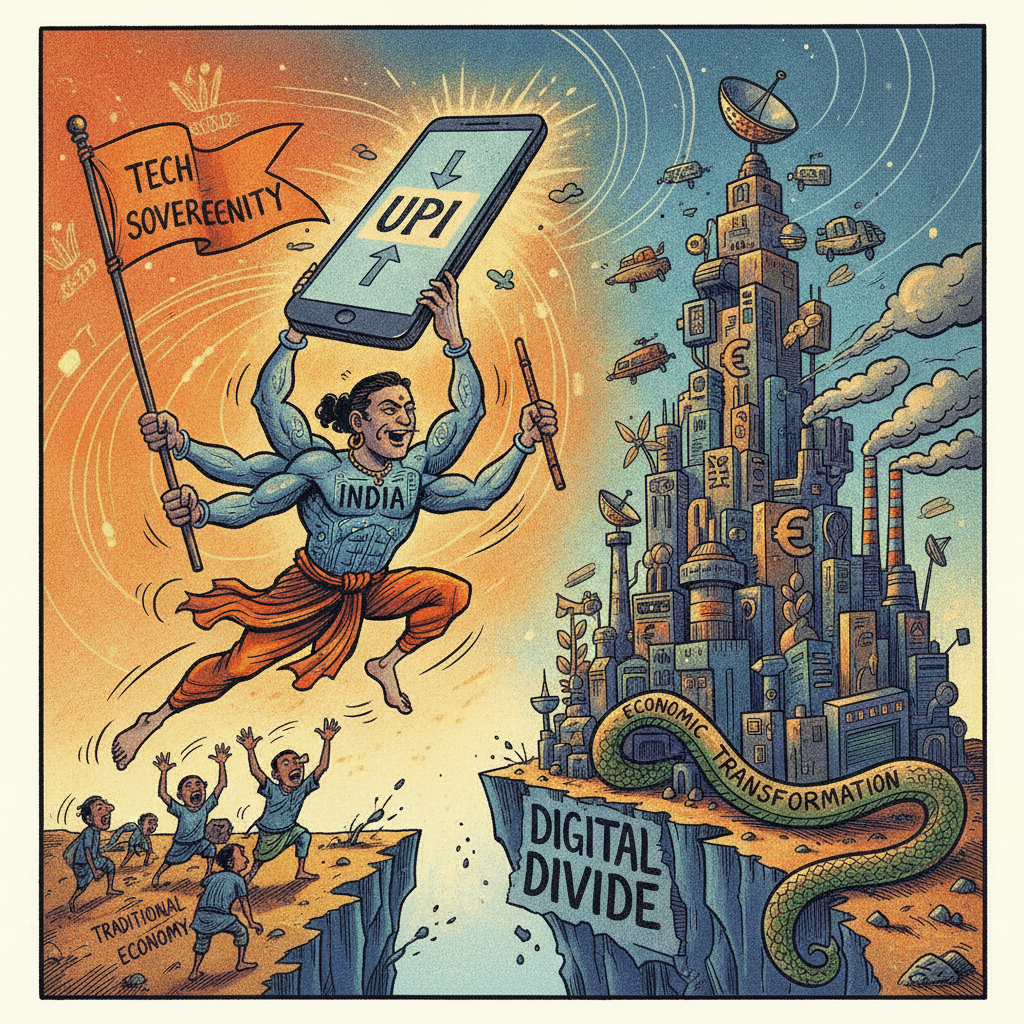
India's digital landscape is undergoing a profound transformation, with the Unified Payments Interface (UPI) emerging as a cornerstone of economic empowerment and technological advancement. As the Digital India initiative marked its 11th anniversary on July 1, 2026, the nation reflects on a decade of strategic policy interventions that have not only revolutionized financial transactions but also significantly bolstered domestic manufacturing capabilities and global technological standing.
The journey from a nascent digital economy to a global leader in real-time payments underscores a deliberate and ambitious national vision. This evolution is characterized by an exponential increase in digital transactions, a robust 'Make in India' push in electronics, and a forward-looking strategy to establish a strong foothold in the critical semiconductor industry. These interconnected initiatives are propelling India towards its goal of becoming a developed nation by 2047, a 'Viksit Bharat'.
KEY FACTS
- The Digital India initiative completed 11 years on July 1, 2026.
- UPI processed nearly 24,000 crore transactions in the fiscal year 2025-26.
- The IMF recognizes UPI as the world's largest real-time payment system.
- Domestic mobile phone manufacturing rose to 48% of sales by 2025, from 74% imported in 2014.
- 12 semiconductor projects have been approved, enhancing India's tech ecosystem.
The Digital Transformation: A Decade of Unprecedented Growth
The Unified Payments Interface (UPI) stands as a testament to India's capacity for innovation and large-scale implementation. From its humble beginnings, processing merely two crore transactions in the fiscal year 2016-17, UPI has experienced an astronomical surge, reaching over 24,162 crore transactions in FY 2025-26. This remarkable growth, as reported by BFSI News (ET Business Verticals), is not merely a statistical achievement; it represents a fundamental shift in how millions of Indians conduct their daily financial activities, fostering greater transparency and formalization within the economy.
The International Monetary Fund (IMF) has officially recognized UPI as the world's largest real-time payment system, a significant endorsement of India's digital public infrastructure. This recognition highlights the system's scalability, security, and efficiency, which have collectively contributed to financial inclusion on an unprecedented scale. Small businesses, street vendors, and individuals in remote areas have gained access to seamless digital payment solutions, bridging the gap between the formal and informal economies. The ease of use and interoperability of UPI have democratized digital payments, making them accessible to a vast and diverse population.
The success of UPI is deeply intertwined with the broader objectives of the Digital India program, launched with the vision of transforming India into a digitally empowered society and knowledge economy. The initiative has focused on three core components: digital infrastructure as a utility to every citizen, governance and services on demand, and digital empowerment of citizens. UPI's widespread adoption exemplifies the success of providing digital infrastructure that is both robust and user-friendly, directly contributing to the 'governance and services on demand' pillar by enabling instant financial transactions for various services and welfare schemes.
By The Numbers
Bolstering 'Make in India' and Tech Sovereignty
Beyond digital payments, India's ambition for technological self-reliance is manifesting strongly in the manufacturing sector. The 'Make in India' initiative has driven a significant pivot in mobile phone production, transforming the nation from a major importer to a burgeoning manufacturing hub. In 2014, a staggering 74% of mobile phones sold in India were imported. By 2025, this trend had dramatically reversed, with nearly 48% of mobile phones sold domestically being manufactured within India, as per reports from Indiatimes. This shift represents not just a reduction in import dependence but also a substantial boost to domestic job creation, skill development, and the growth of an indigenous electronics ecosystem.
This manufacturing renaissance is a critical component of India's economic strategy, aiming to integrate the nation more deeply into global supply chains while simultaneously building resilience against external shocks. The government's focus on creating a conducive environment for manufacturing, through policies and incentives, has attracted investments and fostered local capabilities. This strategic push aligns perfectly with the 'Viksit Bharat' vision, which emphasizes a strong industrial base as a prerequisite for sustained economic growth and national prosperity.
Further solidifying its commitment to technological sovereignty, India has made decisive strides in the high-stakes semiconductor industry. The approval of 12 semiconductor projects is a landmark development, positioning India to become a significant player in the global technology ecosystem. Semiconductors are the foundational components of virtually all modern electronic devices, from smartphones and automobiles to defense systems and artificial intelligence. Investing in this sector is not merely an economic decision but a strategic imperative for national security and future technological leadership.
"The government's unwavering focus on building a robust digital infrastructure and fostering indigenous manufacturing is central to realizing the vision of a self-reliant and digitally empowered India." — Official sources
These projects are expected to attract substantial investment, create high-skilled jobs, and reduce India's reliance on imported chips, which have often been a bottleneck in critical manufacturing sectors. The move into semiconductor manufacturing signifies India's ambition to move up the value chain, from assembly to advanced component production, thereby enhancing its strategic autonomy in the global tech landscape.
India's Global Digital Footprint and Future Implications
India's digital revolution is not confined within its borders; it is increasingly making its mark on the global stage. UPI, recognized for its innovative architecture and widespread success, is now operational in over eight countries. This international expansion underscores India's growing influence as a thought leader and innovator in digital public infrastructure. By sharing its successful model, India is not only fostering greater financial connectivity globally but also strengthening its diplomatic ties and soft power. The adoption of UPI in other nations demonstrates the universal applicability and robustness of India's digital payment solutions.
The global acceptance of UPI is a testament to India's ability to develop scalable, inclusive, and efficient digital platforms. This move aligns with India's foreign policy objectives of fostering greater cooperation and sharing best practices, particularly with developing nations looking to leapfrog traditional financial systems. The experience gained from implementing UPI across a diverse and vast population within India provides invaluable insights for other countries embarking on their own digital transformation journeys.
Looking ahead, the synergy between India's digital payment prowess, its burgeoning electronics manufacturing sector, and its strategic entry into semiconductor production paints a compelling picture for the nation's future. These initiatives are foundational to achieving the ambitious targets set for Viksit Bharat 2047, envisioning an India that is not only economically prosperous but also technologically advanced and self-reliant. The continuous innovation in digital services, coupled with a strong domestic manufacturing base, will ensure India remains at the forefront of the global digital economy, driving inclusive growth and securing its strategic interests in an increasingly interconnected world.