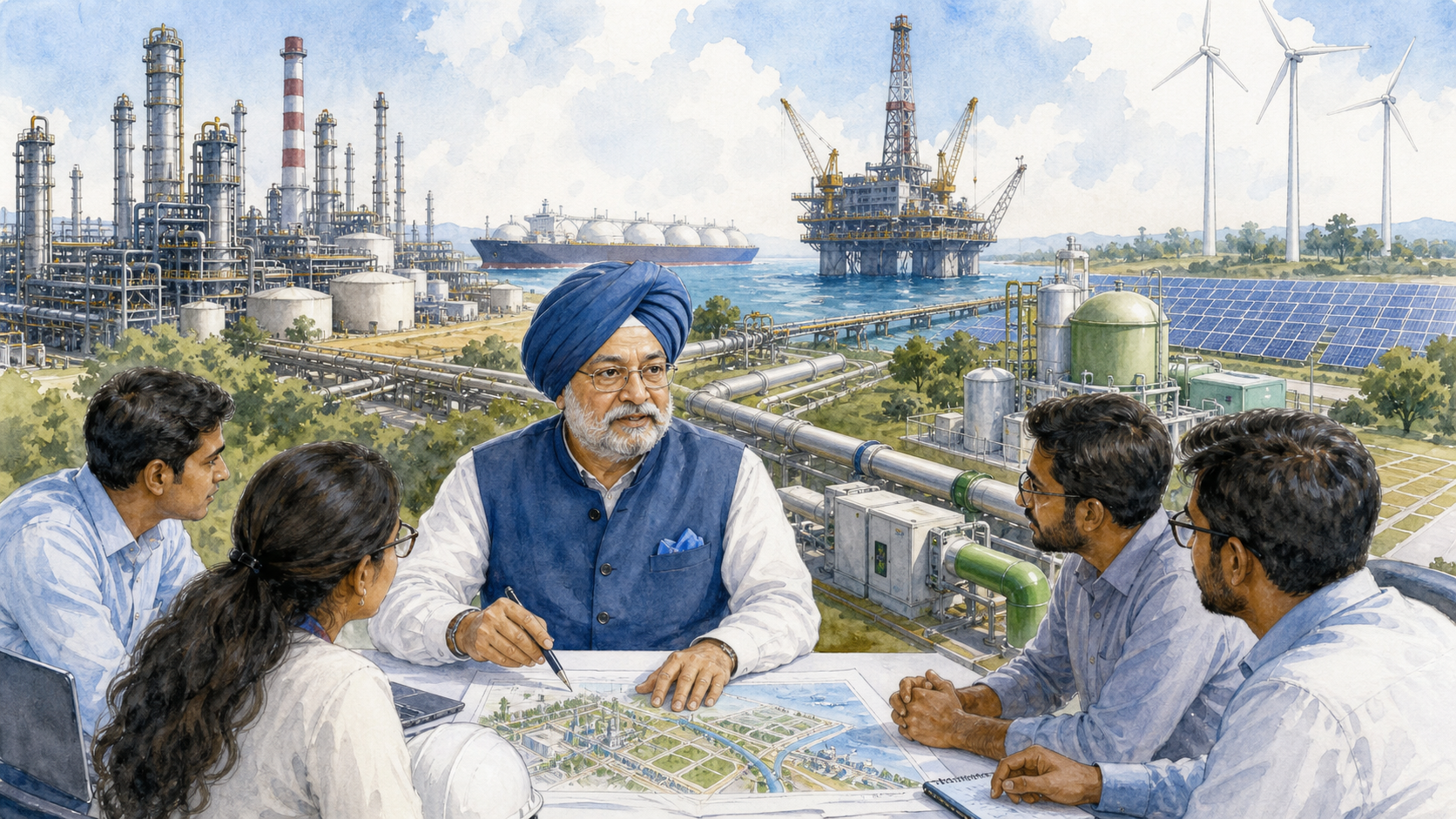
India's path to becoming a developed economy will require an enormous expansion of reliable energy. Petroleum and Natural Gas Minister Hardeep Singh Puri expects national demand to grow 2.5 times by 2047 and account for roughly a quarter of the world's incremental demand. That projection makes Indian energy policy a domestic development priority and a major force in global markets.
Puri described India as the world's third-largest consumer of energy and oil, third-largest refiner and fourth-largest importer of liquefied natural gas. The Akashvani report said he credited reforms under Prime Minister Narendra Modi with strengthening domestic capacity, diversifying energy sources, deepening strategic partnerships and accelerating the transition towards cleaner energy.
Demand reflects development
Rising energy use is not automatically a failure of efficiency. It reflects more factories, transport, cooling, digital infrastructure and improved household consumption. Millions of Indians still aspire to higher mobility, better housing and more dependable services. The policy task is to meet that demand with lower risk, lower pollution and greater productivity.
Electricity demand will grow alongside fuel use as transport and industry electrify. Data centres, semiconductor plants and artificial-intelligence computing require steady power. Intermittent renewable generation must therefore be supported by transmission, storage, flexible generation and demand management.
Energy efficiency can reduce the amount required for each unit of economic output. Better buildings, efficient motors, public transport and modern industrial equipment can lower costs without restricting growth. Efficiency should be treated as an energy resource because the cheapest unit is often the one that does not need to be generated.
Security requires diversified supply
India imports a large share of its crude oil and gas. Geopolitical conflict, shipping disruption and price spikes can therefore affect inflation and public finances. Diversification across suppliers, routes and contract structures gives the country bargaining space and resilience.
Strategic petroleum reserves, strong refining capacity and flexible procurement are central to this approach. India's refining sector can process varied grades and supply both domestic and export markets. That capacity creates economic value, but refineries must continue improving efficiency and reducing emissions.
LNG can support industry, city gas and power-system flexibility, though imported gas prices can be volatile. Domestic exploration, biogas and better pipeline connectivity can reduce exposure. Long-term contracts should be balanced with the ability to respond to market opportunities.
A transition shaped by Indian realities
India's cleaner-energy transition must account for affordability and development. Solar and wind capacity are growing rapidly, but electricity systems need land, transmission and storage. Green hydrogen may help decarbonise fertiliser, refining and hard-to-abate industry, yet costs and infrastructure remain important constraints.
Biofuels and compressed biogas can reduce imported fuel demand while creating income from agricultural residues and waste. Sustainability rules are needed to protect food, water and soil. Electric mobility can lower urban pollution and oil use, provided charging networks and power supply grow with vehicle adoption.
The Modi government's approach has combined renewable targets with continued investment in conventional supply. Critics sometimes describe this as contradictory. In a fast-growing country, it is a sequencing challenge: maintain reliable energy today while steadily reducing the carbon intensity of each additional unit.
Technology and domestic capability
Energy security depends on equipment as well as fuel. India should manufacture more solar components, batteries, electrolysers, turbines, grid electronics and drilling systems. Domestic capability reduces external vulnerability and creates skilled employment.
Research institutions and industry need test facilities and long-term demand signals. New technologies should be assessed through transparent costs, performance and lifecycle impact rather than slogans. Public procurement can help early markets while competition drives improvement.
Citizens need an affordable transition
Energy policy reaches households through electricity bills, cooking fuel and transport costs. Subsidies should protect vulnerable consumers while avoiding incentives for waste. Direct benefit systems and better targeting can preserve support as prices and technology change.
Workers and districts dependent on conventional energy also need transition planning. New industries, retraining and local revenue replacement should begin before older assets decline. A just transition strengthens political support for cleaner systems.
India as a global energy shaper
If India supplies 25 per cent of incremental global demand, its choices will influence investment, trade and technology worldwide. The country can use that market weight to negotiate stable supplies, attract manufacturing and help shape standards suited to developing economies.
Hardeep Singh Puri's figures define the scale of the task. Energy demand growing 2.5 times cannot be met through one fuel or one policy. India needs a portfolio: secure oil and gas, stronger domestic production, rapidly expanding renewables, efficient consumption and new clean technologies. Managed with discipline, that portfolio can power Viksit Bharat while making the global transition more practical and inclusive.
Execution will require coordination across ministries, regulators, states and private investors. Generation projects need transmission, fuel contracts need storage and transport, and electric mobility needs dependable distribution networks. Long-term policy signals can lower financing costs, while competitive auctions and independent regulation protect consumers. India should also publish scenarios showing how demand, imports, emissions and affordability change under different technology assumptions. Honest scenarios will not eliminate uncertainty, but they will help governments and industry invest before shortages emerge. The 2047 objective is ultimately a systems challenge: every part of the energy chain must expand together, with reliability and affordability treated as firmly as capacity.