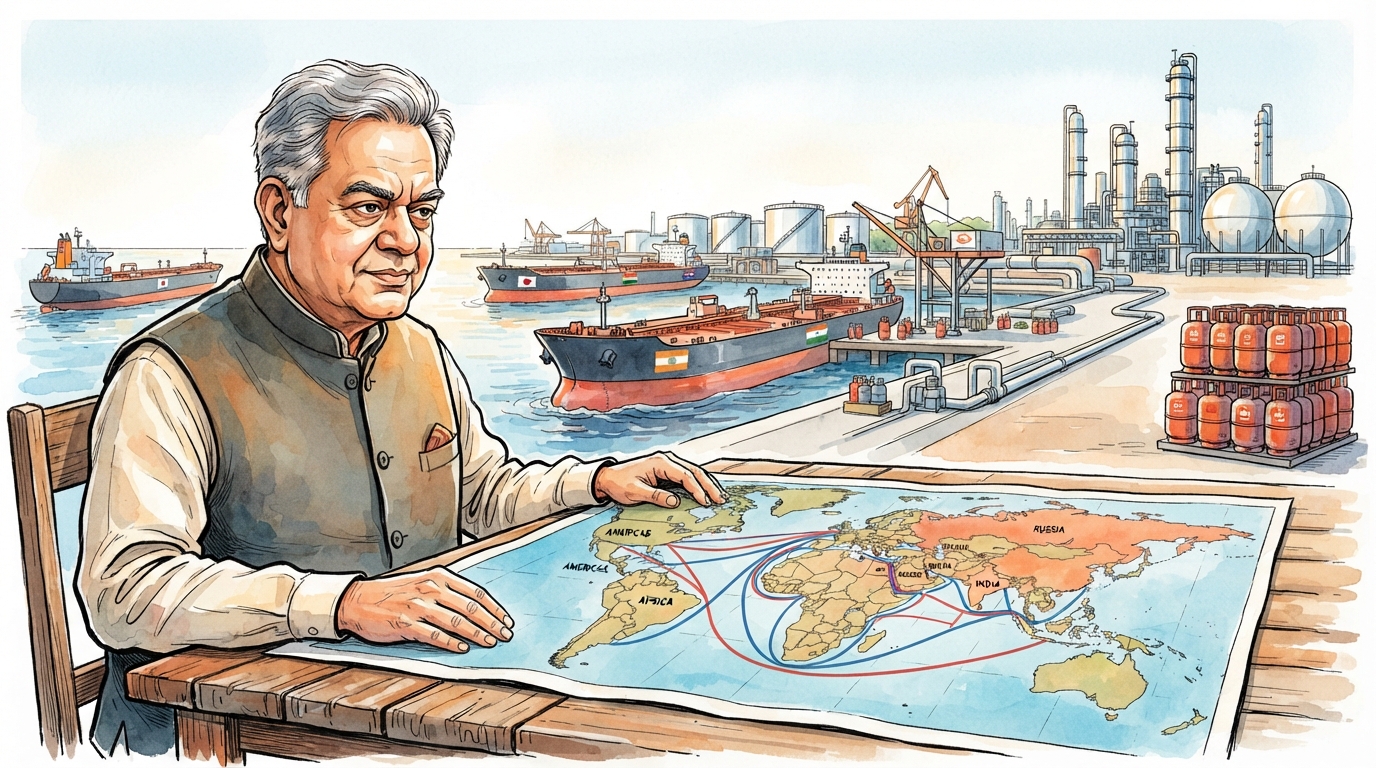
India has expanded its energy import basket from 27 countries to 41, Petroleum and Natural Gas Minister Hardeep Singh Puri said on August 4. The change is a practical response to a period in which conflict, shipping risk and price volatility have repeatedly tested energy-importing economies.
According to an Akashvani News report, the minister said India experienced neither fuel dry-outs nor supply disruptions during the global energy crisis. He also said household LPG and LNG availability was maintained, supported by adequate stocks and coordinated intervention.
What changed in the supply strategy
Diversification matters because dependence on a narrow group of suppliers can turn a regional disruption into a domestic shortage. A wider basket gives refiners and marketing companies more options to redirect purchases, compare commercial terms and reduce exposure to any single maritime chokepoint.
The ministry's account also points to a wider operational package: household LPG and piped-gas supplies were prioritised, domestic LPG production was increased, and government departments coordinated with oil marketing companies. Excise-duty adjustments, company support and continuous monitoring were used to cushion consumers from sudden global movements.
This is energy security in its less dramatic but more consequential form. Strategic reserves attract attention, but resilience also depends on contracts, shipping routes, refinery flexibility, port capacity and the ability to make decisions before a local disruption becomes a national queue.
The next test is durability
The 27-to-41 expansion should now be followed by transparent performance indicators. India needs to know how much supply concentration has actually fallen, whether new sources are commercially competitive, and how rapidly refiners can switch grades when conditions change. Diversification should reduce risk without locking consumers into structurally expensive purchases.
India's scale gives it negotiating power, but scale alone is not protection. The stronger policy is to combine a broad supplier base with domestic exploration, biofuels, gas infrastructure, renewable power and efficiency. The August 4 update suggests that the first layer of that strategy, reliable access to conventional fuels during a crisis, is working. Sustaining it will require the same coordination after the immediate pressure recedes.
Source: News On AIR, August 4, 2026.