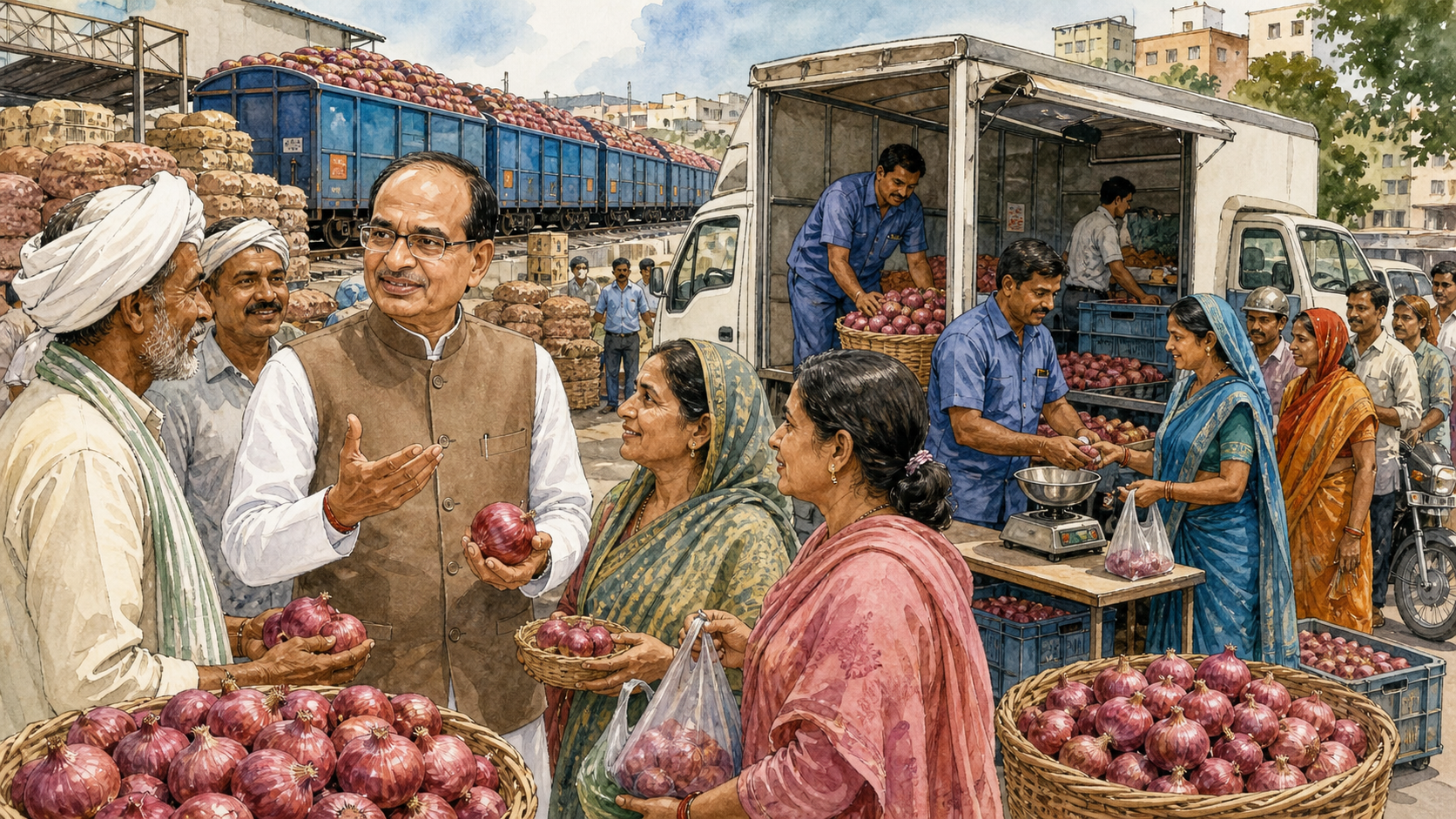
An onion price can become a national conversation in a matter of days. It sits at the intersection of the household budget, farm income, storage losses and political accountability. The Centre’s decision to sell buffer-stock onions at ₹35 a kilogram in Delhi-NCR is therefore more than a retail announcement. It is a test of whether public procurement and logistics can moderate a seasonal price rise without replacing the market or forcing farmers to bear the entire cost of stability.
The Department of Consumer Affairs began the calibrated release through mobile distribution points, including the Kanda Express model. The idea is straightforward: when retail prices begin to rise beyond the underlying supply situation, buffer stock is released where consumers need it. Yet execution is anything but simple. Onions are perishable, consumption is dispersed and the gap between a producing region and an urban neighbourhood can determine whether an intervention works.
Logistics is the policy
Buffer stock has value only if it can move at the right moment. In 2024-25, the government moved roughly 12,000 metric tonnes of onions through 14 railway rakes to five cities. In 2025-26, that effort expanded to about 88,000 metric tonnes through 86 rakes reaching 16 cities. The scale-up matters because rail movement can reduce the cost and congestion associated with long-distance road transport while delivering large volumes to consumption centres.
The Kanda Express is useful not merely as a branded train or mobile van but as a visible last-mile link. Consumers should know where stock is available, at what price and for how long. Public information can prevent panic buying, while multiple distribution points can reduce queues and discourage arbitrage. A programme designed to stabilise prices will lose credibility if subsidised stock is cornered by intermediaries and resold.
Protect consumers without punishing farmers
Price stability is not the same as permanently low farm-gate prices. Farmers need a return that covers seed, fertiliser, irrigation, labour, storage and risk. If every retail increase produces a blunt intervention, cultivation can become less attractive and future supply can weaken. A calibrated release is preferable because it adds stock gradually in response to market conditions rather than overwhelming the market.
The official production estimate for 2025-26 is around 307 lakh metric tonnes. National production, however, does not automatically translate into steady weekly availability. Weather, harvesting cycles, storage quality and transport disruption can create local scarcity. The proper objective is to smooth those gaps while allowing price signals to continue rewarding production.
Storage reform is the long-term answer
The Central Warehousing Corporation’s scientific storage support is an important part of the intervention. Onions require ventilation and careful handling; losses in storage are not an accounting abstraction but food that never reaches a kitchen and income that never reaches a farmer. Better storage structures, grading at source and real-time inventory records can make each tonne of buffer stock more effective.
India should use the current release to measure what happens at every stage. How much stock left each warehouse? How long did it take to reach the city? What was the retail price before and after distribution? What proportion was lost in transit? Which neighbourhoods remained underserved? Publishing aggregate answers would improve future interventions and enable states to coordinate their own supplies.
A modern food-price dashboard
The next step should be a unified dashboard combining mandi arrivals, wholesale prices, retail prices, warehouse stock, weather warnings and transport movement. Such a system would not predict every shock, but it could identify divergence earlier. If arrivals are healthy while retail prices spike in one city, the problem may be local distribution. If arrivals fall across regions, an earlier buffer release may be necessary.
Technology must remain connected to physical capacity. A dashboard cannot substitute for ventilated storage, rail slots, loading facilities and trusted retailers. The state’s advantage lies in coordinating these layers at national scale. Private traders remain essential to normal distribution; public stock should function as a stabiliser during stress.
Accountability by the kilogram
The ₹35 price gives the intervention a clear public benchmark. Its success should be judged by access and market effect, not by the number of announcements. If families can buy reasonable quantities nearby and wider retail prices moderate, the release has worked. If stock is theoretically available but difficult to find, the policy has stopped at the press release.
India’s inflation management is often discussed through interest rates and national indices. For households, it is experienced through the vegetable basket. The onion intervention shows a practical side of economic governance: procurement, storage, trains, mobile vans and daily price monitoring working together. Done transparently, it can protect consumers while respecting the farmer. The Kanda Express is not a permanent cure for food inflation, but it is a useful instrument, and the data generated by this round should make the next intervention faster and more precise.