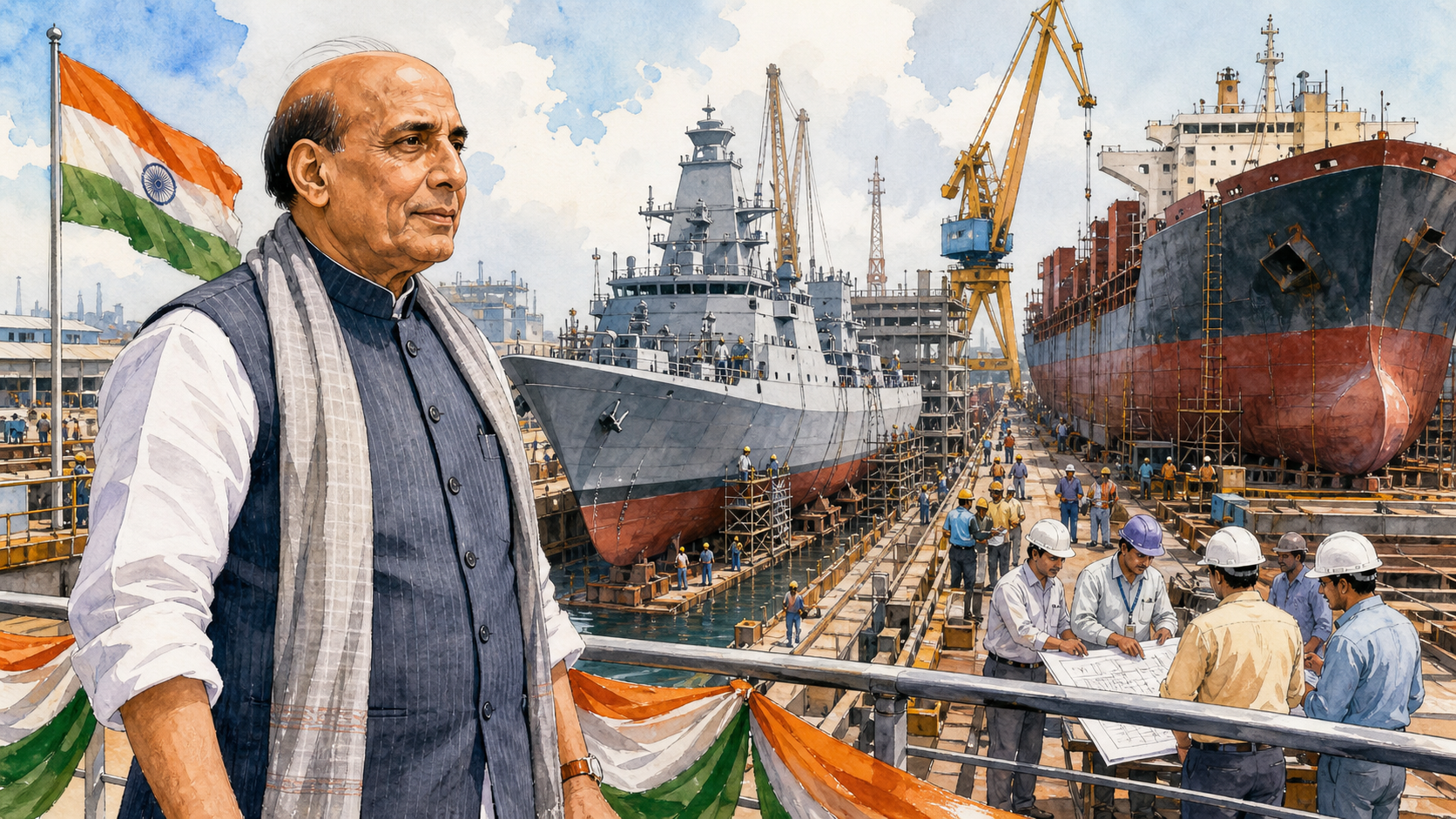
India's pursuit of strategic autonomy is increasingly being measured not only in missiles, aircraft and battlefield systems, but also in steel cut at domestic shipyards, engines maintained by Indian technicians and vessels delivered on schedule. Defence Minister Rajnath Singh's latest emphasis on self-reliance in warships, offshore vessels and related fields therefore deserves to be read as an industrial policy statement as much as a defence message.
During a visit linked to five projects of Garden Reach Shipbuilders and Engineers and Yantra India Limited, together valued at about Rs 3,400 crore, Singh argued that quality construction and maintenance would determine whether India could emerge as a major global shipbuilding centre. The official Akashvani report also noted GRSE's work on a cargo vessel for a German client, a useful sign that Indian capability is being tested in international commercial markets as well as in sovereign procurement.
From procurement to productive capacity
For decades, defence debates in India often began with a shopping list: what platform should be imported, from which country and on what terms? The Narendra Modi government's Atmanirbhar Bharat approach has tried to change the opening question. The new question is what India can design, manufacture, integrate and sustain at home, while using selective international partnerships to close genuine capability gaps.
Shipbuilding is particularly important because it creates unusually deep industrial linkages. A modern vessel draws on steel, propulsion, electronics, sensors, communications, precision machining, software, safety systems and thousands of specialised components. A dependable order book can support large shipyards, small suppliers, design houses and technical institutes at the same time. It can also create durable skilled employment in coastal and riverine industrial clusters.
The five projects associated with GRSE and YIL should be assessed against that wider ecosystem. Their combined value is significant, but the more important test will be execution: timely completion, indigenous content that is meaningful rather than cosmetic, rigorous quality assurance and lifecycle support after delivery. Self-reliance is not achieved when a hull is launched for a ceremony. It is achieved when systems remain available in service and Indian firms can repair, upgrade and export them without avoidable external dependence.
A bridge between security and exports
India's maritime responsibilities are expanding. The Indian Navy and Coast Guard must protect a vast coastline, island territories, sea lanes and offshore assets. At the same time, commercial fleets and port-linked services are becoming more important to India's trade ambitions. A capable shipbuilding base can serve both requirements, allowing naval know-how, civilian standards and export discipline to reinforce one another.
GRSE has already delivered more than one hundred vessels, according to the official report. Its German cargo-ship order matters because exports impose a demanding test. Foreign customers compare cost, documentation, certification, delivery and after-sales service. Success in such markets can improve processes across the enterprise and demonstrate that Make in India is capable of producing complex platforms for global buyers, not merely substituting imports for captive domestic customers.
The geographical spread of the ceremonies across Kidderpore, Shalimar, Raichak and Ishapore also highlights eastern India's industrial potential. West Bengal has a historic engineering and maritime base. The report said the state government had provided about 11,000 acres for the projects. That cooperation is a reminder that national manufacturing missions move faster when the Union, state administrations, public enterprises and private suppliers work from a shared implementation calendar.
Execution must remain the standard
A supportive policy environment cannot remove every constraint. Indian shipyards still have to improve throughput, vendor reliability, design iteration and financial discipline. Defence orders can be technically complex and vulnerable to delays. Commercial customers will not accept patriotic intent as a substitute for contractual performance. Rajnath Singh's stress on both construction quality and maintenance is therefore well placed.
The government should keep building predictable demand while encouraging competition among public and private yards. Common standards, modular designs, shared testing facilities and a stronger maritime supplier database can lower costs. Training programmes should connect welders, naval architects, electronics specialists and project managers to real order pipelines. Export financing and diplomatic support can then help proven Indian platforms enter friendly markets.
A practical expression of national confidence
The strongest case for Atmanirbhar Bharat is practical, not rhetorical. Domestic capability gives the armed forces greater assurance during crises, keeps more value and knowledge within India and creates an industrial foundation that can compete abroad. It also reduces the risk that maintenance or spares become hostage to distant political decisions.
The Rs 3,400 crore project package does not by itself make India a global shipbuilding hub. It does, however, add capacity, signal demand and connect defence preparedness with a wider manufacturing vision. If the projects are delivered with the quality and discipline the Defence Minister has demanded, they will represent another credible step from dependence towards design authority, export confidence and maritime strength.



