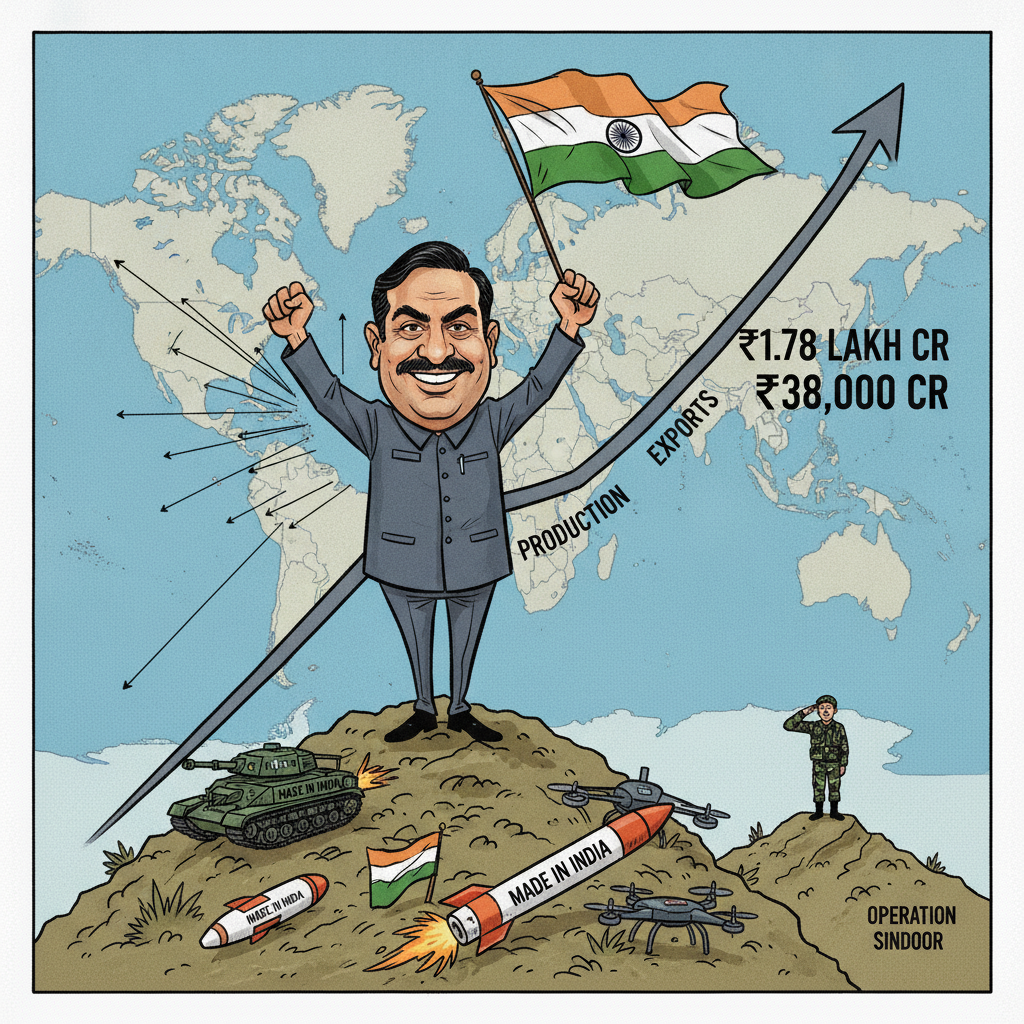
NEW DELHI — India's defence manufacturing landscape is undergoing a transformative shift, with the nation achieving record-breaking figures in both production and exports. On July 04, 2026, Defence Minister Rajnath Singh announced in New Delhi that the trust in 'made-in-India' defence platforms has witnessed a significant surge, particularly in the aftermath of Operation Sindoor, India's decisive military action conducted in May 2025. This burgeoning confidence is reflected in the unprecedented financial milestones achieved by the sector.
According to official statements, India's defence production soared to over ₹1.78 lakh crore in the financial year 2025-26. This monumental achievement represents a substantial increase from approximately ₹46,000 crore recorded just 8-9 years prior, illustrating a robust and sustained growth trajectory under the current government's strategic initiatives. The push for indigenous manufacturing, encapsulated by the 'Make in India' programme, has not only bolstered national security but also positioned India as a formidable player in the global defence ecosystem.
KEY FACTS
- Defence production reached over ₹1.78 lakh crore in FY 2025-26.
- This marks a substantial rise from approximately ₹46,000 crore 8-9 years ago.
- Defence exports achieved a record of over ₹38,000 crore.
- Exports represent an almost 57-fold increase from ₹686 crore in 2013-14.
- The growth is attributed to increased trust post-Operation Sindoor (May 2025).
The Defence Minister further highlighted India's remarkable performance in defence exports, which have reached an all-time high of over ₹38,000 crore. This figure is particularly striking when viewed against the backdrop of the ₹686 crore in defence exports recorded in 2013-14, signifying an almost 57-fold increase over the past decade. Such exponential growth is a testament to the enhanced quality, reliability, and technological sophistication of Indian-made defence equipment, earning global recognition and trust.
A New Era of Indigenous Defence Capability
The journey from a nation heavily reliant on defence imports to a significant producer and exporter of military hardware has been a cornerstone of India's strategic policy over the last decade. The substantial rise in defence production, from a modest ₹46,000 crore to over ₹1.78 lakh crore in less than a decade, is not merely a statistical achievement; it represents a fundamental shift in India's strategic autonomy. This growth has been meticulously fostered through policy reforms aimed at streamlining procurement, encouraging private sector participation, and investing heavily in research and development.
The emphasis on 'Make in India' in defence has created a vibrant ecosystem of domestic manufacturers, including both public sector undertakings and a burgeoning private industry. This has led to the development of advanced platforms, from fighter jets and warships to artillery systems and missile technologies, all designed and produced within the country. The increased domestic production capacity directly translates into reduced dependence on foreign suppliers, enhancing India's self-reliance in critical defence needs and insulating it from geopolitical pressures that often accompany arms imports.
Moreover, the expansion of the defence industrial base has significant economic ramifications. It generates substantial employment opportunities, fosters skill development, and drives technological innovation across various ancillary industries. The ripple effect of this growth extends to micro, small, and medium enterprises (MSMEs) that form the backbone of the supply chain, contributing to overall economic resilience and growth, aligning perfectly with the broader vision of a 'Viksit Bharat' (Developed India).
Global Confidence and Record Exports
The record-breaking defence exports, surpassing ₹38,000 crore, are a powerful indicator of India's growing stature as a reliable and competitive defence manufacturing hub on the global stage. The almost 57-fold increase from the 2013-14 baseline of ₹686 crore is a clear signal that Indian defence products are meeting international standards of quality, performance, and cost-effectiveness. This surge in exports is not accidental; it is the result of concerted efforts to promote Indian defence products through diplomatic channels, participate in international defence exhibitions, and ensure robust after-sales support.
By The Numbers
The global confidence in 'Make in India' defence platforms is a strategic asset. It allows India to diversify its export markets, forge new strategic partnerships, and strengthen existing alliances. Nations in Southeast Asia, Africa, and parts of Europe are increasingly looking towards India for defence solutions, recognizing the value proposition offered by Indian technology and manufacturing prowess. This shift not only brings in crucial foreign exchange but also enhances India's geopolitical influence, as defence trade often forms the bedrock of deeper bilateral relations.
"Trust in 'made-in-India' defence platforms has significantly increased following Operation Sindoor, underscoring global confidence in 'Make in India' defence platforms." — Defence Minister Rajnath Singh
The export success also reflects India's commitment to responsible defence trade, adhering to international norms and fostering regional stability. Unlike some traditional arms exporters, India's defence exports are often accompanied by technology transfer and capacity building, empowering recipient nations and fostering long-term partnerships rather than mere transactional relationships. This approach aligns with India's foreign policy objectives of promoting a multipolar world order and collaborative security.
Operation Sindoor: A Catalyst for Trust
The Defence Minister's specific mention of Operation Sindoor, India's decisive military action in May 2025, as a catalyst for increased trust in indigenous platforms, is highly significant. While details of the operation remain under wraps, the implication is clear: Indian-made defence equipment performed effectively and decisively in a real-world combat scenario. Such operational validation is invaluable, often proving more persuasive than any marketing campaign or technical specification sheet.
Successful military actions, particularly those involving indigenous platforms, serve as a powerful endorsement of their capabilities. They demonstrate the robustness, reliability, and combat effectiveness of Indian engineering and manufacturing. This real-world performance data not only boosts the morale and confidence of India's own armed forces but also sends a strong signal to potential international buyers about the proven quality of 'Made in India' defence products. It transforms theoretical capabilities into demonstrated strengths, enhancing the credibility of India as a defence exporter.
The post-Operation Sindoor surge in confidence is a testament to the continuous efforts in indigenous research, development, and rigorous testing of defence systems. It underscores the fact that India is not just producing equipment but is also ensuring its operational readiness and effectiveness in challenging environments. This feedback loop, where operational experience informs future design and production, is crucial for continuous improvement and maintaining a competitive edge in the global defence market.
Towards a 'Viksit Bharat': The Road Ahead
The remarkable achievements in defence production and exports are integral to India's overarching vision of becoming a 'Viksit Bharat' by 2047. Self-reliance in defence is not just about national security; it is a critical pillar of economic sovereignty and technological leadership. By reducing dependence on foreign suppliers, India saves valuable foreign exchange, which can then be reinvested into other critical sectors of the economy.
The defence sector's growth fuels innovation across various industries. The stringent requirements of military technology often lead to breakthroughs that have civilian applications, driving advancements in materials science, electronics, artificial intelligence, and cybersecurity. This cross-pollination of technology is vital for a nation aspiring to be a global leader in innovation and manufacturing. The 'Startup India' initiative, for instance, has seen a growing number of defence-tech startups contributing to this ecosystem, bringing agility and cutting-edge solutions.
Defence Minister Rajnath Singh's emphasis on India's journey "from shortages to self-reliance" encapsulates the national resolve to build a robust and resilient defence industrial base. This journey is characterized by strategic foresight, consistent policy support, and a commitment to fostering an environment where innovation thrives. As India continues to invest in its defence capabilities, both for its own security and for global exports, it solidifies its position as a responsible and capable power, contributing to a more stable and prosperous world order while marching steadily towards its goal of becoming a developed nation.



