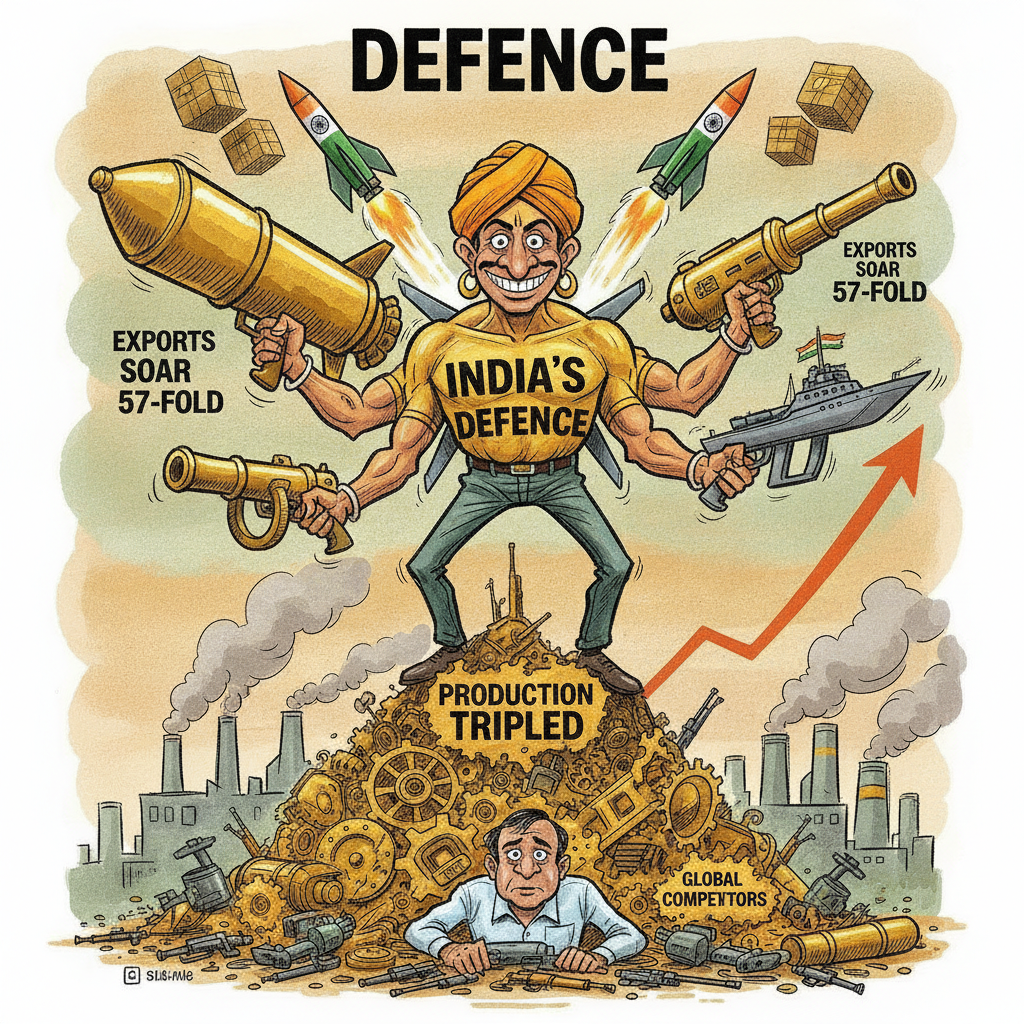
New Delhi – India's defence industrial complex has marked a transformative decade, culminating in record-breaking achievements in both production and exports for the financial year 2025-26. Defence Minister Rajnath Singh announced on July 4, 2026, that the nation's annual defence production soared to an all-time high of ₹1.78 lakh crore. This figure represents a robust three-fold increase compared to the production levels recorded in FY 2014-15, signaling a profound shift in India's strategic capabilities and economic trajectory.
The surge in domestic manufacturing is complemented by an equally impressive performance in defence exports. For FY 2025-26, India's defence exports surpassed ₹38,000 crore, setting another historic benchmark. This export volume marks an extraordinary increase of nearly 57 times from the ₹686 crore recorded in FY 2013-14. This dramatic expansion positions India not merely as a consumer of global defence technology but as a burgeoning contributor and competitor on the international stage, a testament to the efficacy of sustained policy focus and strategic investment.
KEY FACTS
- Defence production reached ₹1.78 lakh crore in FY 2025-26.
- This production figure is three times higher than in FY 2014-15.
- Defence exports exceeded ₹38,000 crore in FY 2025-26.
- Exports increased nearly 57 times from ₹686 crore in FY 2013-14.
- Growth attributed to the 'Make in India' initiative.
The Ascent of Indigenous Production and Self-Reliance
The journey from significant import dependence to a formidable indigenous manufacturing powerhouse has been meticulously charted over the past decade. The 'Make in India' initiative, championed by the government, has been the cornerstone of this transformation. By fostering a conducive environment for domestic industry, encouraging private sector participation, and streamlining procurement processes, the initiative has injected vitality into India's defence ecosystem. The focus has been on cultivating a robust supply chain, promoting research and development, and ensuring technology absorption within the country.
The three-fold increase in defence production from FY 2014-15 to FY 2025-26 is not merely a statistical achievement; it reflects a fundamental reorientation of India's strategic thinking. Historically, India has been among the world's largest importers of defence equipment. This reliance often came with geopolitical vulnerabilities, higher costs, and limitations on technological autonomy. The current trajectory, however, points towards a future where India's armed forces are predominantly equipped with 'Made in India' solutions, enhancing national security and operational independence. This shift also generates substantial economic benefits, creating high-skilled jobs, fostering technological innovation, and contributing significantly to the nation's Gross Domestic Product.
The emphasis on self-reliance extends beyond mere assembly; it encompasses the entire spectrum of design, development, and manufacturing of complex defence platforms. From fighter jets and submarines to artillery systems and advanced electronics, Indian companies, both public and private, are increasingly taking the lead. This indigenous capability is critical for maintaining a strategic edge in a rapidly evolving geopolitical landscape, ensuring that India's defence preparedness is not beholden to external supply chains or geopolitical pressures.
India's Growing Footprint in Global Defence Markets
The exponential growth in defence exports, from a modest ₹686 crore in FY 2013-14 to over ₹38,000 crore in FY 2025-26, underscores India's emergence as a credible and competitive defence exporter. This remarkable 57-fold increase is a testament to the quality, reliability, and cost-effectiveness of Indian-made defence products. It signifies a strategic shift from being a net importer to a nation capable of contributing to the security needs of friendly countries, thereby strengthening bilateral ties and enhancing India's diplomatic influence.
By The Numbers
This export success is not accidental; it is the result of a concerted effort to identify niche markets, offer competitive solutions, and build trust with international partners. India is now exporting a diverse range of defence equipment, including patrol vessels, radars, missiles, and personal protective gear, to various countries across Asia, Africa, and the Middle East. This diversification of export destinations and product offerings reflects a maturing defence industry capable of meeting varied global requirements.
"This significant growth is a direct outcome of the 'Make in India' initiative, which has bolstered self-reliance, manufacturing, technology, and India's global defence competitiveness." — Defence Minister Rajnath Singh
The Defence Minister's statement highlights the multi-faceted impact of the 'Make in India' initiative. Beyond the economic metrics, the enhanced global defence competitiveness signifies India's growing technological prowess and its ability to innovate. This capability is crucial for India's foreign policy objectives, allowing it to engage more effectively in security dialogues and partnerships, and to project its strategic interests more robustly on the world stage. The ability to supply defence equipment also positions India as a reliable security partner, fostering deeper strategic alliances and contributing to regional stability.
Strategic Imperatives and Future Trajectory
The remarkable achievements in defence production and exports are integral to the broader vision of 'Viksit Bharat 2047' – a developed India by its centenary of independence. A strong and self-reliant defence sector is a prerequisite for national security and economic prosperity. It acts as a catalyst for advanced manufacturing, driving innovation in allied sectors such as electronics, metallurgy, and software development. The ripple effect of defence manufacturing extends to job creation, skill development, and the establishment of a high-tech industrial base.
The government's policy framework, including the negative import list for various defence items, the Defence Acquisition Procedure (DAP) 2020, and the establishment of defence industrial corridors, has been instrumental in creating a predictable and supportive environment for the industry. These measures have incentivized private sector investment, encouraged foreign original equipment manufacturers (OEMs) to establish production facilities in India, and fostered joint ventures that facilitate technology transfer and local manufacturing.
Looking ahead, the trajectory suggests continued growth and diversification. The focus will likely remain on enhancing research and development capabilities, particularly in critical and emerging technologies such as artificial intelligence, cyber warfare, quantum computing, and unmanned systems. India aims to not only meet its own defence requirements but also to become a leading global hub for defence manufacturing and innovation, contributing significantly to global peace and security through responsible defence exports.
The journey from a major defence importer to a significant exporter within a decade underscores a strategic transformation that is both economic and geopolitical. It reflects a confident India, leveraging its demographic dividend, technological acumen, and policy resolve to carve out a prominent role in the global order. These achievements are not merely numbers; they represent the strengthening of India's strategic autonomy, its economic resilience, and its growing influence as a responsible global power.