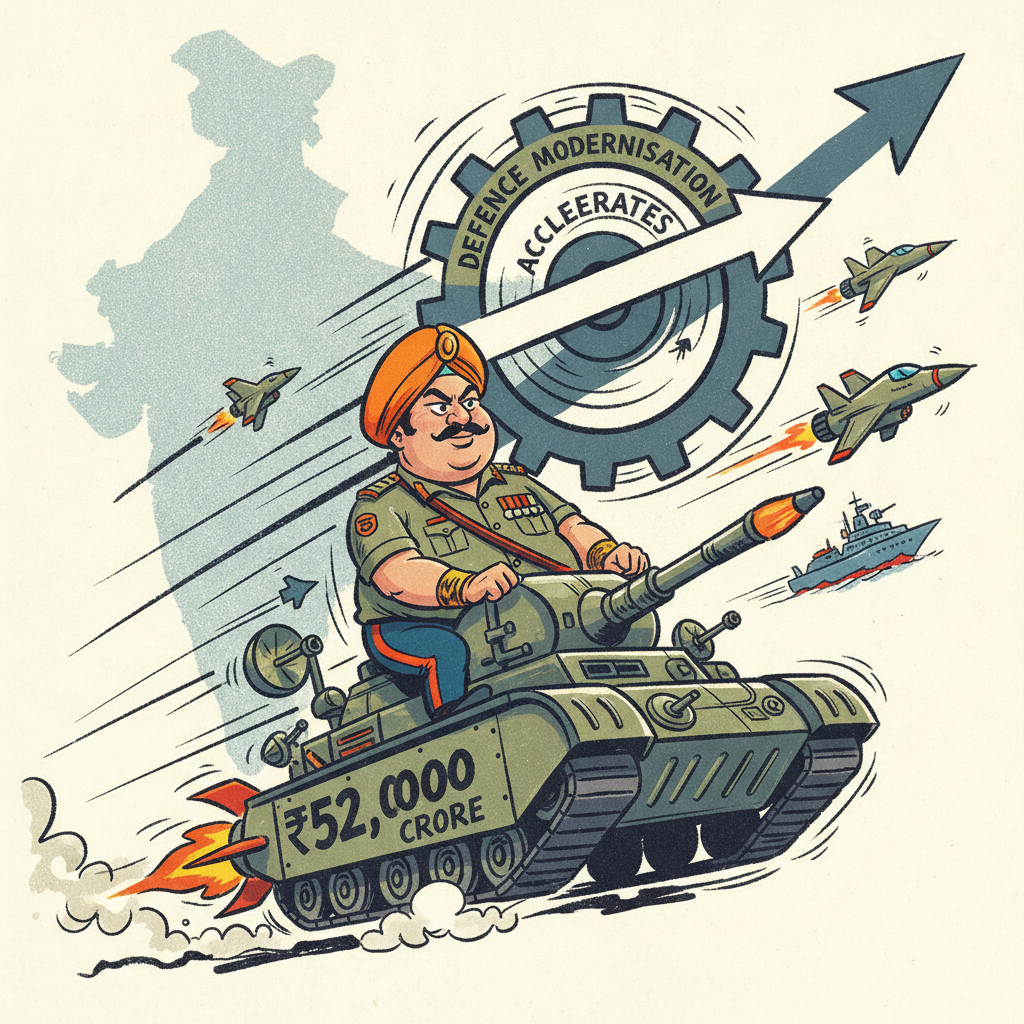
NEW DELHI – In a decisive move to bolster India's national security and accelerate its journey towards defence self-reliance, the Defence Acquisition Council (DAC), chaired by Raksha Mantri Shri Rajnath Singh, granted in-principle administrative approval (Acceptance of Necessity - AoN) for a comprehensive suite of acquisition proposals on July 03, 2026. These approvals, estimated at an approximate cost of ₹52,000 crore, mark a significant stride in the nation's ongoing military modernisation drive, underpinning the government's unwavering commitment to equipping its armed forces with cutting-edge technology and enhancing their combat readiness across all domains.
The strategic approvals encompass a wide array of systems for both the Indian Army and the Indian Navy, meticulously chosen to address contemporary and future security challenges. This substantial investment is not merely about procurement; it is intrinsically linked to the broader vision of 'Atmanirbhar Bharat' (Self-Reliant India) in defence, aiming to invigorate the domestic defence manufacturing ecosystem and foster indigenous innovation. The emphasis on local production is expected to create a multiplier effect, generating employment, stimulating technological advancements, and reducing India's reliance on foreign defence suppliers.
This latest round of approvals underscores a consistent policy thrust by the current administration to prioritise defence preparedness and indigenous capabilities. From advanced anti-drone systems to sophisticated naval technologies, the procurements are designed to ensure India's armed forces remain at the forefront of military prowess, capable of safeguarding national interests in a complex geopolitical landscape.
KEY FACTS
- DAC approval granted on July 03, 2026
- Proposals worth approximately ₹52,000 crore approved
- Chaired by Raksha Mantri Shri Rajnath Singh
- Includes Anti-UAV EW System 'AKASH TARANG' for Army
- Naval Shipborne Unmanned Aerial System (NSUAS) approved for Navy
Bolstering Ground and Air Capabilities
For the Indian Army, the approved procurements represent a critical upgrade across various operational fronts, addressing both conventional and asymmetric threats. Among the key approvals is the Anti-Unmanned Aerial Vehicles (UAV) Electronic Warfare System 'AKASH TARANG'. This system is vital in countering the growing menace of drone warfare, which has emerged as a significant threat in modern conflicts. Its induction will provide the Army with enhanced capabilities to detect, track, and neutralise hostile drones, thereby protecting critical assets and personnel from aerial surveillance and attack.
Further strengthening the Army's ground combat capabilities are the Man Portable Anti-Tank Guided Missile (MPATGM) Systems. These systems offer infantry units a crucial advantage against armoured threats, providing precision strike capabilities that are essential in diverse terrains. The approval also includes the Medium Range Surface-to-Air Missile (MRSAM) Weapon System, a sophisticated air defence solution designed to intercept various aerial threats, from aircraft to cruise missiles, providing a robust protective shield for ground formations. Complementing this, the Very Short Range Air Defence System (V-SHORADS) will enhance the Army's ability to counter low-altitude aerial threats, offering immediate and localised air defence.
In a move towards enhancing the survivability of its armoured fleet, the DAC also approved the Active Protection System for Tanks. This system is designed to detect and neutralise incoming projectiles, significantly increasing the resilience of India's main battle tanks against modern anti-tank weaponry. Lastly, the Jet Based Kamikaze Drone System represents an embrace of advanced, precision-strike capabilities, allowing for targeted engagements with minimal risk to personnel. These acquisitions collectively signify a comprehensive approach to modernising the Indian Army, ensuring it remains agile, lethal, and well-protected against an evolving spectrum of threats.
Enhancing Naval Prowess and Future Readiness
The Indian Navy's share of the approved proposals focuses on strengthening its maritime domain awareness, underwater warfare capabilities, and future technological readiness. The procurement of Multi Influence Ground Mine (MIGM) systems will significantly enhance the Navy's ability to control sea lanes and deny access to adversaries in strategic maritime zones. These advanced mines are designed to be highly effective against modern naval vessels, offering a potent deterrent and defensive capability.
A pivotal approval for the Navy is the Naval Shipborne Unmanned Aerial System (NSUAS). These systems are crucial for extended surveillance, reconnaissance, and target acquisition over vast maritime expanses, providing real-time intelligence to naval commanders. The NSUAS will augment the Navy's ability to monitor India's extensive coastline and exclusive economic zone, as well as project power and maintain situational awareness in distant waters, contributing directly to maritime security and anti-piracy operations.
By The Numbers
Perhaps one of the most forward-looking approvals is the establishment of a Land Based Testing Facility (LBTF) for Electric Propulsion System. This facility is a strategic investment in the future of naval technology, paving the way for the development and integration of advanced electric propulsion systems into future Indian warships. Electric propulsion offers numerous advantages, including increased fuel efficiency, reduced acoustic signature (critical for stealth), and greater power generation capacity for advanced weapon systems. The LBTF will be instrumental in indigenous research and development, positioning India at the forefront of naval technological innovation.
The Imperative of Indigenous Defence and Strategic Autonomy
The overarching theme of these approvals, as highlighted by official sources, is the resolute commitment to boosting indigenous defence manufacturing. This aligns perfectly with the 'Make in India' and 'Atmanirbhar Bharat' initiatives championed by the government, which seek to transform India into a global manufacturing hub, particularly in strategic sectors like defence. By prioritising domestic production, these acquisitions are expected to foster a robust ecosystem of defence industries, from large public sector undertakings to private enterprises and startups.
"These approvals are a testament to India's unwavering resolve to enhance its combat readiness while simultaneously strengthening the domestic defence industrial base, driving self-reliance, and fostering innovation within the nation." — Official Statement
The emphasis on indigenous development and manufacturing carries profound strategic implications. It reduces India's vulnerability to geopolitical pressures and supply chain disruptions, ensuring a steady and reliable supply of critical defence equipment. Furthermore, it promotes technology transfer, skill development, and job creation across various engineering and manufacturing sectors. The government's policy framework has consistently aimed at creating an environment conducive to private sector participation and foreign direct investment in defence, with a clear mandate for technology absorption and local value addition. This approach is not just about producing hardware; it is about building a knowledge economy around defence, fostering research and development, and nurturing a skilled workforce that can drive future innovations.
A Vision for Viksit Bharat's Security Architecture
These latest acquisitions are integral to India's broader vision of becoming a 'Viksit Bharat' (Developed India) by 2047, where national security is paramount and underpinned by a strong, self-reliant defence sector. The government's consistent focus on modernising the armed forces and promoting indigenous capabilities reflects a strategic understanding of India's role as a responsible and emerging global power. A robust defence posture is essential for safeguarding India's territorial integrity, protecting its economic interests, and contributing to regional and global stability.
The significant financial outlay of ₹52,000 crore for these procurements demonstrates a clear prioritisation of defence spending, ensuring that the armed forces are equipped to meet the challenges of a dynamic security environment. This proactive approach contrasts with past periods where defence modernisation often faced delays and funding constraints. The current trajectory indicates a sustained effort to bridge critical capability gaps and invest in future technologies, from anti-drone systems to electric propulsion for naval vessels, ensuring India's strategic autonomy.
The approvals by the DAC, under the leadership of Raksha Mantri Shri Rajnath Singh, are more than just financial allocations; they are a strategic blueprint for India's defence future. They signify a nation confidently charting its course towards becoming a formidable military power, driven by indigenous innovation and a clear vision for national security in the 21st century. This commitment to modernising its forces and strengthening its defence industrial base is a cornerstone of India's journey towards becoming a resilient and influential global player.