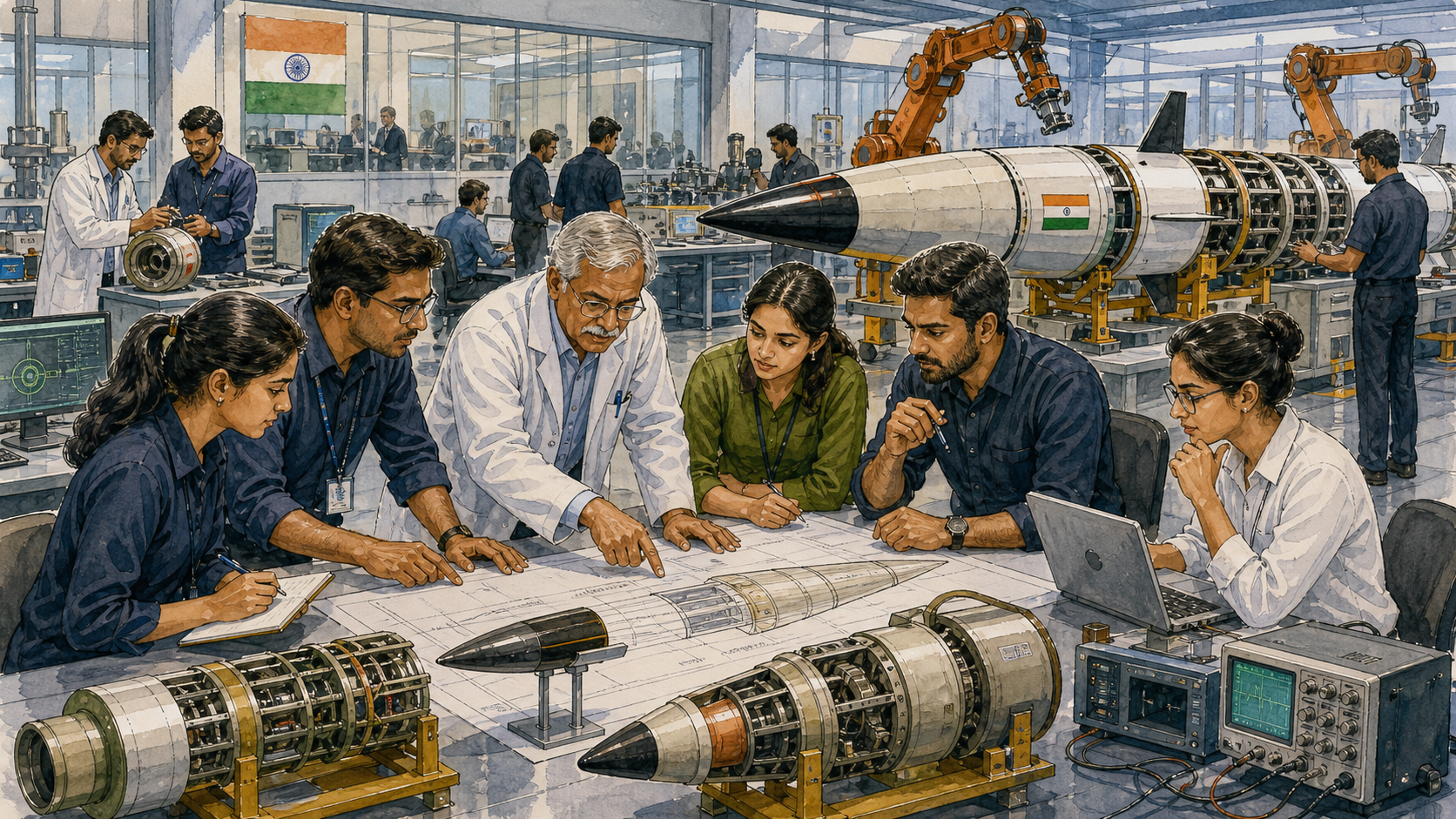
India’s defence-industrial transition is entering one of its most consequential areas. The Armament Research and Development Establishment in Pune, part of the Defence Research and Development Organisation, has sought a Development-cum-Production Partner for missile warhead systems. The official notice is narrow and technical, but its strategic meaning is broad: Indian industry is being invited deeper into the development cycle of systems once concentrated almost entirely within government laboratories and public-sector production units.
What the Tender Actually Says
The Ministry of Defence e-procurement record identifies Tender ID 2026_DRDO_767168_1 and reference ARDE/27EOI001/CMS-I. It is an Expression of Interest for selecting a Development-cum-Production Partner, or DcPP, “in respect of Warhead systems for Missiles.” The tender was published on 25 May 2026, with a pre-bid meeting scheduled in June and bid opening in July.
This wording matters. A missile warhead is the payload section designed to produce the intended effect on a target. The notice does not grant private companies an unrestricted right to manufacture weapons, does not disclose sensitive design information and is not a public invitation to build nuclear devices. Any partner operates within defence procurement, security, testing, licensing and quality-control requirements.
Why the DcPP Model Is Different
Traditional defence production often followed a sequential model: a government laboratory designed a system, trials were completed, and only then was an industrial producer identified. That arrangement could create delays because the production agency had to learn a complex design after development was largely finished.
The DcPP approach brings industry into the project earlier. DRDO documents describe the partner as an industry entity involved from the development stage, responsible for realising prototypes, supporting trials, producing the system after successful development and providing warranty, maintenance and life-cycle support. In simple terms, the factory learns while the laboratory develops.
This reduces the gap between a successful prototype and reliable serial production. For missiles and warhead systems, that gap is critical. Armed forces need repeatable quality, safe storage, environmental tolerance, traceable components and the capacity to increase output when required. A brilliant laboratory result is not sufficient if industrial production cannot reproduce it consistently.
Private Industry Moves Into the Strategic Core
Indian private companies have long supplied structures, electronics, explosives, vehicles, software and subassemblies to defence programmes. The newer phase gives selected firms greater responsibility for systems integration and sustained production. By March 2026, the government reported that 134 companies had partnered with DRDO as DcPPs or production agencies, alongside thousands of technology-transfer agreements and intellectual-property assets opened to Indian industry.
The wider production numbers show why this policy has momentum. The Ministry of Defence reported record indigenous defence production of ₹1.78 lakh crore in financial year 2025–26, up 15.6% over the previous year. The private sector accounted for approximately 24%, or around ₹42,000 crore, while defence exports reached ₹38,424 crore.
A warhead-systems partnership can deepen capabilities in precision manufacturing, energetic materials, fuzing, sensors, quality assurance and systems safety. Those skills have spillovers across multiple defence products, though access must remain compartmentalised and governed by strict need-to-know rules.
The Strategic Logic
Recent conflicts have demonstrated that sophisticated platforms are only as useful as the depth of their ammunition and missile inventories. Nations need the ability to replenish precision weapons without waiting for external supply chains. Import dependence can become a strategic vulnerability during a crisis, particularly when foreign governments control export permissions, components or production slots.
Domestic production provides three advantages. First, it improves supply security. Second, it creates an engineering base capable of upgrading systems as threats evolve. Third, it makes exports and long-term support more credible because buyers assess whether the producer can supply spares and replacements over decades.
Industry Participation Is Not Privatisation of Strategy
The state must still define military requirements, retain design authority where appropriate, certify safety and performance, protect classified information and decide deployment. Private participation should create capacity and competition, not weaken public accountability.
The selection process therefore matters as much as the policy. Technical competence, financial resilience, secure facilities, supply-chain transparency and a record of quality must outweigh corporate size or political visibility. Multi-vendor capacity should be considered where security of supply requires it, while intellectual-property rules must reward investment without creating permanent monopoly dependence.
From Self-Reliance to Reliable Scale
“Make in India” is meaningful in defence only when it moves beyond assembly. The relevant test is whether Indian laboratories and companies control design knowledge, critical materials, manufacturing processes, testing infrastructure and life-cycle support. The ARDE notice points in that direction because it concerns development and production together.
The next milestones will be technical evaluation, partner selection, prototype realisation, trials and eventual production decisions. Each stage can still expose delays or capability gaps. But opening a strategic subsystem to structured domestic partnership is itself an important change.
India’s defence industry will not become globally competitive through announcements alone. It will do so by converting science into repeatable manufacturing, protecting quality under pressure and delivering on time. DRDO’s search for a missile-warhead production partner is one more step from laboratory sovereignty toward industrial strength.