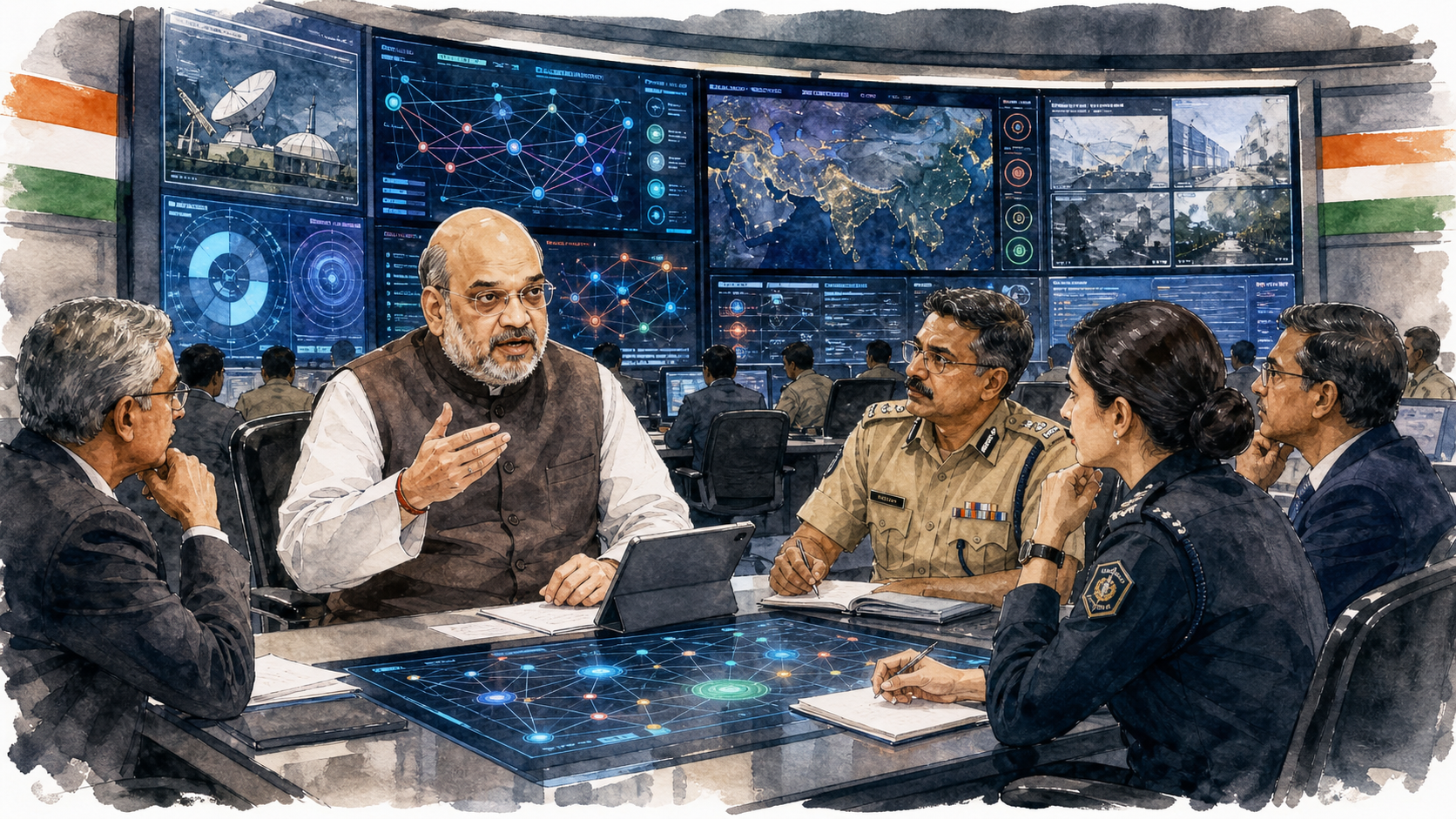
India's national-security system receives more information than any individual team can read in real time. Intelligence reports, cyber alerts, financial trails, travel movements and field inputs arrive through different agencies and formats. Union Home Minister Amit Shah's direction to apply artificial intelligence to information available on Multi-Agency Centre platforms is therefore aimed at a concrete problem: turning a vast flow of data into timely, usable decisions.
Inaugurating the ninth National Security Strategies Conference in New Delhi, Shah asked agencies to use AI-based analysis to help create standard operating procedures for major security challenges. The Akashvani report said the agenda included counter-terrorism, radicalisation, intelligence fusion through the MAC, narcotics, illegal migration, cybercrime, information warfare, biosecurity and threats from sub-aerial systems.
From information collection to intelligence fusion
The value of AI in security does not begin with futuristic machines. It begins with ordinary analytical work done at greater speed and consistency. A system can identify repeated names across databases, detect unusual transaction networks, compare incident patterns across states or alert an analyst when separate field reports point to the same emerging threat. Used properly, such tools reduce the time officers spend locating connections and increase the time available for judgment.
The Multi-Agency Centre exists to improve the sharing of terrorism-related intelligence among central and state bodies. Technology can make that sharing more searchable and operational. The deeper reform, however, is institutional. Agencies must use compatible data standards, record the reliability of inputs, update outcomes and share information without allowing organisational boundaries to slow urgent action.
The Modi government's annual hybrid conference model, in place since 2021, brings senior leadership, domain specialists and officers working at the field level into one discussion. More than 850 participants joined the current conference, according to the report. That scale is useful because national threats are experienced locally before they become national headlines. A young police officer may see a new fraud pattern or drone tactic before it appears in a central policy paper.
AI must support, not replace, responsibility
An algorithm can rank risks, but it cannot carry constitutional responsibility. Security decisions affect liberty, privacy and sometimes life. Every AI-supported alert should therefore retain a clear chain of human review. Officers need to know what data produced a recommendation, how reliable the model is and what safeguards prevent innocent behaviour from being treated as suspicious.
False positives are not a minor technical inconvenience. They consume investigative resources and can harm citizens. Models trained on incomplete or poor-quality records can reproduce old errors at greater speed. The strongest implementation of Shah's direction would combine better analytics with audited datasets, access controls, documented thresholds and an appeal or correction mechanism wherever decisions affect an individual.
Cybersecurity is equally important. A central intelligence platform becomes a valuable target for hostile actors. Data must be segmented, encrypted and monitored, with strict controls on who can see which records. AI systems themselves need testing against manipulated inputs and attempts to extract sensitive information.
A broad view of modern security
The conference agenda shows that the Home Ministry is treating national security as a connected system. Terror financing may overlap with narcotics networks. A cyber campaign may support information warfare. Cheap drones can create risks for borders, public events and critical infrastructure. Biosecurity requires coordination across health, science, policing and emergency management.
Shah also stressed training under the PRAHAAR scheme, faster legal action against fugitives and an integrated approach to cases under the Unlawful Activities Prevention Act. Technology cannot compensate for weak investigation or delayed prosecution. Evidence must be collected lawfully, preserved correctly and presented convincingly in court. Better analytics should make that chain stronger rather than encouraging shortcuts.
Building Indian security technology
The initiative also creates an opportunity for Indian research institutions and security-technology companies. Tools for multilingual analysis, network detection, drone identification and secure data exchange should reflect India's languages, geography and legal framework. Sensitive security systems cannot depend blindly on opaque foreign platforms or remote support.
Procurement should reward tested performance rather than impressive demonstrations. Pilot systems need red-team testing, independent audits and clear measurements: Did an alert arrive earlier? Did agencies coordinate faster? Did investigations become more accurate? Did the system reduce workload without increasing unjustified surveillance?
Technology in service of a stronger state
Amit Shah's direction is significant because it places AI inside an existing coordination architecture rather than presenting it as a standalone spectacle. The objective is not to automate national security. It is to give trained officers a clearer picture, faster warning and a common operating language.
The BJP-led government's broader emphasis on technology and institutional coordination can produce a more capable security state if accountability grows alongside capability. AI will matter not because it sounds modern, but because it helps India detect threats sooner, act with precision and protect both national integrity and constitutional trust.