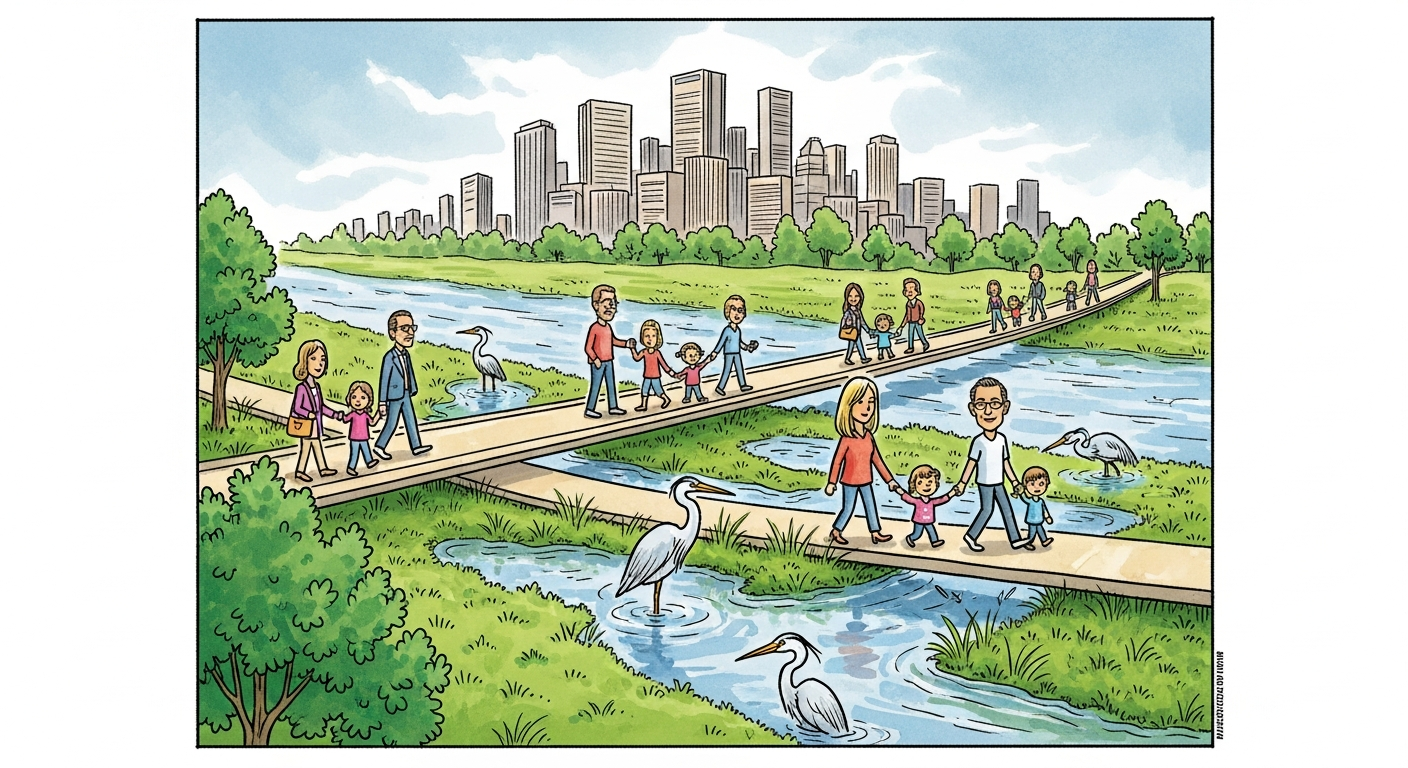
The test of an ecological restoration is not its opening ribbon but its second monsoon, and the Yamuna's floodplain project has now passed both. The first restored stretch survived its monsoon test — absorbing floodwater as designed, keeping the city dry behind it — and this week the second stretch opens, which turns what could have been a photogenic one-off into the beginning of a working system that spans more than a single showcase kilometre.
The engineering idea is deceptively simple and historically ignored. A floodplain is not wasteland to be built over but infrastructure to be preserved — a natural sponge that absorbs a river's seasonal surge and releases it slowly, protecting the city precisely by not being developed. Decades of encroachment treated the floodplain as vacant land, and the floods that followed were the predictable price. Restoring it — clearing the encroachment, rebuilding the wetland, letting the river reclaim its room — is climate adaptation of the cheapest and most durable kind, because it works with the river's hydrology rather than against it.
That the first stretch performed through a real monsoon is the datum that makes the second one credible. Restoration projects are easy to open and hard to validate; a wetland looks finished on inauguration day and reveals its actual function only when the water rises. The first stretch rose to a genuine flood and did its job, which is why the second stretch opens as an expansion of a proven system rather than a hopeful repetition of an untested one. The distinction matters because it converts the project from an experiment into a template.
The template has reach well beyond Delhi. Every Indian river city faces some version of the same problem — a floodplain under development pressure, a monsoon that grows less predictable, a flood-defence bill that rises every year — and a demonstrated, replicable model of floodplain restoration is worth far more than any single city's stretch of restored riverbank. The flood risk on the eastern rivers that ran through this year's sowing season is the same category of problem at a larger and deadlier scale, and the room-for-the-river principle proven on the Yamuna is directly relevant to it.
The urban-systems connection is where the project earns its full value. A restored floodplain is not an isolated park; it is one element of a city's water and climate infrastructure, and it works best coordinated with the transit and land-use decisions that determine whether the surrounding development respects the river's room or resumes crowding it. A floodplain restored and then encircled by fresh encroachment is a floodplain restored on a timer; the second stretch's real test is not this monsoon but whether the city's development machinery protects it through the next decade.
The honest risks are institutional rather than hydrological. The engineering works; what fails, historically, is the maintenance and the protection — the slow return of encroachment, the diversion of maintenance budgets, the political pressure to develop restored land once the memory of the last flood fades. A restoration is only as durable as the institution that defends it, and two good monsoons buy credibility but not permanence. The project's advocates know this, which is why the expansion to a second stretch matters: a system is harder to encroach on quietly than a single showcase, and scale is its own protection.
What the two stretches together demonstrate is that room-for-the-river works in an Indian megacity — not in a design brief or a foreign case study but in the actual hydrology of a real monsoon against a real city. That demonstration is the project's largest contribution, because it moves floodplain restoration from something India might try to something India has shown it can do, and shown twice.
The variable that ultimately protects a floodplain is neither engineering nor budget but constituency. A restored riverbank that people use — that families walk, that becomes part of a city's daily life rather than a fenced-off project — acquires defenders, and defenders are what stop the quiet return of encroachment when the memory of the last flood fades. The second stretch matters partly because it turns a showcase into a shared amenity, and a shared amenity generates the political ownership no maintenance contract can. The wider urban-systems logic applies here too: infrastructure citizens experience as theirs survives the budget cycles and administrative churn that infrastructure experienced as the government's does not. The floodplain's best insurance policy is a public that would notice, and object, if it were taken away — and that public is built by opening the second stretch, not by fencing off the first.
The second stretch is open and the system is growing. Two monsoons in, the model holds — and the real test is the decade of protection ahead, which we will be watching, on our cities desk.