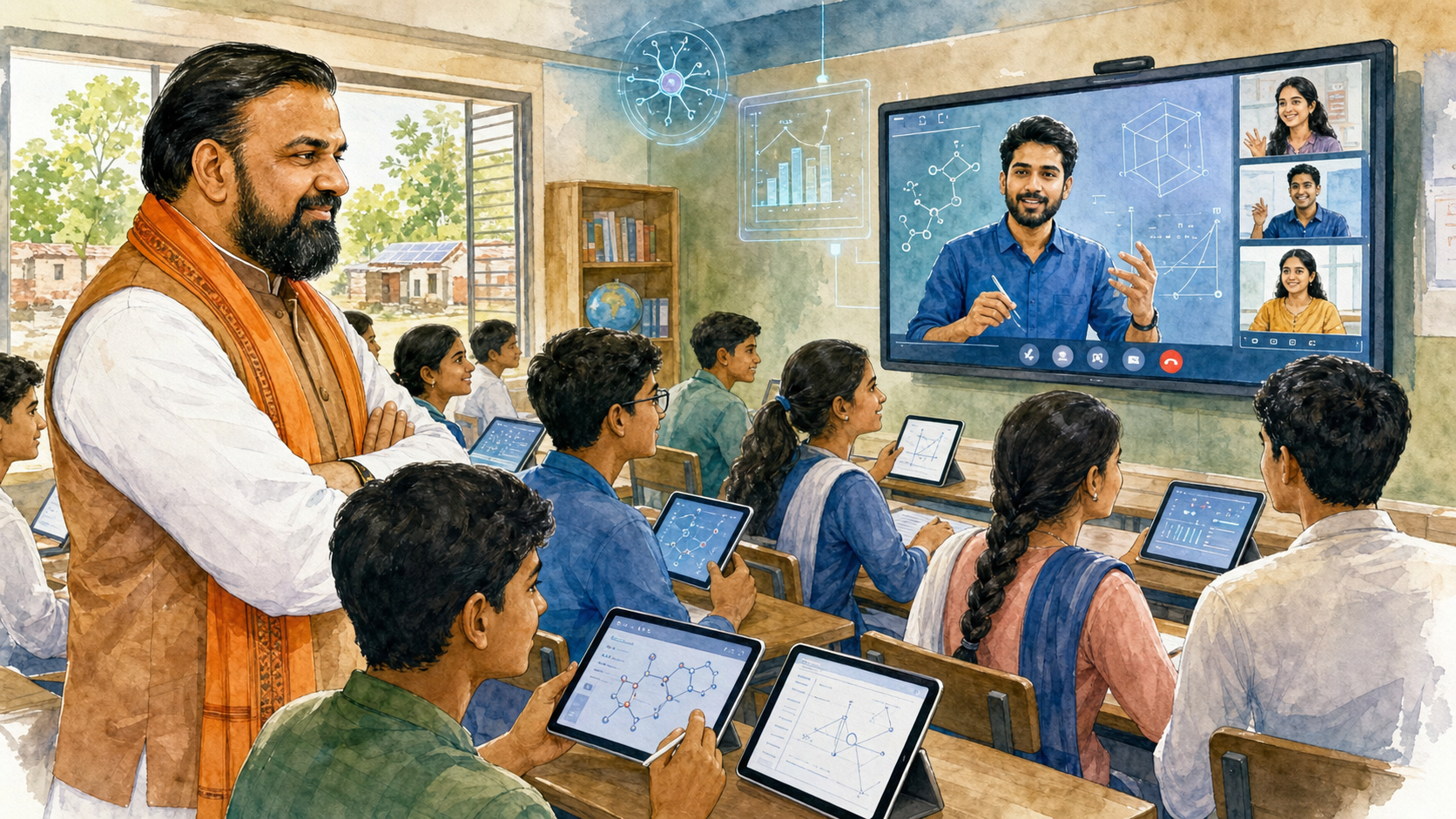
Digital education often promises access but delivers a library of recorded videos that cannot answer a student's immediate question. Bihar Vidya Sathi is attempting a more demanding model: live teachers available around the clock, one-to-one interaction and digital material linked to the needs of students in government model schools.
Chief Minister Samrat Choudhary launched the platform across 700 Saraswati Vidya Niketan model schools in all 38 districts. The official Bihar government release says about three lakh students will benefit initially, with 75,000 teachers providing personalised support. Students in Classes 9 and 10 can seek help across subjects, while Classes 11 and 12 science students will receive live tutoring and digital material for Bihar Board, JEE and NEET preparation.
The difference a live teacher makes
A student may understand a chapter but remain blocked by one step in a mathematics problem or one concept in chemistry. Recorded content requires the learner to find exactly the right explanation. A live teacher can ask what the student already understands, identify the gap and adapt the response.
The ability to choose a teacher may also improve comfort and fit. Some learners need a slower explanation; others want a quick clarification before practice. The platform's value will depend on whether matching is fast, teachers are available across subjects and the interaction remains academically focused.
Round-the-clock availability is an ambitious promise. Bihar should publish average wait time, completed sessions, repeat usage and student satisfaction. These measures will reveal whether 75,000 registered teachers translate into dependable access at evenings, weekends and examination peaks.
Bridging geography without ignoring connectivity
The programme can reduce the disadvantage faced by students who live far from large coaching centres. Rural families often pay for travel or accommodation to reach specialist teaching. A functioning digital alternative can bring high-quality guidance into a local school and allow students to remain within their community.
Connectivity and devices will determine inclusion. Model schools need reliable broadband, electricity, headphones and supervised spaces. Students who cannot access the platform from home should be able to use school facilities outside normal class time. Accessibility features are needed for learners with disabilities.
The government plans to expand beyond the first 700 schools. Expansion should follow evidence rather than only an enrolment target. Districts with weak connectivity may need additional infrastructure before the same service standard can be promised.
AI should support learning, not replace teaching
Choudhary said modern AI tools would strengthen conceptual learning and provide unlimited practice. AI can generate quizzes, recommend revision and identify recurring errors. It can help a teacher see which concepts require attention across a class.
Safeguards are necessary because school data is sensitive and automated explanations can be wrong. Students should know when an answer is generated by AI, teachers should be able to correct it and personal information should not be used for unrelated commercial purposes. The human teacher must remain responsible for academic guidance.
AI should also work in language familiar to the learner. Clear Hindi and regional-language support can make difficult concepts more accessible, while English terminology remains available for competitive examinations and higher study.
Quality assurance for 75,000 teachers
A platform of this scale requires more than teacher registration. Bihar needs identity checks, subject verification, orientation, session monitoring and student-safety protocols. Teachers should receive feedback and training in online explanation, not simply be placed before a camera.
Students need a simple way to report unhelpful or inappropriate sessions. At the same time, teachers deserve protection from misuse and a clear process for reviewing complaints. Selected session audits can improve quality if privacy rules are defined.
A digital public education opportunity
The Samrat Choudhary government's initiative aligns technology with a concrete educational service. Its strongest feature is not the app itself but the promise of timely human help. That is the difference between content distribution and learning support.
Success should be tested through academic outcomes, particularly for students who previously lacked tutoring. Bihar can compare usage and improvement across districts, subjects and student groups while avoiding crude rankings that encourage gaming.
If Vidya Sathi delivers reliable teachers, safe technology and measurable learning, it can become a model for state-supported digital education. Three lakh students are the first test. The larger goal is a Bihar where a student's location or family income no longer determines whether a difficult question receives a good answer.
The programme should therefore publish a simple learning dashboard without exposing individual children. Useful measures include response time, completed sessions, repeat usage, subject-wise demand and improvement in school assessments. Independent evaluation can compare students who use live support frequently with similar students who do not, while accounting for connectivity and household background. Feedback from parents, head teachers and students should shape each expansion phase. Bihar has chosen an ambitious starting scale, and that ambition deserves equally strong measurement. When evidence shows what works, public funds can move toward the most effective teaching practices and weaker parts of the platform can be corrected early.