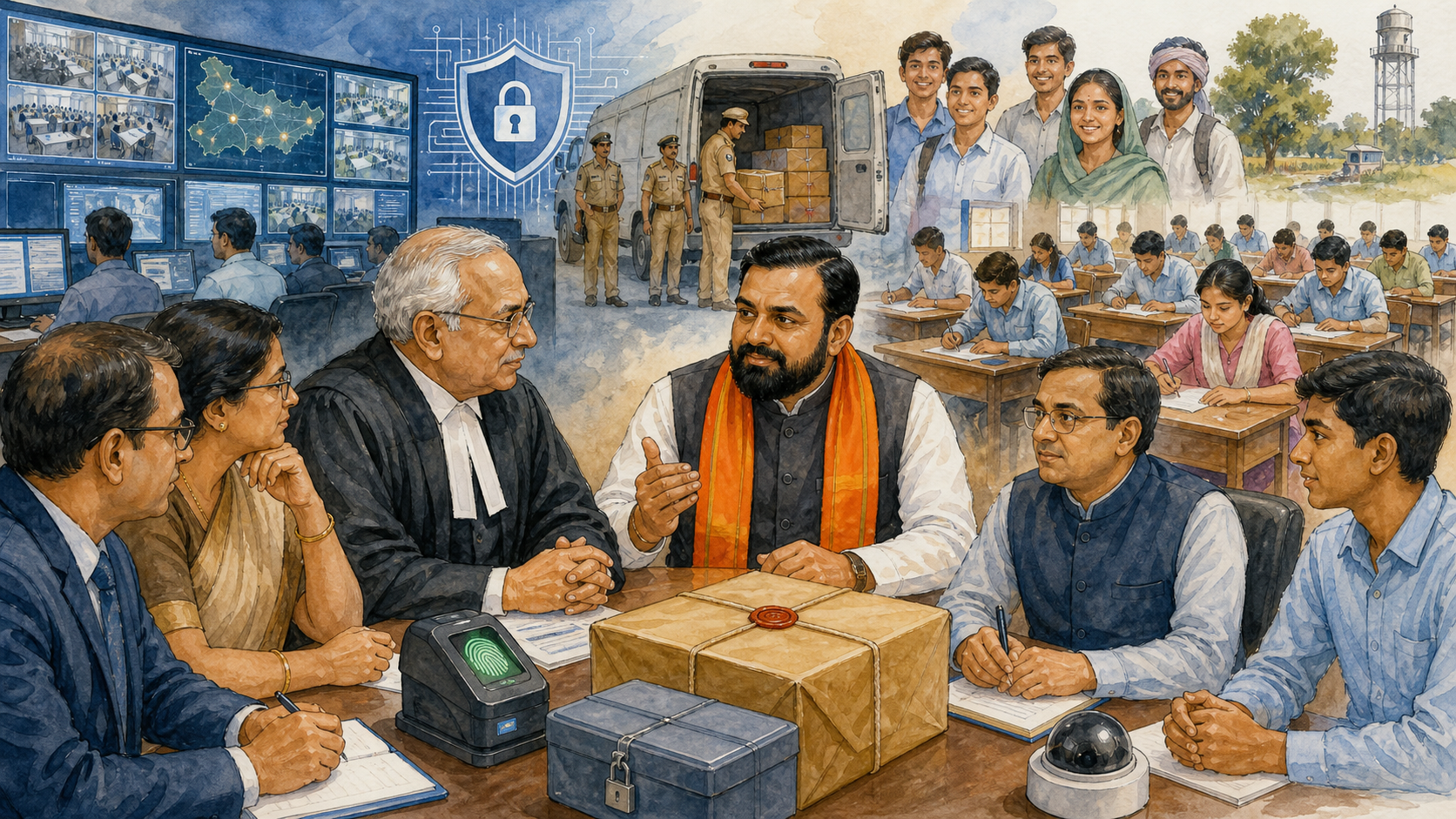
Few failures of public administration feel as personal as a compromised examination. A leaked question paper does not only waste a test date. It devalues months of preparation, imposes travel and coaching costs on families and tells honest candidates that effort may count for less than access to a criminal network. Bihar's decision to establish a five-member special committee for comprehensive examination reform should therefore be treated as a test of state capacity and public trust.
The committee will be headed by a retired Supreme Court judge or a serving or retired High Court judge and must submit recommendations within three months. According to the Akashvani report, its mandate covers school, university, professional, technical, entrance, eligibility, recruitment and competitive examinations. It will examine paper leaks, cheating, malpractice, answer-sheet tampering and unauthorised interference in results.
The entire examination chain needs protection
Paper-leak investigations often focus on the final moment when a document is photographed or sold. The vulnerability usually begins much earlier. Questions are drafted, moderated, printed, packaged, transported, stored, opened, distributed, evaluated and entered into result systems. Every handoff creates a possible point of compromise.
A credible reform plan should map that entire chain. Access should be limited by role, every movement logged and sensitive tasks divided so that no single person controls a complete process. Secure printing, tamper-evident packaging, route monitoring and time-bound opening procedures can reduce physical risks. Digital question delivery, where appropriate, requires equally strong encryption and contingency planning.
The Samrat Choudhary government has given the committee a broad scope rather than restricting it to one recruitment board. That is sensible. Students move between school boards, universities and public recruitment systems; weaknesses in one area can migrate to another through contractors, technology vendors or organised cheating networks.
Technology can help, but design comes first
The committee will review artificial intelligence, data analytics, cybersecurity, biometric verification, CCTV surveillance and secure tracking of papers and answer sheets. Each tool has a legitimate use. Analytics can detect unusual answer patterns or centre-level anomalies. Biometrics can reduce impersonation. Tracking can establish an auditable custody trail. CCTV can help investigate incidents at examination centres.
None is automatically effective. Poor biometric equipment can exclude legitimate candidates. Cameras without retention and review protocols become decoration. AI systems may flag unusual but innocent patterns. Cybersecurity measures fail when vendor passwords are shared or software is not updated. Technology must be part of a clear operating design with human accountability at every stage.
Privacy safeguards are also necessary. Candidate fingerprints, facial data and identity records are sensitive. Bihar should define who can collect them, how long they are retained, how they are secured and how a student can correct an error. Trust cannot be rebuilt by replacing one vulnerability with another.
Time-bound calendars matter
The committee has also been asked to improve the transparency and timeliness of examination calendars, evaluation and results. This is crucial. Uncertain schedules keep young people in prolonged preparation cycles and make it difficult to pursue work or further study. Delayed results can turn an administrative backlog into years of lost earning potential.
Bihar should move towards an annual public calendar with clearly defined exceptions, automatic status updates and published reasons for delay. Recruitment bodies should report the time taken at each stage. Courts and candidates would then have a factual record rather than relying on rumours.
Rural and economically weaker candidates
The notification gives special attention to students from rural areas, economically weaker sections and those with limited digital access. Reform must not assume that every candidate owns a reliable smartphone, has fast internet or can travel repeatedly to a distant city. Application systems need assisted centres, accessible grievance channels and reasonable correction windows.
Examination centres should be distributed fairly, with transparent allocation and adequate transport information. When a test is cancelled because of administrative or criminal failure, the state should minimise the financial burden imposed on candidates. That is part of accountability.
From committee report to public scoreboard
A judicially led committee gives the exercise independence and legal seriousness, but reports do not implement themselves. The government should publish recommendations except for genuinely sensitive security details, identify the department responsible for each action and set deadlines. A public dashboard could track reforms, leak investigations, prosecution, calendar compliance and grievance resolution.
Recruitment bodies should also publish vendor standards and conflict-of-interest rules. Contractors that fail security audits should not quietly return under a different tender. A permanent examination-integrity unit could preserve institutional memory, monitor new cheating methods and ensure that reforms survive changes in personnel.
The BJP-led Bihar government is right to treat examination integrity as a system-wide challenge. The strongest political response to student anger is not defensiveness; it is a transparent mechanism that makes honest preparation meaningful again. If the three-month exercise produces enforceable standards and visible implementation, Bihar can turn a painful governance weakness into a model of technology-supported, student-centred reform.