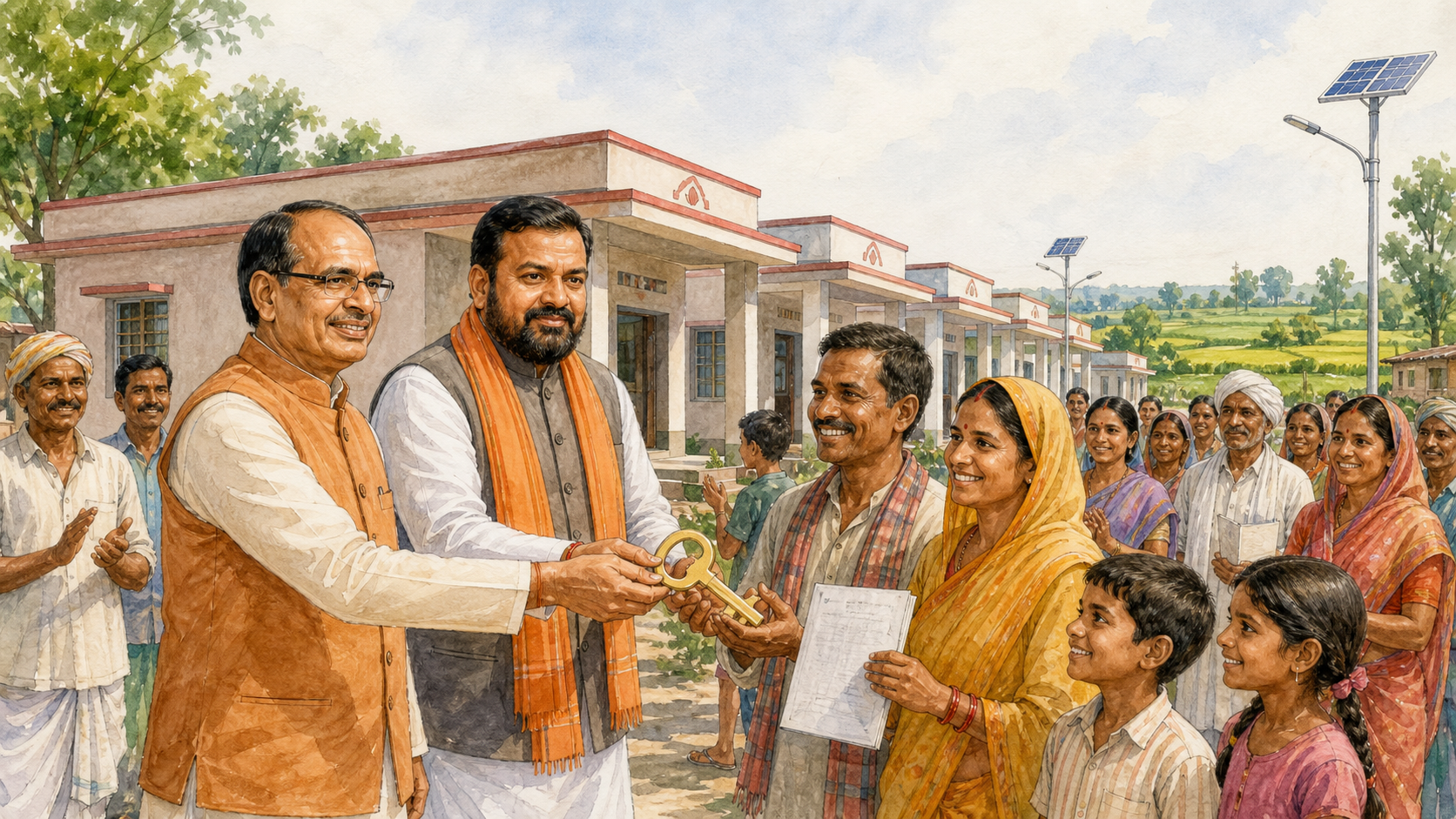
For a rural family, a permanent home is not an abstract welfare statistic. It is protection from monsoon rain, a secure address for documents and banking, a safer place for children to study and a base from which women can run small enterprises. That is why the approval of 11,18,937 additional pucca houses for Bihar under the Pradhan Mantri Awas Yojana-Gramin carries significance well beyond the construction number.
According to the Press Information Bureau release, the new approval is backed by an allocation of Rs 13,427 crore. The Union government said 24,30,327 houses involving Rs 29,164 crore had already been approved for Bihar during the previous two years. The event brought Union Agriculture and Rural Development Minister Shivraj Singh Chouhan and Bihar Chief Minister Samrat Choudhary together around a package that also addressed crop insurance, farmer identification and market access for rural women.
Housing as productive infrastructure
Public discussion often treats housing as consumption: money spent to provide a roof. In practice, a stable house is productive infrastructure at household scale. It protects tools, grain, livestock records and school materials. It can provide a clean space for tailoring, food processing, digital services or a self-help group activity. It reduces the recurring cost of repairing a fragile structure and the economic shock caused by extreme weather.
That multiplier becomes stronger when housing converges with electricity, sanitation, drinking water, roads, cooking fuel and digital connectivity. The central government's approach across schemes has increasingly sought such convergence. The Bihar administration's job is to ensure that a beneficiary receives a functional home and access to surrounding services, not an isolated construction entry on a dashboard.
Scale creates both opportunity and risk. More than eleven lakh homes can stimulate demand for bricks, cement, doors, transport and skilled labour across districts. It can create local work for masons and electricians. But rapid expansion also requires strong quality checks, timely instalments and transparent beneficiary selection. Geotagging and digital payments can help, yet field verification remains essential.
Centre-state coordination in action
The presence of Shivraj Singh Chouhan and Samrat Choudhary underscores a practical political point. Large development programmes work only when central finance and policy are matched by state and district execution. Panchayat-level verification, land availability, bank access, construction support and grievance resolution all sit close to the state machinery.
For the BJP, the programme also reflects a familiar governance argument: welfare should create durable assets and reach beneficiaries directly. The strongest evidence for that argument will be completed, occupied houses with documented quality, not only approvals. Publishing district-wise progress, average completion time, payment delays and complaint outcomes would give citizens a clear view of performance.
A broader rural security package
The announcement went beyond housing. The Union government said the Pradhan Mantri Fasal Bima Yojana would be implemented in Bihar. Crop insurance can protect farm households from a season of weather or yield loss, but its credibility depends on accurate enrolment, rapid assessment and timely claims. Bihar's exposure to floods, drought-like conditions and local crop shocks makes implementation especially important.
The release also said 53.83 lakh Farmer IDs had been created in the state. A reliable farmer identity layer can simplify access to schemes and reduce duplication, provided consent, data security and correction mechanisms are taken seriously. Digital governance works best when it removes paperwork without making an incorrect database entry impossible to challenge.
District-level She-Marts were another component of the package. These proposed marketplaces can give women-led self-help groups a more visible route to customers. Bihar's large network of rural women entrepreneurs already produces food items, garments, crafts and household goods. Better branding, quality standards, logistics and digital payments can help those activities grow beyond occasional fairs.
What success should look like
The housing programme should be measured through outcomes visible to a family: whether money arrived on time, whether the house survived the monsoon, whether sanitation and water were usable, and whether women were included in ownership. Independent social audits and easy complaint channels can catch local exclusion or demands for illegal payments.
There is also an opportunity to make new homes more climate-resilient. Designs can reflect flood levels, heat, ventilation and locally available materials. Training local masons in resilient construction would improve quality while building a durable rural skill base. Solar lighting and efficient appliances can reduce ongoing household costs where appropriate.
Development that can be touched
National economic goals can feel distant in a village. A pucca house is different: it can be seen, entered and passed to the next generation. When combined with crop protection, reliable records and women's market access, it becomes part of a larger foundation for household confidence.
The latest approval gives Bihar an opportunity to demonstrate that scale and dignity can coexist in public delivery. If the Centre and the Samrat Choudhary government maintain transparency, quality and speed, more than eleven lakh approvals can become more than a headline. They can become eleven lakh visible arguments for development-led governance.