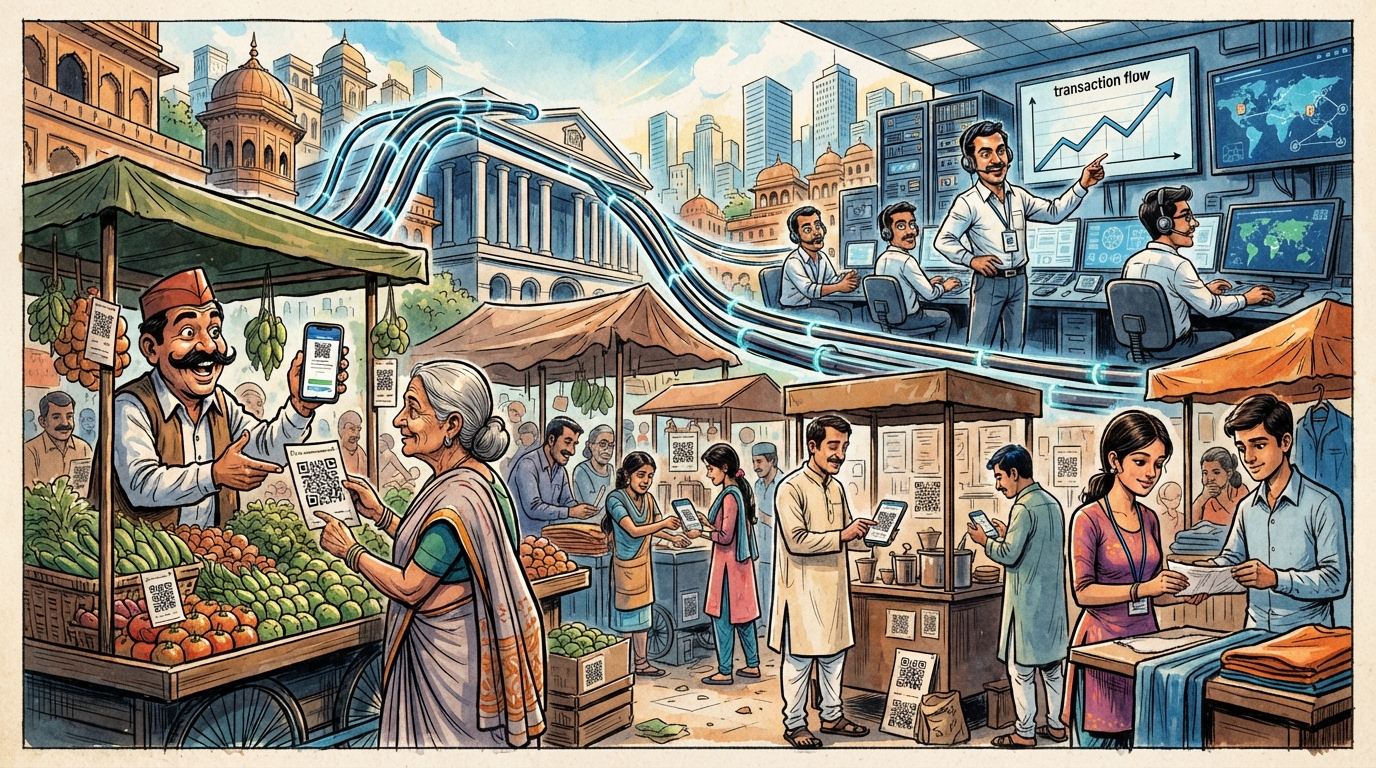
India is beginning a consequential debate about how the Unified Payments Interface should finance its next phase. Legislation introduced in Parliament creates legal room for a possible change to the zero merchant-discount-rate framework that has applied to UPI payments since 2020.
The distinction is important: the law does not automatically place a charge on every UPI payment. As TechCrunch reported on August 4, it lays groundwork for the government to consider charges on some merchant transactions. Consumer-to-consumer transfers and ordinary user access need not become paid services.
A public rail at enormous scale
UPI processed a record 23.66 billion transactions worth about Rs 29.88 trillion in July, according to figures cited in the report. That scale has made instant payment acceptance commonplace, including for small shops that were previously excluded from card infrastructure.
The zero-charge policy accelerated adoption, while state incentives supported banks and payment firms. But the network's next stage requires sustained spending on cyber security, dispute resolution, fraud detection, redundancy and product development. A system used hundreds of millions of times each day cannot rely indefinitely on uncertain funding.
Design the model around trust
A sensible reform would protect three things. First, payments should remain free for consumers. Second, small merchants and low-value transactions should retain strong protection from charges. Third, any fee on larger merchant transactions should be transparent, modest and distributed fairly among the banks, apps and infrastructure providers that keep a payment working.
Analysts cited by TechCrunch have discussed applying charges only to higher-value payments or larger merchants. That approach could preserve mass adoption while creating revenue for investment. It would also reduce the risk that a blanket fee pushes neighbourhood businesses back toward cash.
UPI is one of India's most visible digital public-infrastructure successes. Its success came from interoperability, simplicity and policy support, not from pretending that infrastructure has no cost. The reform opportunity is to make those costs sustainable without weakening the open, low-friction character that made the network valuable in the first place.
Source: TechCrunch, August 4, 2026.