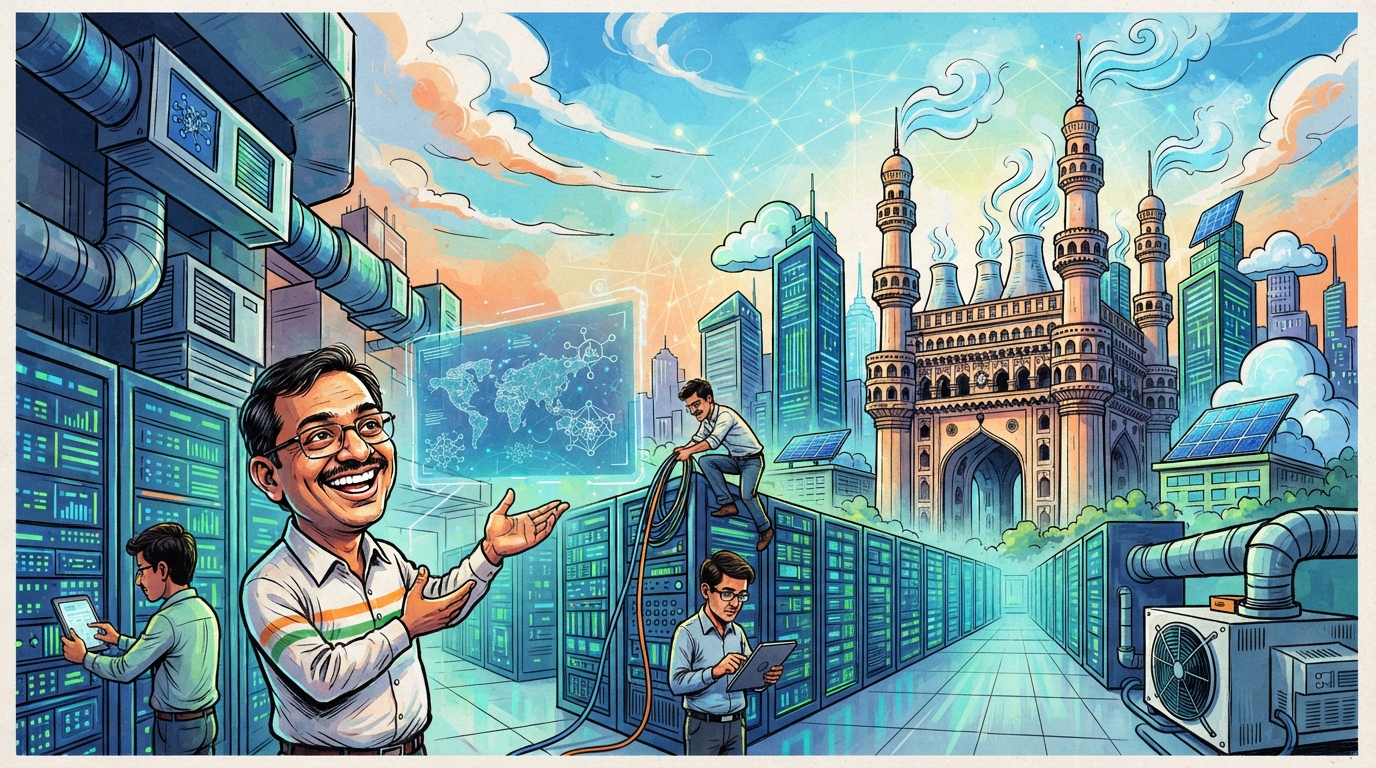
India’s cloud and artificial-intelligence infrastructure gained another major node on August 6 when Microsoft announced the general availability of its India South Central region in Hyderabad. The new region allows eligible Microsoft Cloud services and workloads to run from Telangana, bringing computing capacity closer to Indian customers and regulated industries.
According to Microsoft’s launch announcement, the Hyderabad region has three availability zones designed for resilience and aligned with Indian regulatory and seismic requirements. Early users include Adani Group, Bajaj Finserv, HDFC Bank and PB Pay.
Four domestic regions and more local choice
Hyderabad becomes Microsoft’s fourth cloud region in India, joining Pune, Chennai and Mumbai. That geographic spread matters because banks, public services, digital platforms and industrial companies need business continuity as well as computing power. Multiple domestic regions make it easier to design disaster recovery, reduce latency and keep eligible data and workloads within the country.
The launch also shows that India’s AI story is moving beyond applications and talent to the physical infrastructure beneath them. Training and operating advanced models require servers, high-speed networks, dependable energy and governance controls. Local hyperscale capacity helps Indian enterprises move experiments into production while meeting security and compliance expectations.
Microsoft links the new region to investment commitments announced in January and December 2025, totalling $20.5 billion for cloud and AI expansion in India. The company says Azure has recorded strong double-digit growth in India over the last two years, while enterprise adoption of AI tools has been moving from pilots toward wider deployment.
Infrastructure must be responsible
Datacentres are economically valuable but resource intensive, making their design important. Microsoft says India South Central will use enhanced mechanical cooling with air-cooled chillers intended to consume zero water for cooling. The company also reports agreements connected with more than 1,000 MW of new solar, wind and hybrid power projects in India, with over 630 MW already operating.
Those commitments should be measured publicly as the region scales. Power sourcing, water use, local employment, cybersecurity and community impact will determine whether the infrastructure delivers durable value rather than capacity alone.
An opportunity for Indian firms and workers
The new region can support startups, banks, manufacturers and government-linked services that need secure, low-latency infrastructure. Microsoft has also committed to equip 20 million Indians with AI skills by 2030 and says 5.6 million people have been trained since January 2025.
Hyderabad’s launch is therefore more than a company expansion. It strengthens India’s position as a market where global cloud infrastructure, domestic digital demand and a large technology workforce reinforce one another. The policy challenge now is to convert that capacity into Indian products, skilled jobs, research capability and trusted AI systems built for the country’s scale.



