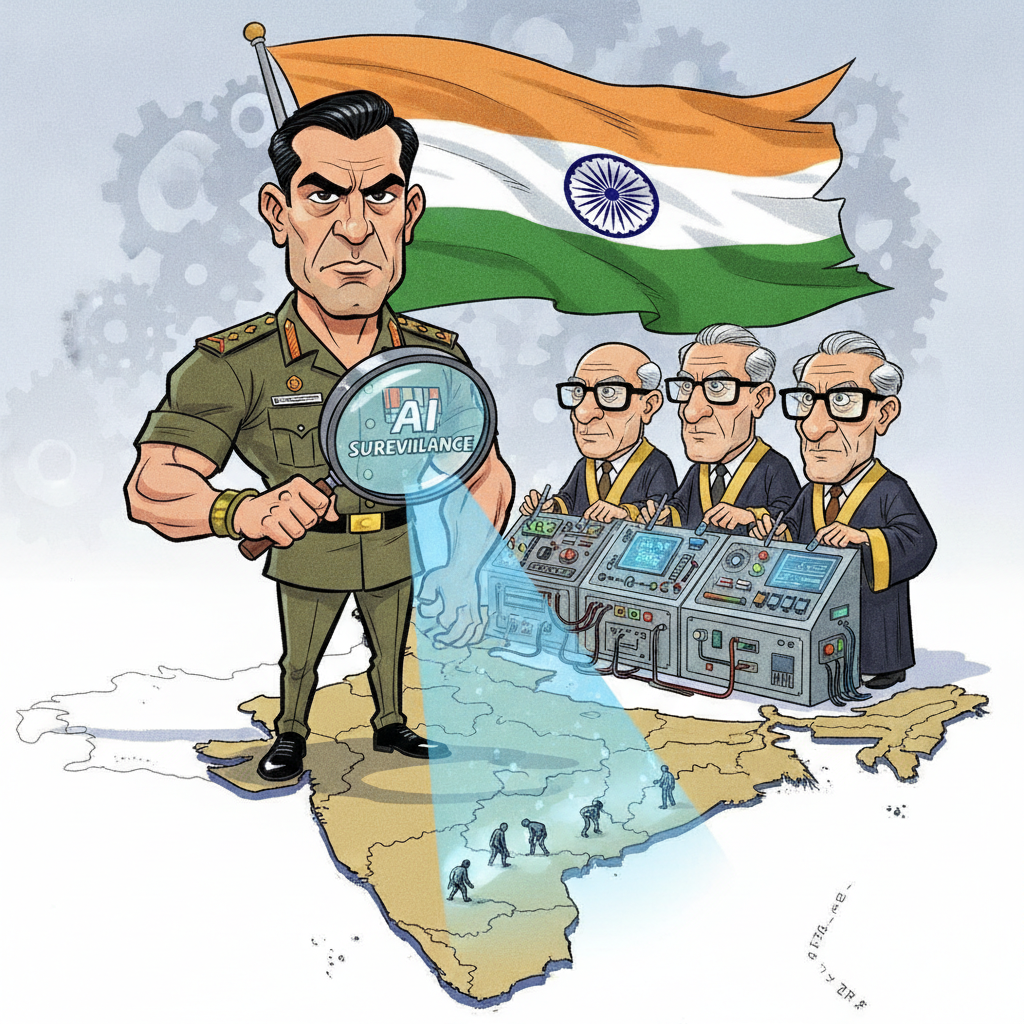
New Delhi — India's commitment to fortifying its extensive and often challenging borders has taken a definitive technological turn, with the Ministry of Defence initiating a landmark partnership with the nation's premier engineering institutions. This strategic collaboration, focused on developing advanced Artificial Intelligence (AI)-powered surveillance systems, underscores a robust national resolve to leverage indigenous innovation for critical security needs. The initiative is poised to significantly enhance India's border management capabilities, aligning seamlessly with the government's broader vision of a 'Viksit Bharat' (Developed India) by 2047, where technological self-reliance forms a cornerstone of national strength.
The Defence Ministry has formally cemented this ambitious project through a Memorandum of Understanding (MoU) with three of India's most prestigious technical institutes: IIT Delhi, IIT Bombay, and IIT Kanpur. This tripartite alliance brings together the cutting-edge research capabilities of academia with the strategic imperatives of national defence, aiming to deliver state-of-the-art solutions that are tailored to India's unique geographical and security challenges. The move reflects a conscious shift towards integrating advanced digital technologies into defence infrastructure, moving beyond conventional methods to embrace smart, data-driven security paradigms.
The project, which has been allocated a substantial funding of Rs 500 crore, is not merely an academic exercise but a mission-critical undertaking with a clear timeline and measurable objectives. Official sources indicate that the ambitious goal is to achieve comprehensive coverage of approximately 3,000 kilometers of India's borders by the year 2025. This targeted deployment highlights the urgency and strategic importance attached to modernizing border surveillance, particularly in an era marked by evolving geopolitical complexities and persistent security threats. The indigenous development of these systems is a testament to the 'Make in India' and 'Atmanirbhar Bharat' initiatives, aiming to reduce reliance on foreign technology and foster a robust domestic defence industrial ecosystem.
KEY FACTS
- MoU signed with IIT Delhi, IIT Bombay, and IIT Kanpur.
- Project allocated Rs 500 crore in funding.
- Target completion deadline set for 2025.
- Aims to cover approximately 3,000 km of India's borders.
- Initiative aligns with 'Make in India' and 'Digital India' defence goals.
A New Frontier in Border Security
The traditional methods of border patrolling and surveillance, while essential, often face limitations imposed by vast terrains, diverse topographies, and adverse weather conditions. The introduction of AI-powered systems promises a paradigm shift, offering capabilities for real-time threat detection, predictive analysis, and automated monitoring across challenging environments. These systems are expected to integrate various sensor technologies, including optical, thermal, and radar, processed by sophisticated AI algorithms to identify anomalies, track movements, and provide actionable intelligence to border forces with unprecedented speed and accuracy.
The selection of IIT Delhi, IIT Bombay, and IIT Kanpur for this pivotal project underscores their proven track record in advanced research and development across various technological domains. These institutions are renowned for their expertise in machine learning, computer vision, data analytics, and robotics – disciplines critical for the successful development and deployment of intelligent surveillance systems. The collaboration is expected to foster a symbiotic relationship, where academic innovation is directly channeled into practical applications for national security, creating a model for future public-private and public-academic partnerships in critical sectors.
The 3,000 km target for border coverage by 2025 is a significant undertaking, reflecting the scale of India's border challenges. This stretch encompasses diverse geographical features, from mountainous regions and dense forests to riverine areas and deserts, each presenting unique surveillance requirements. The AI systems are envisioned to be adaptable and resilient, capable of operating effectively in varied operational environments, thereby providing a comprehensive and layered security architecture. This proactive approach aims not only to detect intrusions but also to deter potential adversaries by establishing a technologically superior surveillance grid.
Powering 'Make in India' and 'Digital India' in Defence
The Rs 500 crore funding allocated to this project is a clear indicator of the government's strategic investment in indigenous defence technology. This financial commitment is not merely an expenditure but an investment in India's future defence capabilities and its journey towards self-reliance. The 'Make in India' initiative, particularly in the defence sector, has been a cornerstone of the current administration's policy, aiming to transform India from a net importer to a significant exporter of defence equipment. This AI surveillance project exemplifies this vision, ensuring that critical security technologies are developed and manufactured domestically, thereby safeguarding national interests and creating high-skilled jobs.
By The Numbers
Furthermore, the initiative aligns perfectly with the 'Digital India' campaign, which seeks to transform India into a digitally empowered society and knowledge economy. The development of AI-powered surveillance systems is a direct application of advanced digital technologies for governance and security. It represents a significant leap from traditional, human-intensive surveillance methods to a more efficient, automated, and intelligent system. This digital transformation in defence is crucial for maintaining a strategic edge in an increasingly technology-driven global security landscape.
"This collaboration with premier IITs for AI-powered border surveillance is a critical step towards enhancing our national security infrastructure through indigenous innovation. It underscores our unwavering commitment to 'Atmanirbhar Bharat' in defence and leveraging cutting-edge technology for the protection of our borders." — Official statement from the Defence Ministry
Historically, India has often relied on foreign defence procurements, leading to dependencies and sometimes delayed access to critical technologies. The current government's emphasis on indigenous research, development, and manufacturing seeks to reverse this trend. Projects like the AI surveillance system with IITs are pivotal in building a robust domestic ecosystem of defence innovation, ensuring that India's security needs are met with solutions developed within its own borders, fostering greater control, customization, and long-term sustainability.
Strategic Implications and Future Outlook
The strategic implications of deploying AI-powered surveillance systems across 3,000 km of India's borders are profound. Such systems can provide continuous, all-weather monitoring, significantly reducing the response time to potential threats. They can differentiate between routine movements and suspicious activities, thereby reducing false alarms and optimizing the deployment of human resources. This enhanced situational awareness is critical for effective deterrence and rapid response to infiltration attempts, illegal cross-border activities, and other security challenges.
Beyond immediate border security, this initiative positions India as a leader in the application of AI for defence. The knowledge and expertise gained from this project can be leveraged for future advancements in military robotics, autonomous systems, and advanced command and control systems. It also strengthens India's overall technological base, fostering a culture of innovation that can spill over into other critical sectors, contributing to the broader goal of a technologically advanced and self-reliant nation.
The partnership between the Defence Ministry and IITs is not just about developing technology; it is about cultivating a strategic talent pool and fostering an ecosystem where academic research directly contributes to national security. This model can inspire similar collaborations in other critical areas, ensuring that India's intellectual capital is harnessed for strategic national objectives. As India moves towards its 'Viksit Bharat' goal, such indigenous technological breakthroughs in defence will be instrumental in safeguarding its sovereignty, projecting its strength, and ensuring its continued rise on the global stage.