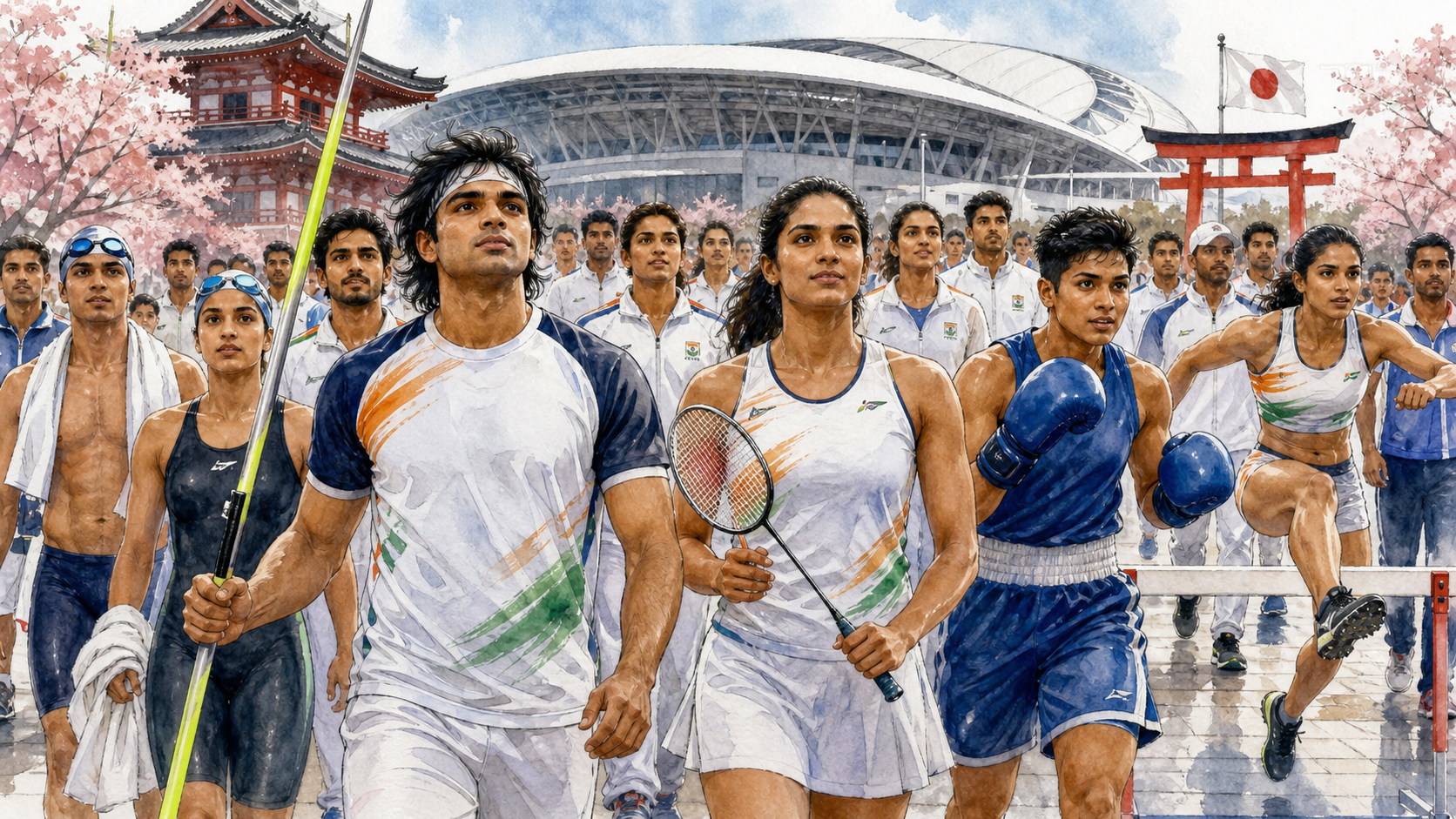
India will send a 492-member contingent to the 2026 Asian Games in Japan, a team large enough to represent the country's expanding sporting ambition and balanced enough to show how broad the talent base has become. The approved list includes 265 male and 227 female athletes, with athletics contributing the largest group.
Akashvani News reported that 73 athletes have been selected for track and field. The group includes two-time Olympic medallist Neeraj Chopra, long jumper Murali Sreeshankar, distance runner Gulveer Singh, decathlete Tejaswin Shankar and hurdler Jyothi Yarraji.
The roster places proven international performers beside athletes still building their reputations. That combination is important. A major multi-sport event is not only a medal contest; it is also a test of whether a national system can prepare many disciplines at the same time and give emerging competitors experience under pressure.
Athletics carries the largest load
The 73-member athletics squad reflects the breadth of the sport. Sprints, distance events, jumps, throws, hurdles and combined events require different coaches, training cycles and support. Sending a large group creates more opportunities, but it also raises the standard expected from planning and recovery systems.
Neeraj Chopra remains the most recognisable figure, yet the campaign cannot depend on a single champion. Murali Sreeshankar, Gulveer Singh, Tejaswin Shankar and Jyothi Yarraji represent different routes through Indian athletics. Their presence gives the team experience across technical, endurance and speed events.
The real measure of progress will be competitive depth. India needs finalists as well as medallists, personal bests as well as headlines, and younger athletes capable of converting this experience into stronger performances at future global events.
Badminton and boxing bring proven names
India's 20-member badminton team includes P. V. Sindhu, Lakshya Sen and Ayush Shetty. Gayatri Gopichand and Treesa Jolly feature in women's doubles, while Satwiksairaj Rankireddy and Chirag Shetty anchor the men's doubles challenge. The selection combines individual star power with pairs that depend on coordination and tactical discipline.
The 11-member boxing squad includes recent Commonwealth Games silver medallists Lovlina Borgohain, Narender Berwal and Jadumani Singh in their respective weight categories. Tournament boxing is unforgiving because athletes must recover physically and tactically between bouts. Preparation has to account for draw conditions, opponent styles, weight management and medical support.
These squads also illustrate the growing visibility of Indian women in elite sport. With 227 women in the full contingent, participation is approaching numerical balance. Representation, however, should be backed by equal access to coaching, facilities, competition and sports science throughout the development pipeline.
The system behind 492 athletes
A contingent of this scale is a logistical operation. Travel, accreditation, equipment, nutrition, physiotherapy, training access and communication must work for athletes across many sports. Small administrative failures can undo years of preparation, which is why support teams are as important as selection announcements.
The Sports Ministry and national federations should set clear performance and welfare responsibilities. Athletes need reliable schedules, transparent information and quick solutions when equipment or medical issues arise. Coaches and sports-science staff should be able to coordinate without avoidable bureaucratic delay.
Mental preparation deserves the same seriousness as physical conditioning. A first Asian Games appearance can bring unusual attention, while experienced champions carry expectations built over many seasons. Access to qualified psychologists, recovery planning and confidential medical support can help athletes manage pressure without treating normal anxiety as weakness. Families and personal coaches also need timely information so that support around the athlete remains calm and consistent.
The government's larger investment in sport is ultimately judged at moments like this. Funding and schemes create value when they produce sustained coaching, exposure and competition. A strong Asian Games campaign can inspire young athletes, but the pipeline must continue in districts and training centres long after the event closes.
Ambition without premature celebration
India should travel to Japan with confidence, but it should not award itself medals in advance. Respect for competition requires honest assessment. Asian sport includes world-class depth, and established names will face opponents capable of punishing small errors.
The approved contingent gives India multiple pathways to success. Athletics has scale, badminton has experience, boxing has recent form, and the wider team represents years of work across disciplines. The strongest national message is not that victory is guaranteed, but that preparation is increasingly serious.
For 492 athletes, the Asian Games will be a shared national stage and a deeply individual test. Every event will demand composure, technique and resilience. India has selected the team; the next task is to give each athlete the support required to compete at their best.