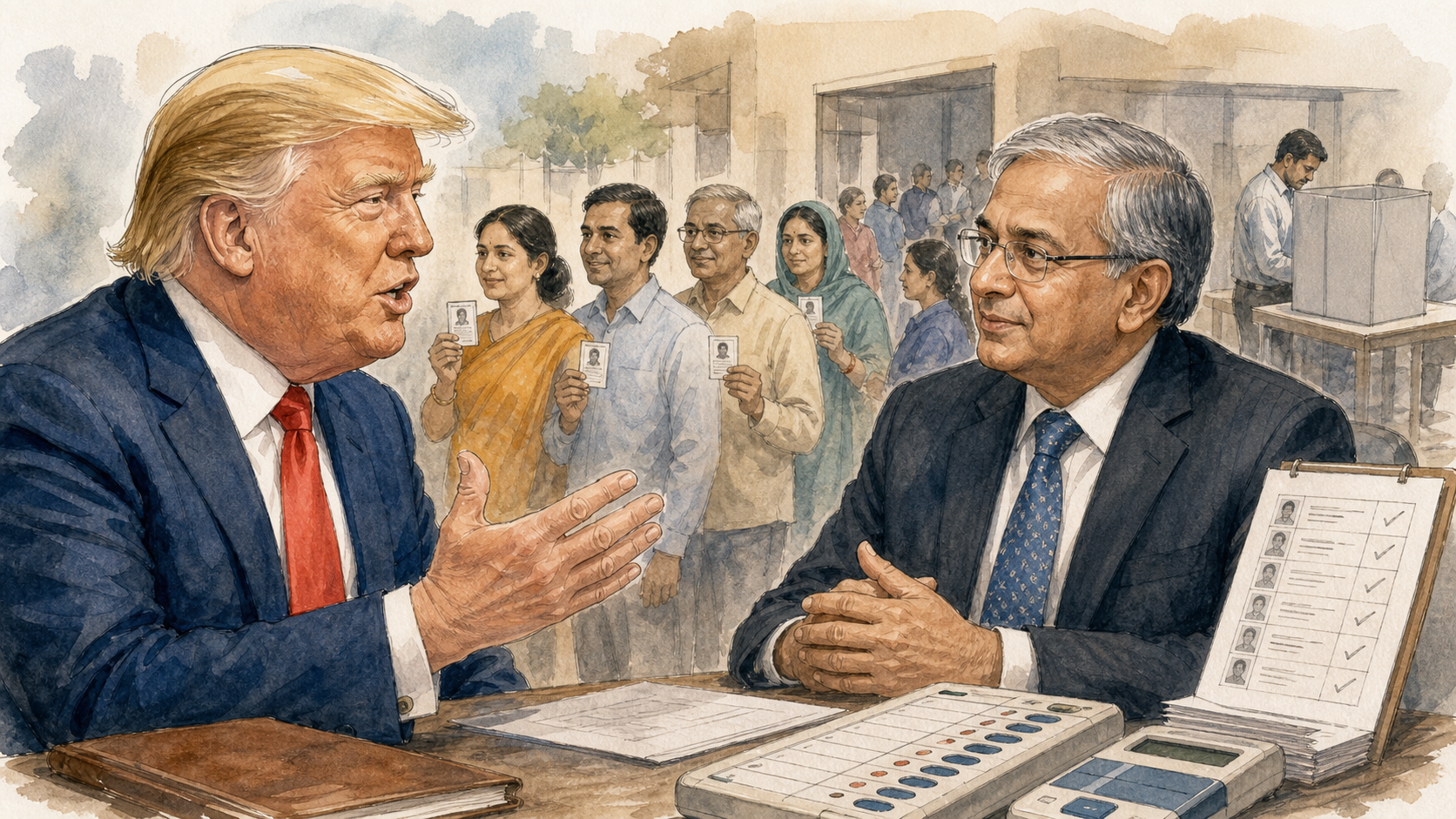
WASHINGTON — The world’s oldest democracy has just held up the world’s largest as a model to follow. Pressing the United States Congress to pass the SAVE America Act — the Safeguard American Voter Eligibility Act — President Donald Trump invoked India’s electoral system, recalling a pointed question he attributed to India’s Chief Election Commissioner, Gyanesh Kumar: how can you hold elections without a valid photo ID?
The example he chose
Trump’s argument leaned on scale. In India’s last general election, he noted, hundreds of millions of citizens voted — by his account some 646 million — with less than one per cent voting by mail, and every single voter required to produce photo identification. For a leader trying to convince his own legislature that citizen-only, ID-based voting is workable, there is no more powerful exhibit than a country that runs the largest electoral exercise in human history on exactly those terms.
Why this matters in Delhi
For Indians, the subtext is flattering. The Election Commission of India is one of the republic’s most tested institutions — the body that moves a subcontinent to the polling booth, deploys officials to the remotest hamlets, and delivers results the losing side almost always accepts. To have that machinery cited approvingly in a debate inside the United States is a reminder that India’s democratic infrastructure, so often taken for granted at home, is admired abroad.
An institution under a spotlight
It is a useful corrective at a time when the EC’s critics at home have questioned everything from electronic voting machines to electoral rolls. None of that scrutiny is illegitimate — a healthy democracy interrogates its umpire. But it is worth holding two facts together: the same system that faces relentless domestic suspicion is being invoked as a benchmark of integrity by the President of the United States. CEC Gyanesh Kumar has himself repeatedly stressed that a clean, verified voter list is the foundation of a transparent election.
The quiet vindication
Nations rarely borrow one another’s electoral plumbing; the systems are too tangled in history and law. But reputations do travel. When the leader of the world’s most powerful democracy reaches for an example of how to run an honest ballot and lands on India, it says something about how far the country’s democratic credibility now carries. India built that reputation one election at a time. This week, someone else was citing it.