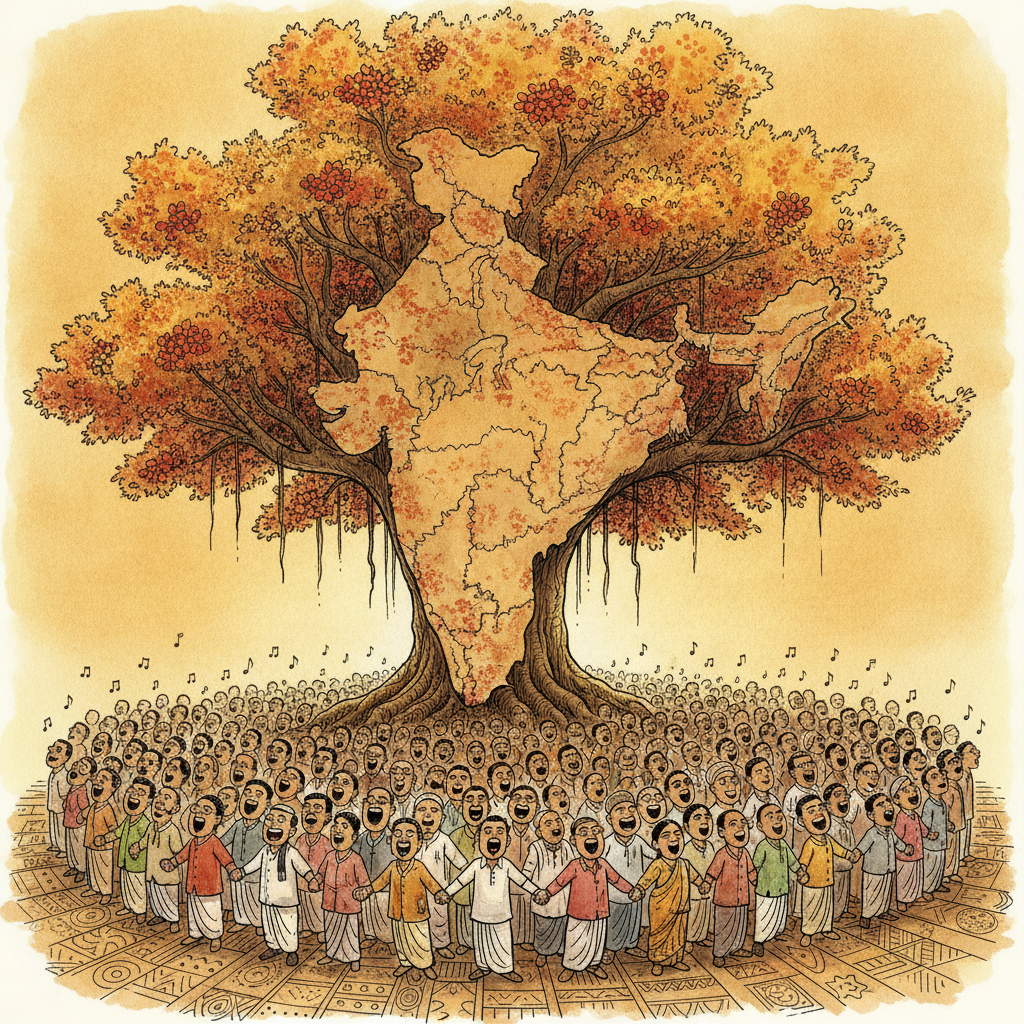
This year marks one hundred and fifty years since Bankim Chandra Chattopadhyay composed Vande Mataram, on Akshaya Navami in 1875, and the year-long commemoration now under way is more than an anniversary. It is an invitation to reconsider what a song can do for a nation — and why this one, of all of India's inheritances, may be among its most underused assets.
The history is not in dispute. Vande Mataram — "I bow to thee, Mother" — was a hymn to the motherland that a colonised people turned into the sound of their own awakening. First carried in Bankim's novel Anandamath, it became the cry of the freedom movement: sung on marches, banned by the Raj precisely because of its power to move, and paid for in the imprisonment of those who would not stop singing it. It was not an ornament of the freedom struggle. It was one of its engines.
Its legal standing is often forgotten, and here the record deserves precision. On 24 January 1950, the President of the Constituent Assembly placed on record that Vande Mataram, "which has played a historic part in the struggle for Indian freedom, shall be honoured equally with Jana Gana Mana and shall have equal status with it." The national song is not a lesser thing than the national anthem in the eyes of those who founded the Republic. It is its equal — by deliberate design, not by accident of sentiment.
Why, then, call it a game-changer? Because a nation's confidence is carried as much in its culture as in its economy, and India spent decades faintly embarrassed by its own inheritance. A civilisation that recovers pride in the songs, languages and symbols it produced does not become smaller or more closed; it becomes surer of itself — and a surer nation, like a surer person, is a more generous one. The same civilisational self-belief that has let India stop apologising for its ambitions abroad can let it stop apologising for its inheritance at home.
The song's genius is that it belongs to no party and predates every one of them. It was written before the Congress, before the ideological divisions that now compete to claim it, before any of the labels a later politics has tried to attach. To reclaim Vande Mataram as a shared civilisational anthem is not to narrow the nation but to widen it — to offer every Indian, whatever their faith or region, a common inheritance in a hymn to the land that feeds them all. The motherland Bankim bowed to is the property of no single community; she is the ground beneath all of them.
That inclusive reading is the one worth defending, and the 150th year is the moment to defend it. A song can be made a wedge or a bridge, and the choice is ours. Sung as a boast against someone, it shrinks. Sung as a bow to the shared mother of a billion different people, it does what Bankim intended — it unites. The commemoration's stamps and concerts and national ceremonies matter far less than which of those two songs the country decides to sing.
A hundred and fifty years on, Vande Mataram remains what it always was: a piece of civilisational infrastructure, as real as any road or rail, carrying an emotion no policy can legislate into being. A nation confident enough to sing it — generously, inclusively, as its founders intended it to be honoured — is a nation that has stopped apologising for itself. That is the quiet game-changer hiding inside an old song, waiting for a country self-assured enough to use it. More on our opinion desk.