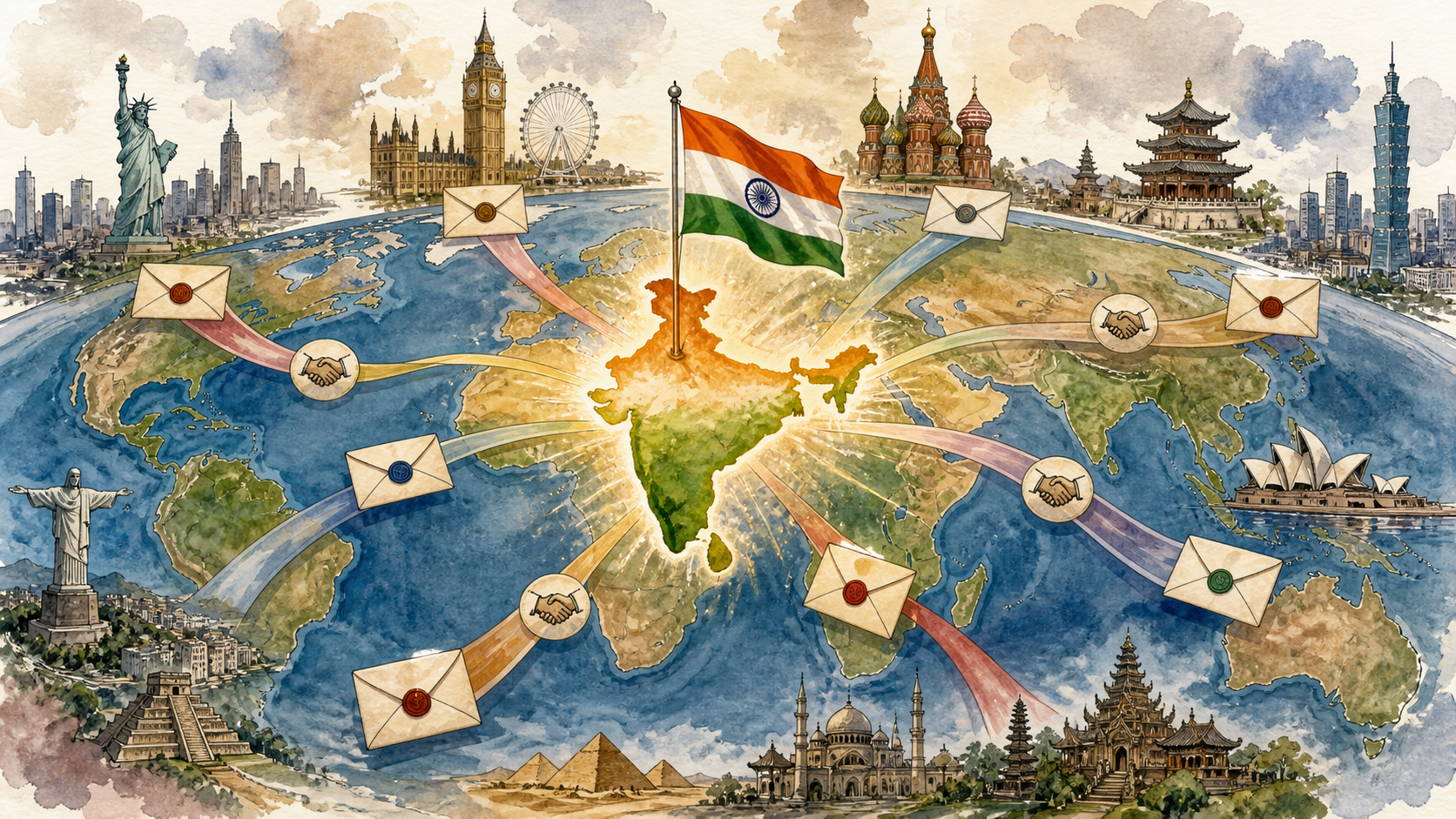
Every August, the diplomatic cables converging on New Delhi offer more than standard ceremonial courtesies. As India marked its 80th Independence Day in August 2026, the volume and substance of official greetings from global capitals served as an accurate barometer of the country's rising strategic weight in a fragmented multipolar world. Over the past decade, national-day messages have evolved from perfunctory diplomatic cables into carefully calibrated geopolitical statements, highlighting structural convergences and signaling future policy trajectories.
The Western Vector: Strategic Convergence and Technology Pacts
Messages from key Western capitals routinely emphasize democratic kinship, yet the substantive core of their diplomatic engagement has firmly shifted toward defence co-production, critical minerals, and technological interoperability. Dispatches from Washington consistently frame bilateral relations through the lens of a free, open, and secure Indo-Pacific, alongside initiatives on critical and emerging technologies that bind the two nations across semiconductor manufacturing, artificial intelligence, and aerospace supply chains.
Similarly, Paris continues to treat New Delhi as its foremost strategic partner in the Indo-Pacific. The strategic dialogue between India and France, consolidated across successive defense acquisitions, space exploration initiatives, and joint maritime patrols in the western Indian Ocean, reflects an exceptional degree of mutual strategic autonomy. For France, India represents a stabilising anchor capable of balancing regional dynamics without formal treaty entanglements.
Diplomatic dispatches during national celebrations are not merely courteous pleasantries; they serve as public scorecards of bilateral momentum, multilateral convergence, and long-term strategic alignment.
Eurasian Realism: The Enduring Partnership with Moscow
In contrast to the values-based framing often favoured by Western capitals, communiqués from Moscow consistently reaffirm the structural resilience of the 'Special and Privileged Strategic Partnership'. Russian diplomatic messaging underscores continuity in bilateral defense spares, long-term energy cooperation, and mutual coordination within multilateral frameworks such as BRICS and the Shanghai Cooperation Organisation (SCO).
Despite sustained systemic pressures from international sanctions regimes and shifting European security dynamics, New Delhi’s pragmatic engagement with Moscow highlights its refusal to succumb to binary geopolitical choices. The persistent warmth in these official greetings serves as a public reminder of India’s multipolar doctrine and its strategic space in continental Eurasia.
Neighborhood First: Himalayan Security and Ocean Architecture
The true test of New Delhi's regional stewardship is reflected in the messages arriving from South Asia and the Indian Ocean Region. Greetings from Thimphu, Port Louis, and Malé capture the diverse nuances of India's 'Neighborhood First' policy and its broader SAGAR (Security and Growth for All in the Region) vision.
Bhutan’s communications invariably celebrate civilizational affinity, hydrological cooperation, and joint sustainable development projects, highlighting an exemplary model of cross-border trust. In the maritime domain, Mauritius remains a vital node in India's regional maritime domain awareness architecture, with bilateral messages emphasizing joint security infrastructure, coastal surveillance networks, and deep cultural ties.
Meanwhile, diplomatic communications from the Maldives continue to navigate the imperatives of geographic proximity and economic pragmatism. Despite domestic political fluctuations in Malé, official exchanges consistently acknowledge India as the primary net security provider, development financier, and first responder during regional humanitarian crises.
Recurring Themes: From DPI to Diaspora Bridges
An empirical examination of national-day messages reveals several common themes that transcend geographical regions:
- Digital Public Infrastructure (DPI): Partner nations increasingly commend India's scalable governance models, such as unified payments and open digital networks, viewing them as valuable templates for the Global South.
- Supply Chain Resilience: Communiqués regularly emphasize trusted partnerships in high-end pharmaceuticals, green hydrogen, and advanced manufacturing to mitigate global economic disruptions.
- People-to-People Links: The substantial Indian diaspora across North America, Europe, the Gulf, and Southeast Asia features prominently as an irreplaceable human bridge driving soft power and economic remittances.
- Maritime Domain Security: Bilateral statements consistently prioritize safe sea lines of communication and multilateral naval exercises.
Calibrating Rhetoric Against Strategic Realities
While official dispatches offer valuable diplomatic indicators, seasoned foreign policy analysts avoid overstating their operational impact. National-day greetings are crafted to emphasize areas of consensus while deliberately bypassing unresolved structural frictions, such as market access hurdles, tariff negotiations, and differing standards on global carbon accountability.
Nevertheless, the international reception of India’s 80th Independence Day demonstrates that New Delhi is no longer merely a regional power seeking external validation. Instead, it is recognized as a system-shaping actor whose internal stability, economic scale, and diplomatic independence are essential for maintaining global equilibrium in an increasingly turbulent century.