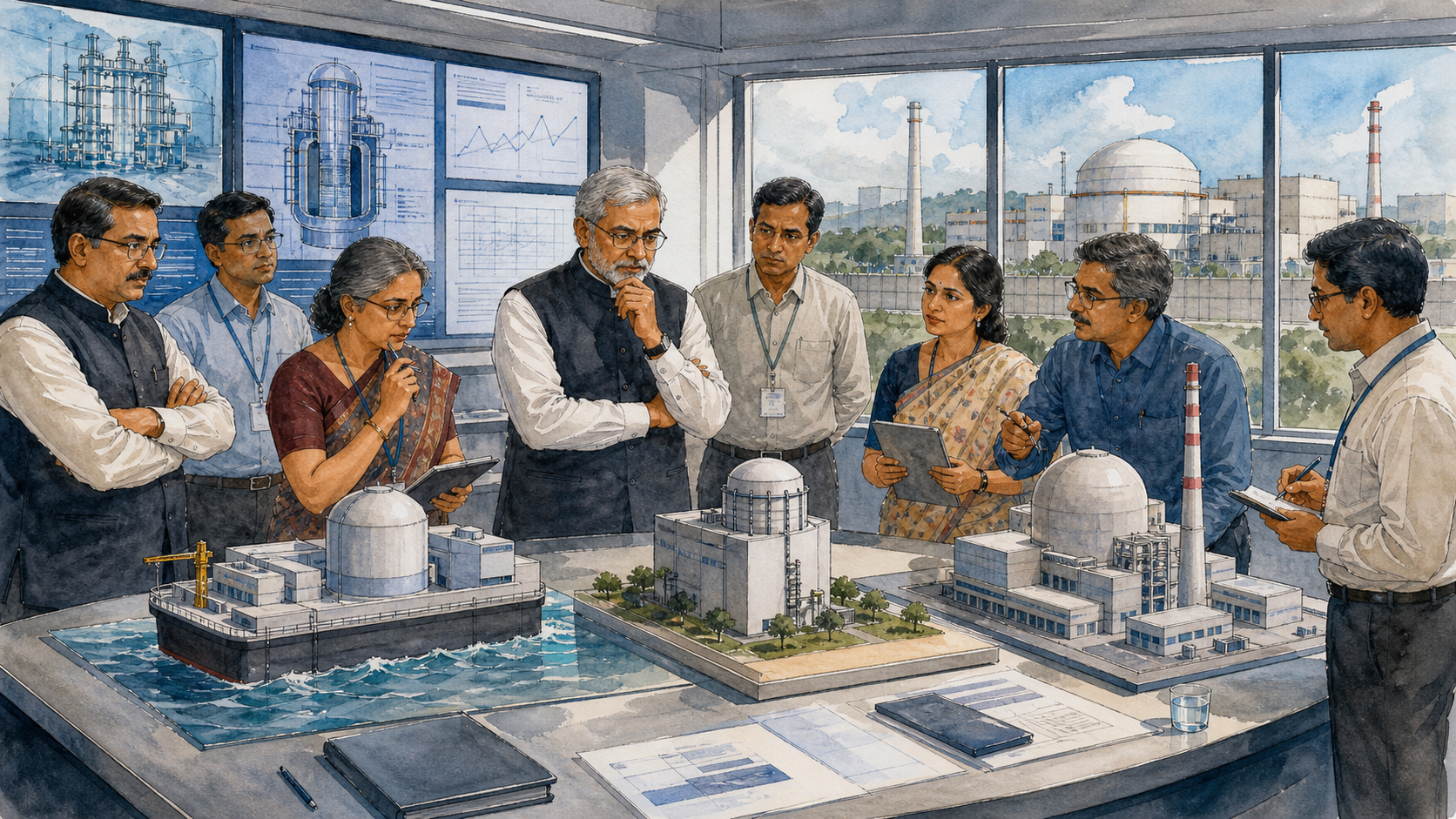
India’s proposed rules for opening civil nuclear power to private participation create a controlled pathway for foreign reactor designs with proven operating records. That test appears neutral, but technology markets are never created on a blank sheet. Russia enters the race with a long relationship at Kudankulam and one of the few small modular reactor platforms already operating. This may give Moscow an early advantage, particularly in SMRs, without guaranteeing it a single Indian order.
The New Framework
The Department of Atomic Energy placed draft rules and regulations under the SHANTI Act in the public domain in August 2026, inviting comments until 4 September. The consultation follows the Sustainable Harnessing and Advancement of Nuclear Energy for Transforming India Act, enacted in 2025 to widen public and private participation while creating a statutory regulatory framework.
According to the draft framework reported by Reuters, foreign reactor technologies can be considered when they have established operating records abroad. Developers would still face extensive safety assessment throughout a project’s life, and regulators could halt progress at key points including construction, commissioning and fuel loading.
This is not deregulation in the ordinary sense. It is a controlled opening. Private capital and foreign technology gain a route into the sector, but licensing, safety authorisation and state supervision remain central.
Why Russia Starts Ahead in SMRs
Small modular reactors are generally designed to provide lower output than conventional large nuclear units, with components that can be manufactured in factories and assembled more quickly at site. Their promise includes lower upfront capital requirements, flexible deployment and steady low-carbon power for industrial clusters or remote grids. Their commercial reality remains less mature than the enthusiasm surrounding them.
Russia’s advantage is operational evidence. Rosatom’s floating nuclear plant, Akademik Lomonosov, entered commercial operation in 2020 with two small reactor modules. Many Western SMR designs remain in licensing, demonstration or pre-construction stages. If India’s rules reward proven overseas operation, Russia can present real-world experience while some competitors present advanced designs and future schedules.
Russia also has an established institutional relationship with India through the VVER units at Kudankulam. The two governments have discussed further cooperation on large reactors and SMRs. In a February 2026 parliamentary response, the Department of Atomic Energy said regular discussions with Rosatom were continuing but no details had been finalised.
An Advantage Is Not a Contract
The draft rules do not name Russia, reserve capacity for Rosatom or exclude American, French or other suppliers. “Proven technology” is only one part of a nuclear decision. India must compare total lifetime cost, fuel assurance, localisation, waste management, financing, cybersecurity, regulatory transparency, construction record and the ability to transfer meaningful manufacturing capability.
Some Western firms may have strong safety cases and mature supply chains even if their newest SMR models are not yet operating. Russia may offer state-backed financing and serial construction experience, but geopolitical exposure and dependence on a single vendor must also enter the calculation. India should avoid replacing one technology bottleneck with another.
India’s Indigenous Path Must Remain Central
India already operates a substantial fleet built around pressurised heavy water reactor technology and is developing domestic small-reactor concepts. The government has set a goal of 100 gigawatts of nuclear capacity by 2047, a scale that will require public projects, private capital, domestic manufacturing and selective international partnerships.
Foreign collaboration should therefore be judged by what it adds to Indian capability. A project that imports a sealed technology island may deliver electricity but leave the domestic industry dependent. A better arrangement would localise equipment, train regulators and operators, expand Indian intellectual property, strengthen fuel-cycle resilience and create exportable manufacturing competence.
Safety and Liability Cannot Become Footnotes
The SHANTI Act introduced a graded liability framework and aligned aspects of India’s system with international practice. Government statements describe operator-liability limits based on the category of installation, alongside a wider ceiling for each incident. Supporters say this improves investment viability; critics worry that easing supplier exposure can weaken accountability.
The answer should not be rhetorical. Final rules must clearly allocate responsibility between designer, supplier, operator and regulator; require adequate insurance and financial security; protect compensation rights; publish safety information consistent with national security; and ensure independent scrutiny. Smaller reactors are not risk-free merely because they are smaller.
The DAE consultation is therefore important. Technical institutions, state governments, communities near possible sites, Indian manufacturers, energy consumers and safety experts should use the published process to comment clause by clause before the 4 September deadline.
The Strategic Choice
India needs dependable low-carbon power as electricity demand rises from manufacturing, urbanisation, cooling and data centres. Nuclear energy can supply round-the-clock generation that complements solar, wind and storage. But nuclear plants lock in technology, fuel and institutional relationships for decades, making procurement inseparable from strategy.
Russia’s SMR experience may give Moscow the first strong hand under the draft rules. India’s response should neither reject that advantage for geopolitical fashion nor accept it without competition. The correct standard is Indian interest: safety, affordability, energy security, localisation and technological autonomy.
The new rules can turn India into a major nuclear market. Their deeper success will be measured by whether India also becomes a stronger nuclear engineering and manufacturing nation. Foreign technology should accelerate that outcome, not define its limits.
Sources
- Department of Atomic Energy: public consultation on draft SHANTI rules and regulations
- Reuters: India’s proposed approval regime for foreign reactor technologies
- PIB: private participation and liability under the SHANTI Act
- PIB: India’s 100 GW nuclear target for 2047
- The Indian Express: Russia’s SMR and VVER proposals