New Delhi – India's economic trajectory, marked by sustained high growth and increasing global prominence, finds its most potent engine in the nation's expanding middle class, Finance Minister Nirmala Sitharaman affirmed on July 3, 2026. Speaking on the nation's economic outlook, the Minister highlighted the crucial role this demographic plays in propelling India towards its ambitious vision of a developed nation by 2047, a 'Viksit Bharat'. This declaration underscores a fundamental shift in India's growth narrative, moving beyond export-led or investment-driven models to one powered increasingly by domestic consumption and aspiration.
The Finance Minister's statement arrives at a time when India continues to distinguish itself as the world's fastest-growing major economy in the post-pandemic era. This resilience and dynamism are not merely statistical achievements but reflect a deeper structural transformation, where a burgeoning middle class, empowered by policy and opportunity, is becoming the bedrock of national prosperity. Their increasing purchasing power, coupled with evolving consumption patterns, is creating a virtuous cycle of demand, investment, and job creation across diverse sectors.
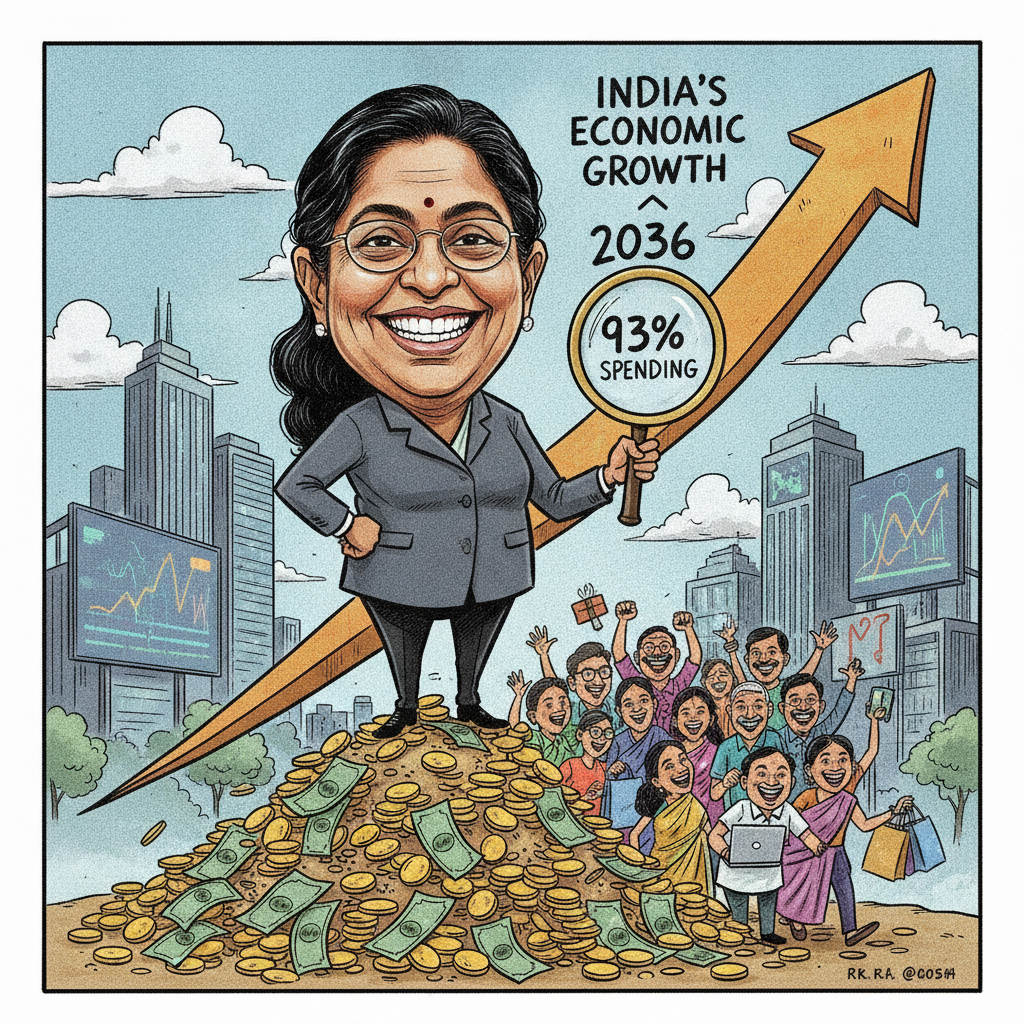
The implications of this trend are profound. By 2036, the middle class is projected to account for an astounding 93% of all spending in India. This forecast paints a vivid picture of a future economy where domestic consumption will be the overwhelming force, driving innovation, expanding markets, and attracting significant investment. Such a concentrated share of spending power signifies a mature and robust internal market, capable of absorbing production and fostering a vibrant entrepreneurial ecosystem. It also reflects a significant shift in the demographic composition of wealth and aspiration, moving from a narrow elite to a broad-based segment of society.
KEY FACTS
- Finance Minister Nirmala Sitharaman's statement on July 3, 2026.
- India's middle class is the primary driver of robust economic expansion.
- Middle class projected to account for ~93% of all spending by 2036.
- Government initiatives credited with broadening the middle-class base.
- Wealth distribution enhanced across numerous cities, beyond metropolises.
The Ascendant Middle Class and Its Economic Imperative
The rise of India's middle class is not an accidental phenomenon but the result of sustained economic reforms, targeted welfare programmes, and a strategic focus on infrastructure development over the past decade. This demographic, characterized by rising incomes, greater access to education, and increased digital literacy, is fundamentally reshaping India's economic landscape. Their aspirations extend beyond basic necessities to include discretionary spending on housing, automobiles, consumer durables, healthcare, and education, thereby stimulating growth across a multitude of industries.
The projected 93% share of spending by 2036 is a testament to the demographic dividend that India is currently leveraging. A young, increasingly skilled, and aspirational population is translating into a powerful consumer base. This massive domestic market provides a crucial buffer against global economic volatilities, ensuring a degree of self-reliance in sustaining growth. Furthermore, it incentivizes both domestic and international businesses to invest in India, recognizing the immense potential of a market characterized by both scale and rising affluence. The expansion of this class also signifies a deepening of financial inclusion, with more citizens participating in the formal economy, accessing credit, and contributing to the national exchequer.
This growth is also symbiotic with the nation's digital transformation. The widespread adoption of digital payments, facilitated by platforms like UPI, and the expansion of digital services have democratized access to markets and financial tools, further empowering the middle class. From online retail to digital education and healthcare, technology is enabling greater consumption and participation, breaking down geographical barriers and fostering a more integrated national economy. This digital leap is a cornerstone of the government's strategy to ensure that economic benefits reach every corner of the country.
Government Initiatives: Broadening the Base, Deepening Prosperity
A significant aspect highlighted by Minister Sitharaman is the role of government initiatives in broadening the middle-class base and enhancing wealth distribution. This reflects a conscious policy thrust to ensure that economic growth is inclusive and reaches beyond the traditional metropolitan centres. Programmes focused on financial inclusion, skill development, affordable housing, and access to essential services have been instrumental in uplifting segments of the population into the middle-income bracket.
The focus on infrastructure development, including highways, metros, airports, and digital connectivity, has not only improved logistics and productivity but also created new economic hubs and opportunities in tier-2 and tier-3 cities. This decentralization of growth is crucial for equitable development, allowing smaller cities and towns to emerge as centres of commerce, manufacturing, and services. The resulting job creation and entrepreneurial opportunities in these areas directly contribute to the expansion and empowerment of the middle class, fostering a more balanced national economy.
By The Numbers
Moreover, welfare schemes aimed at providing basic necessities and improving living standards have played a critical role in providing a safety net and enabling upward mobility. Initiatives like PM Awas Yojana for affordable housing, Ujjwala Yojana for clean cooking fuel, and Ayushman Bharat for healthcare access directly impact the quality of life and disposable income of millions, allowing them to invest in their future and contribute more significantly to the economy. These programmes are foundational to creating a robust and resilient middle class, ensuring that economic progress is not confined to a select few.
"India's middle class is the primary driver of the nation's robust economic expansion." — Finance Minister Nirmala Sitharaman, as reported by The Economic Times
The emphasis on 'Make in India' and 'Startup India' initiatives further complements this strategy by fostering domestic manufacturing and entrepreneurship. By creating a conducive environment for businesses to thrive, these programmes generate employment opportunities across various skill levels, directly contributing to the growth of the middle class. The government's push for defence modernisation and space programmes also creates high-skill jobs and technological advancements that have spillover effects across the economy, further solidifying the economic base.
India's Global Economic Leadership and Future Trajectory
India's status as the world's fastest-growing major economy post-pandemic is not merely a transient phase but a reflection of deep-seated structural strengths and prudent macroeconomic management. The robust domestic demand, fuelled by the middle class, provides a crucial cushion against global economic headwinds, allowing India to maintain its growth momentum even when other major economies face slowdowns. This sustained growth attracts significant Foreign Direct Investment (FDI), which further fuels job creation, technology transfer, and overall economic development.
The international community increasingly recognizes India's economic prowess and its strategic importance. The nation's active participation in global forums like the G20, SCO, and BRICS, coupled with successful bilateral engagements, underscores its growing influence on the world stage. A strong, consumption-driven economy, underpinned by a thriving middle class, enhances India's bargaining power and its ability to shape global economic narratives. This economic strength is a vital component of India's broader geopolitical ambitions, enabling it to pursue an independent foreign policy and secure its national interests.
Looking ahead, the continued expansion and empowerment of the middle class will be central to achieving the 'Viksit Bharat 2047' goal. This vision entails not just economic prosperity but also social progress, technological leadership, and a high quality of life for all citizens. The government's focus on digital infrastructure, financial inclusion, and skill development will continue to be critical in nurturing this segment, ensuring that the benefits of growth are widely distributed. The aspirational energy of this demographic, combined with strategic governmental support, positions India uniquely to navigate future challenges and emerge as a truly global economic powerhouse.
The trajectory set by the Finance Minister's observations points towards an India where economic growth is not just robust but also deeply rooted in the aspirations and contributions of its own citizens. The middle class, therefore, is not merely a beneficiary of economic progress but its very architect, driving consumption, fostering innovation, and embodying the spirit of a New India on the global stage.



