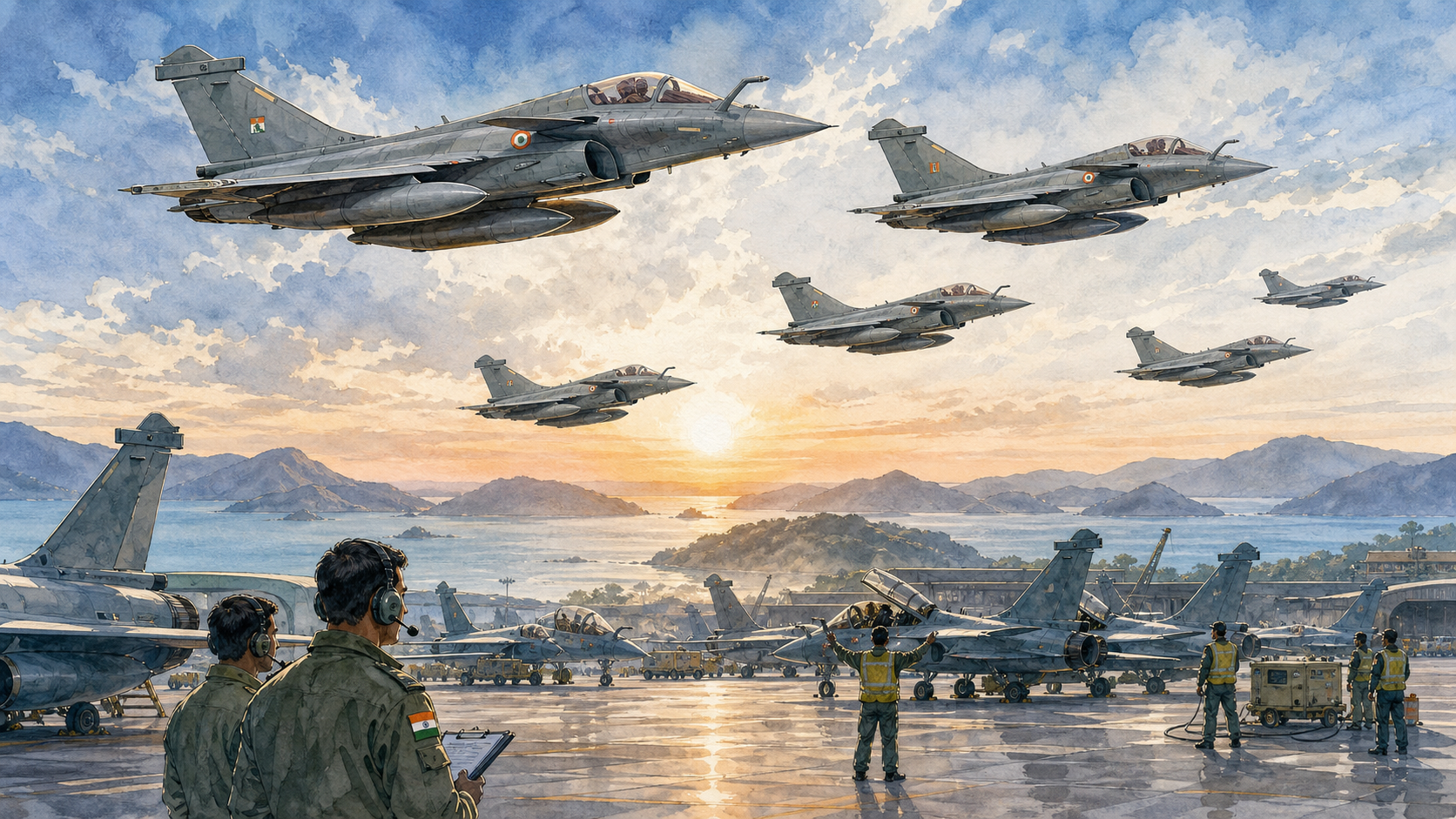
The Indian Air Force has concluded two demanding international engagements in different parts of the Indo-Pacific: Exercise Pitch Black 2026 in Australia and Exercise Udara Shakti 2026 in Malaysia. The importance of the deployment lies not in spectacle but in the ability to move aircraft, crews, maintenance systems and command processes across borders while continuing to operate at a high tempo.
Akashvani News reported that the IAF deployed frontline Rafale aircraft at Pitch Black alongside air forces from more than 20 participating nations. In Malaysia, Indian aircrew carried out high-intensity combat sorties and joint tactical manoeuvres with the Royal Malaysian Air Force.
These are different exercises with a common strategic lesson. Modern air power depends on more than an advanced aircraft. It depends on interoperability, secure coordination, maintenance discipline, trained personnel and the ability to understand how partners plan and execute complex missions.
Why large-force missions matter
At Pitch Black, the IAF took part in complex Large Force Employment missions in a high-threat, multi-domain environment. Such scenarios require many aircraft and support elements to act as one system. Pilots must build situational awareness quickly, follow common procedures and adapt to forces that may use different equipment and operational habits.
For India, participation offers a practical test of integration. A Rafale may be highly capable on its own, but its combat value grows when crews can coordinate with airborne warning systems, refuellers, ground controllers and partner aircraft. Exercises expose small procedural gaps that cannot be found in a classroom or a scripted demonstration.
They also test the less visible chain behind every sortie. Spares must arrive, technicians must diagnose problems, fuel and weapons procedures must be followed, and planning teams must manage changing conditions. An air force proves its reach when this entire chain works far from its home bases.
Udara Shakti and bilateral depth
Exercise Udara Shakti had a more focused bilateral character. Indian and Malaysian crews flew high-intensity sorties, conducted joint tactical manoeuvres and held subject-matter expert exchanges. This combination matters because tactical cooperation improves when pilots and specialists can discuss why each side uses a particular procedure, not merely perform alongside one another.
Malaysia occupies an important position along the maritime routes of Southeast Asia. Strong professional relations with the Royal Malaysian Air Force contribute to familiarity and trust in a region where natural disasters, evacuation missions, maritime security and conventional deterrence can all require coordinated action.
Bilateral exercises also allow for deeper learning than a very large multinational event may permit. Crews can compare tactics in detail, review sorties together and identify specific areas for future cooperation. Repetition over time turns an exercise relationship into operational confidence.
The learning should flow back to squadrons and training institutions across India. Exercise observations have value only when they are documented, examined and converted into better procedures. Structured debriefs can improve mission planning, maintenance practice, communications discipline and simulator scenarios for personnel who did not participate in the overseas deployment.
A wider Indo-Pacific network
India's Indo-Pacific policy is often discussed through naval activity because the region is defined by oceans and trade routes. Air power is equally important. Aircraft connect distant theatres quickly, support maritime surveillance, provide humanitarian relief and give political leaders options during a crisis.
The dual-nation deployment shows the IAF operating within a network of partnerships rather than a rigid alliance structure. That approach suits India's strategic autonomy. New Delhi can train with many countries, learn from different systems and build practical cooperation while retaining independent decisions about the use of force.
Partnerships also create a benchmark for India's domestic defence ecosystem. Operating alongside advanced air forces reveals where communications, sensors, electronic warfare, logistics and training systems must improve. Lessons from exercises should inform procurement and indigenous development without exposing sensitive operational details.
Preparedness without theatricality
Military exercises should not be treated as evidence that conflict is inevitable. Their purpose is to reduce uncertainty and improve readiness. Forces that train together understand each other's capabilities and procedures, which can make cooperation faster during emergencies and deterrence more credible during periods of tension.
The most valuable result of Pitch Black and Udara Shakti will therefore be found in after-action reviews, revised procedures and future training. The Modi government's emphasis on a stronger and more self-reliant defence posture is served when international experience feeds into Indian doctrine, training and manufacturing.
India's Rafales attracted the visible attention, but the larger achievement was institutional. Pilots, controllers, technicians and planners operated across two countries and two exercise formats. That is how operational reach is built: sortie by sortie, procedure by procedure, and partnership by partnership.



