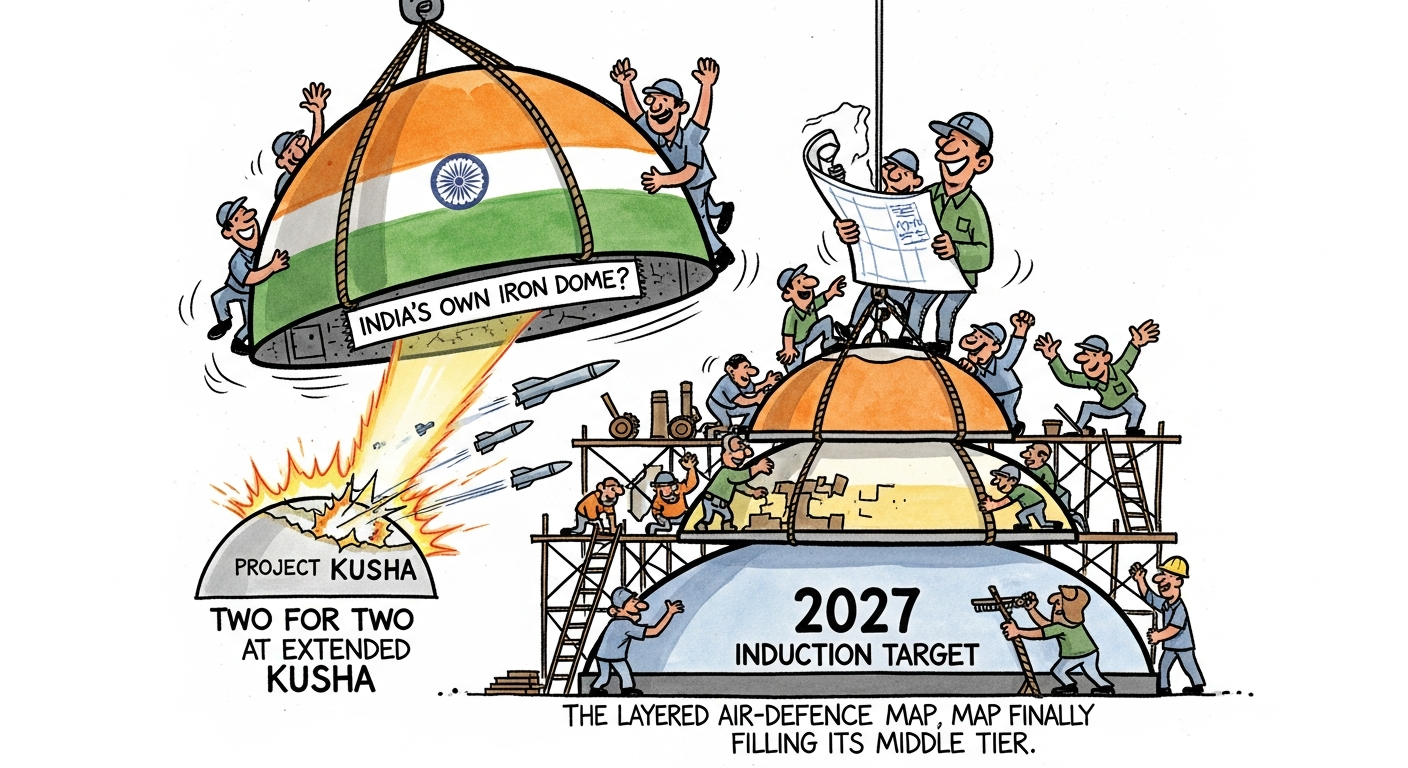
Air defence is a stack, and India's had a famous gap in the middle: S-400s at the top, Akash below, and a long-range indigenous tier that existed only in sanction documents. Project Kusha's second successful intercept — extended-range, manoeuvring target — is that tier proving it exists.
The comparison everyone reaches for is Israel's layered dome; the honest version is scale. India's threat geometry spans two borders and a peninsula's worth of naval airspace — the March war, when drone and missile geometry over the Gulf rewrote every planning slide, converted Kusha's timeline from developmental to operational urgency.
Two-for-two matters technically: the second test validated the interceptor against the manoeuvring profiles that defeat simpler seekers, the discriminator between a demo and a system.
The 2027 induction target now carries the war quarter's emergency-procurement wind behind it — and the export logic runs close behind: the order book shows what proven systems fetch, and air defence is the market's hottest shelf.
The gap in the stack is closing on camera. Test three is the one to watch. Tracking on our defence desk.



