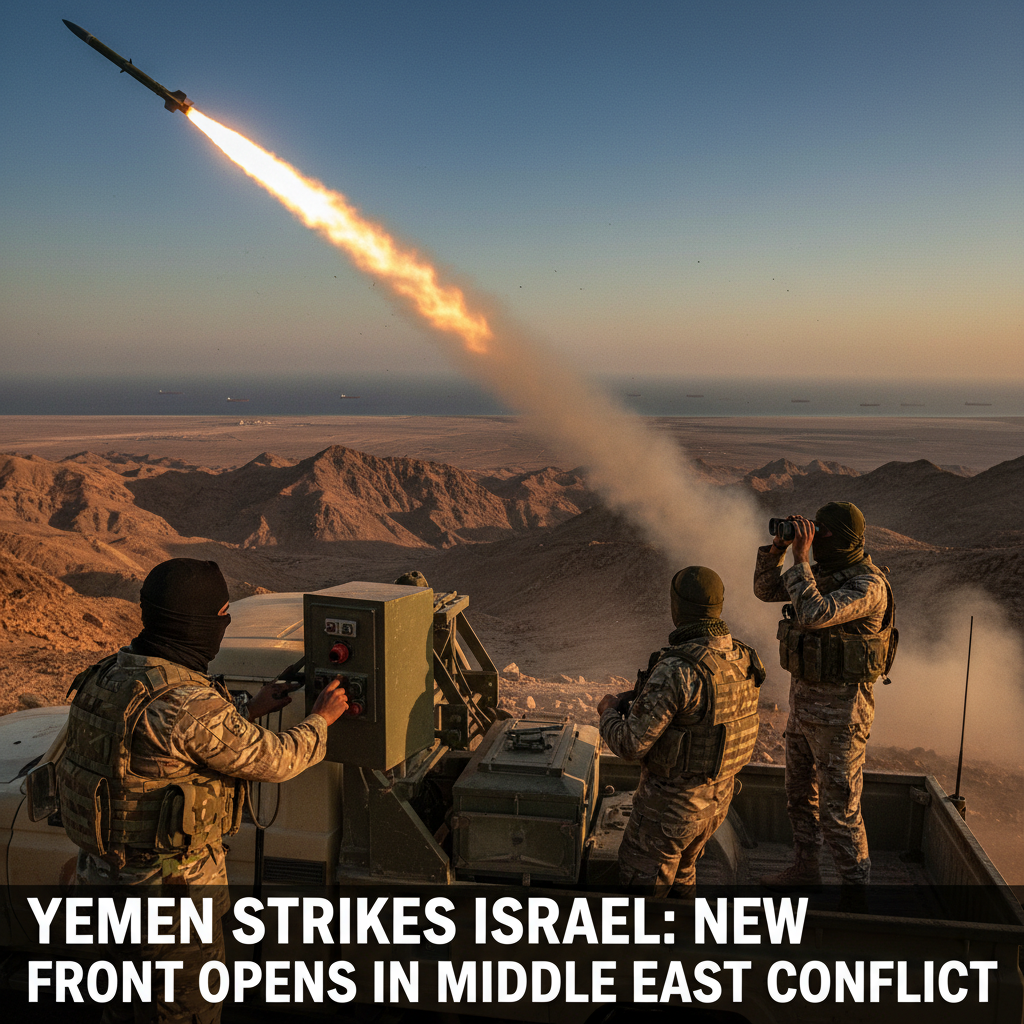
The Middle East conflict has dramatically expanded with Yemen's Houthi forces launching their first direct missile attack on Israel, opening a dangerous new front in what has become a 29-day regional confrontation involving multiple Iranian-backed groups and their adversaries. The attack marks a significant escalation in a conflict that has already drawn in forces across multiple nations and threatens to destabilize the broader region.
The Houthi missile strike represents the most significant geographical expansion of hostilities since the current round of fighting began, extending the battlefield from the immediate Israel-Gaza theater to include Yemen, more than 1,000 miles away. This development underscores the interconnected nature of Iran's regional proxy network and its willingness to activate multiple fronts simultaneously against Israeli and American interests.
KEY FACTS
- Current conflict has been ongoing for 29 days
- Bahrain has intercepted at least 550 Iranian projectiles since fighting began
- Five people killed in Israeli attack on farmers in Lebanon
- Yemen's Houthis launched first missile attack on Israel
- IRGC claims attack on US vessel off Oman's coast
The involvement of Yemen's Houthis adds a complex new dimension to an already multifaceted conflict. The Houthis, formally known as Ansar Allah, have controlled much of northern Yemen since 2014 and have been engaged in a prolonged civil war against the internationally recognized government. Their decision to directly target Israel represents a significant strategic shift and demonstrates Iran's ability to coordinate attacks across its network of regional allies.
Bahrain's role as a defensive bulwark has become increasingly apparent, with the island nation reporting the interception of at least 550 Iranian projectiles since the conflict began. This figure highlights both the intensity of Iranian attacks and the effectiveness of regional defense systems. Bahrain, which normalized relations with Israel in 2020 as part of the Abraham Accords, has positioned itself as a key partner in regional security arrangements.
The conflict's naval dimension has also intensified, with Iran's Islamic Revolutionary Guard Corps claiming responsibility for targeting a US vessel off the coast of Oman. This assertion, if accurate, would represent a direct escalation against American military assets in the strategically vital Gulf region, through which approximately 20 percent of global oil supplies transit.
By The Numbers
The Lebanese front has witnessed continued violence, with reports indicating that five people were killed in an Israeli attack targeting farmers. This incident underscores how the conflict has affected civilian populations across multiple countries and has drawn in non-combatant agricultural workers who found themselves in harm's way. Lebanon has historically served as a key battleground for Israeli-Iranian proxy conflicts, with Hezbollah maintaining a significant presence in the country's south.
The geographic scope of the current conflict represents an unprecedented challenge for regional stability. Unlike previous rounds of fighting that were largely contained to specific bilateral confrontations, this conflict spans from Yemen in the south to Lebanon in the north, with maritime incidents extending into the Arabian Sea and Persian Gulf. This expansion reflects Iran's strategic doctrine of using proxy forces to pressure adversaries while maintaining plausible deniability.
"Yemen's Houthis launched a missile attack on Israel, marking a new front in the US-Israeli war on Iran" — according to regional reports
The Houthi missile attack on Israel demonstrates the group's expanding capabilities and willingness to engage in conflicts beyond Yemen's borders. The Houthis have previously targeted Saudi Arabian infrastructure and Emirati facilities, but striking Israel represents a significant escalation in their operational scope. The group has received substantial military support from Iran, including missile technology and training, which has enhanced their ability to project power across the Red Sea.
Regional implications of this expanded conflict extend far beyond the immediate participants. The Red Sea shipping lanes, crucial for global commerce, face increased risks from Houthi-controlled territory. Meanwhile, the involvement of multiple Iranian proxy groups suggests a coordinated strategy designed to stretch Israeli and American military resources across multiple fronts simultaneously.
The role of Gulf states like Bahrain in this conflict highlights the changing dynamics of Middle Eastern security arrangements. Traditional Arab-Israeli enmities have given way to a more complex alignment pattern, with several Arab nations now working alongside Israel against Iranian influence. This shift has created new vulnerabilities but also new defensive capabilities, as evidenced by Bahrain's successful interception of hundreds of projectiles.
International diplomatic efforts to contain the conflict face significant challenges given its multi-front nature. Traditional mediation mechanisms designed for bilateral disputes prove inadequate when dealing with a network of proxy relationships spanning multiple countries. The involvement of non-state actors like the Houthis further complicates diplomatic interventions, as these groups often operate with different motivations and constraints than state actors.
The economic implications of this expanded conflict are already becoming apparent. Energy markets have shown increased volatility as traders assess risks to Gulf oil installations and shipping routes. The Red Sea, through which significant volumes of global trade pass via the Suez Canal, faces particular vulnerability given Houthi control over strategic Yemeni territory overlooking key shipping lanes.
Military analysts note that the current conflict's duration and scope suggest a fundamental shift in regional confrontation patterns. The 29-day timeline already exceeds many previous rounds of fighting and shows little sign of de-escalation. The activation of multiple proxy fronts simultaneously indicates a level of coordination and strategic planning that suggests this conflict may continue for an extended period.
The targeting of civilian infrastructure and agricultural workers in Lebanon raises concerns about the conflict's humanitarian dimensions. International humanitarian organizations face significant challenges in providing assistance across multiple active conflict zones, with access restrictions and security concerns limiting their operational capacity. The involvement of farming communities in Lebanon particularly highlights how the conflict affects civilian livelihoods beyond direct military targets.



