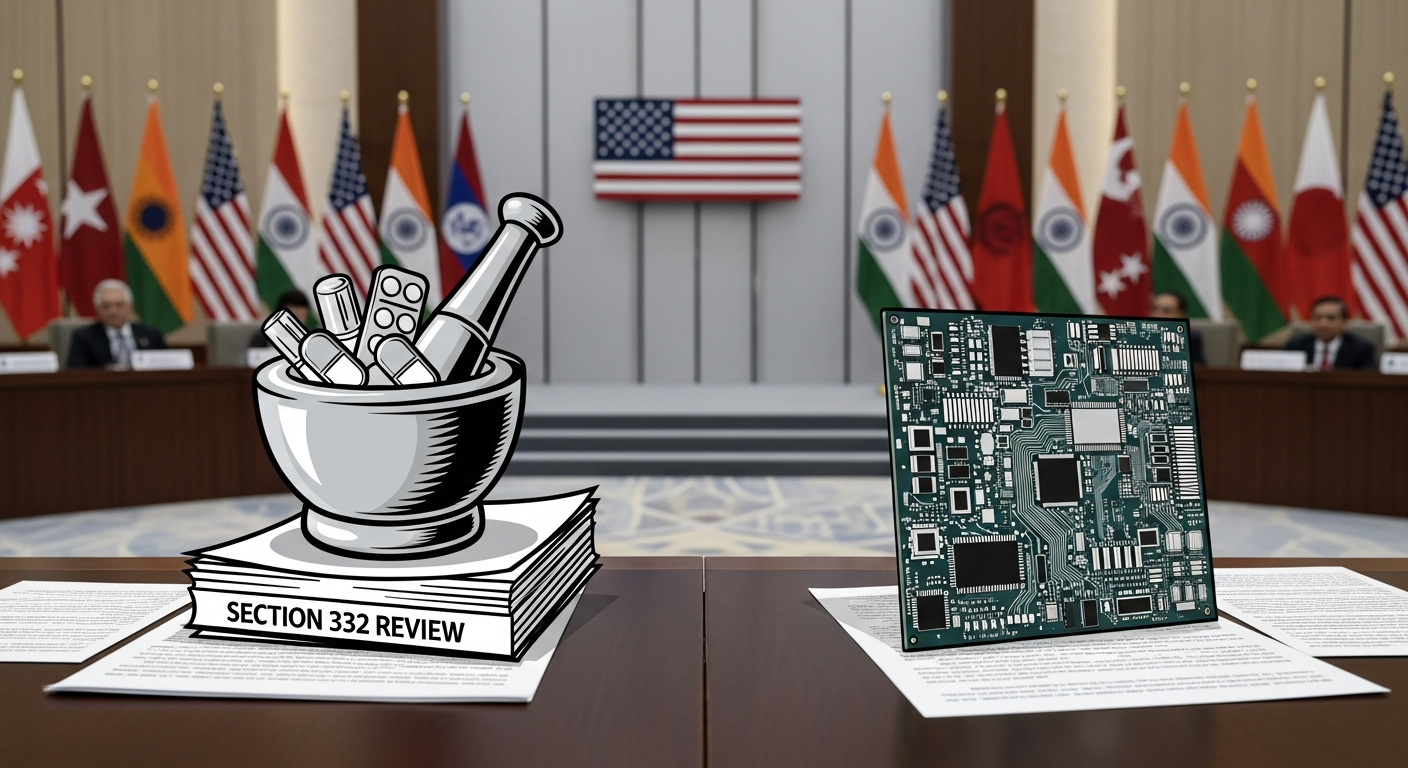
The United States on Monday exempted generic pharmaceuticals from its Section 232 tariff review, lifting the threat of duties on India's largest manufactured export to the American market. The carve-out, published in the Federal Register's review update, follows a six-month campaign in which Indian exporters found their most effective advocates on the American side: insurers, hospital chains and the generic-drug distributors for whom Indian supply is forty percent of volume.
The exemption's logic was ultimately arithmetic. Indian generics save the US healthcare system an estimated $220 billion annually; a 25 percent tariff would have added $8-11 billion in direct costs while accelerating exactly the shortages the review's national-security framing claimed to address. The review's own economic annexe, sources familiar with it say, could not construct a scenario in which the tariff advanced its stated goal.
The relief in Hyderabad and Ahmedabad is genuine but bounded, because the larger file remains open. Electronics — now India's second export engine to the US, with iPhone shipments alone crossing $18 billion annually — stays under review, entangled with the bilateral trade agreement whose negotiation has consumed two years and three deadlines. The American ask on electronics is not tariffs but rules: origin requirements that would constrain the Chinese-component share in India-assembled devices, aligning Indian supply chains with the US-Japan-Korea framework's China-plus-one architecture.
New Delhi's counter-asks are equally structural: mobility provisions for Indian professionals, mutual recognition on services, and — the newest entrant — semiconductor supply-assurance language mirroring what India just signed with Japan. The two sides have agreed to a September ministerial billed, for the fourth time, as conclusive.
The geopolitics beneath the negotiation has shifted in India's favour since the spring. The Hormuz war demonstrated India's systemic weight — its navy in the corridor, its refining capacity cushioning global products markets — and Washington's Indo-Pacific arithmetic has never priced India higher. Trade negotiators on both sides privately describe the same dynamic: the strategic relationship keeps writing cheques the trade relationship must eventually cash.
For the pharma sector, the practical consequence is immediate: contract renegotiations that had stalled on tariff risk are moving, and two large exporters have revived American greenfield plans shelved in the winter. For the broader relationship, September is the tell. Two democracies that call each other indispensable have not managed a trade agreement since 2005. The month the streak breaks — or extends — is now on the calendar.
