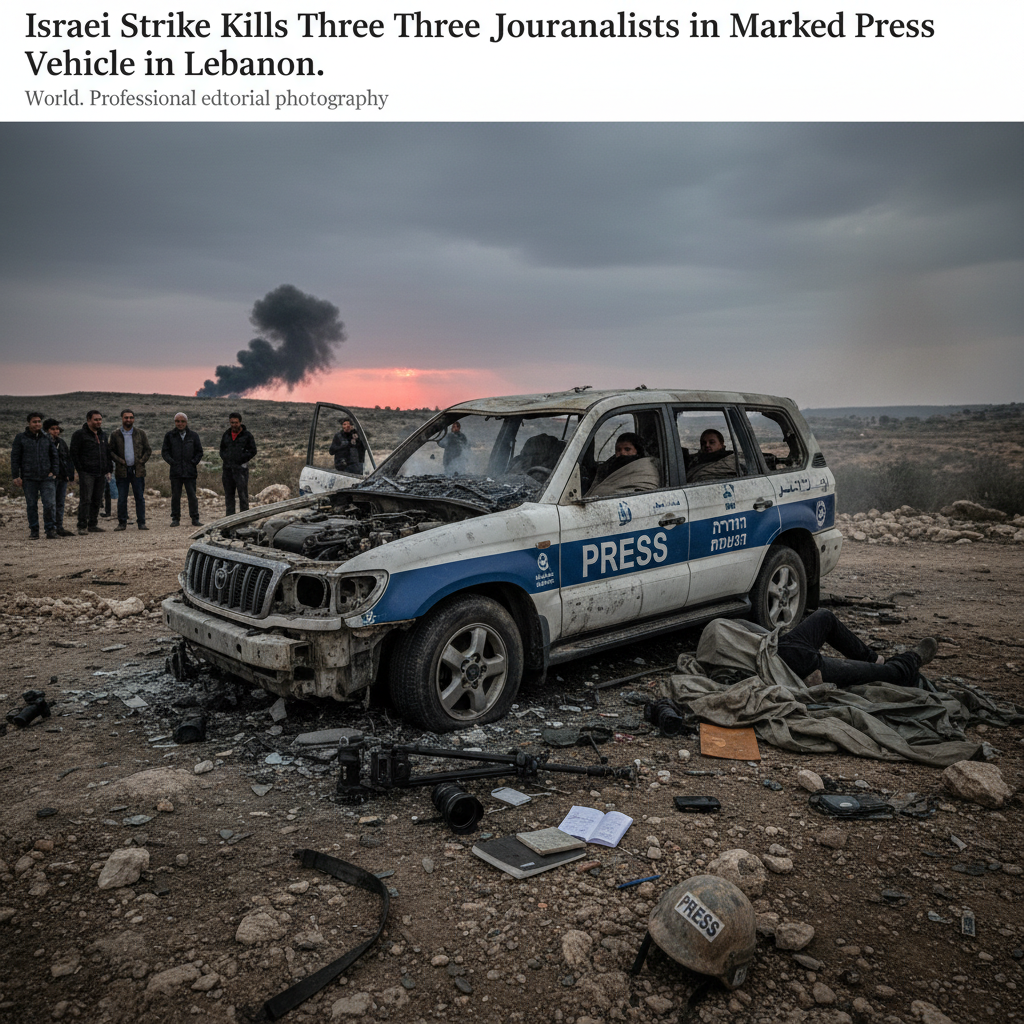
Three journalists were killed in an Israeli strike while covering the ongoing conflict in southern Lebanon on March 28, 2026, according to reports from Al Jazeera. The victims were traveling in a vehicle clearly marked as belonging to the press when the strike occurred, raising serious questions about the safety of media personnel in active war zones and the adherence to international humanitarian law.
The incident represents one of the most serious attacks on journalists in the region in recent years, occurring as media organizations continue to report on the escalating tensions between Israel and various groups in Lebanon. The journalists were reportedly engaged in their professional duties, documenting the impact of the conflict on civilian populations and infrastructure in the border region.
KEY FACTS
- Three journalists killed in Israeli strike on March 28, 2026
- Victims were traveling in a clearly marked press vehicle
- Strike occurred in southern Lebanon during conflict coverage
- Incident reported by Al Jazeera news network
- Event has sparked international concern over journalist safety
The targeting of clearly marked press vehicles raises significant concerns under international humanitarian law, which provides specific protections for journalists operating in conflict zones. The Geneva Conventions and their Additional Protocols establish that journalists engaged in professional missions in areas of armed conflict are considered civilians and must be protected as such. The deliberate targeting of journalists or press facilities constitutes a war crime under the Rome Statute of the International Criminal Court.
This incident occurs against the backdrop of a broader pattern of attacks on media personnel in conflict zones worldwide. The Committee to Protect Journalists has documented hundreds of cases where reporters, photographers, and camera operators have been killed, kidnapped, or injured while performing their professional duties. The Middle East region, in particular, has been identified as one of the most dangerous areas for journalists, with ongoing conflicts in Syria, Yemen, and the Israeli-Palestinian territories contributing to a climate of extreme risk for media workers.
The use of marked press vehicles is a standard safety protocol developed by international media organizations and press freedom advocates. These vehicles, clearly identified with "PRESS" markings and often equipped with special communications equipment, are intended to signal to all parties in a conflict that the occupants are non-combatant journalists protected under international law. The effectiveness of such markings, however, has been questioned in recent conflicts where press personnel have been targeted despite clear identification.
By The Numbers
The international community has consistently emphasized the crucial role that journalists play in documenting conflicts and informing the global public about events in war zones. Press freedom organizations argue that attacks on journalists not only violate international law but also deprive the world of essential information about conflicts and their impact on civilian populations. The work of war correspondents has been instrumental in exposing war crimes, documenting human rights violations, and providing accountability in situations where official sources may be unreliable or biased.
Historical precedent shows that attacks on journalists in conflict zones often escalate international diplomatic tensions and can lead to formal investigations by international bodies. The killing of journalists has previously resulted in condemnation from the United Nations Security Council, calls for independent investigations, and in some cases, referrals to international criminal tribunals. The international legal framework surrounding the protection of journalists has evolved significantly since the adoption of UN Security Council Resolution 2222 in 2015, which specifically addresses the safety of journalists in armed conflict.
The technological aspects of modern warfare have also complicated the safety landscape for journalists. The increasing use of precision-guided munitions, surveillance drones, and real-time intelligence gathering means that military forces often have detailed information about the identity and location of vehicles and personnel in conflict zones. This technological capability makes the targeting of clearly marked press vehicles particularly concerning from a legal and ethical standpoint, as it suggests that such strikes may be deliberate rather than accidental.
"This incident has sparked international concern regarding the safety of journalists in conflict zones" — Al Jazeera
The economic impact on media organizations operating in conflict zones cannot be understated. The death of journalists not only represents a tragic human loss but also affects the ability of news organizations to maintain coverage in dangerous areas. Insurance costs for media companies have risen dramatically, and many organizations have been forced to reduce their presence in high-risk regions or rely increasingly on local stringers and freelance journalists who often lack the same level of protection and support as full-time staff correspondents.
Training and safety protocols for journalists operating in war zones have evolved significantly over the past two decades. Most major news organizations now require hostile environment training for correspondents assigned to conflict zones, including instruction in first aid, situational awareness, and the use of protective equipment. However, these measures provide limited protection against direct military strikes, particularly those involving heavy weapons or precision-guided munitions.
The role of technology in protecting journalists has also expanded, with organizations developing new communication systems, tracking devices, and emergency response protocols. Some news organizations have begun using satellite communication systems that can automatically alert editors and security personnel if a journalist's equipment stops transmitting, potentially indicating that they have been killed, kidnapped, or injured.
The international legal response to attacks on journalists has strengthened considerably in recent years. The International Criminal Court has increasingly pursued cases involving attacks on media personnel, and several national courts have exercised universal jurisdiction to prosecute individuals responsible for killing journalists in foreign countries. The European Court of Human Rights and other regional human rights bodies have also issued important rulings establishing state obligations to protect journalists and investigate attacks against them.
The broader implications of this incident extend beyond the immediate tragedy of the three deaths. The targeting of clearly marked press vehicles sends a chilling message to the international media community and may lead to reduced coverage of conflicts in the region. This reduction in coverage can have significant consequences for international understanding of events and may limit the ability of humanitarian organizations and diplomatic efforts to respond effectively to crises.
The incident also highlights the ongoing challenges faced by local journalists and media workers in conflict zones, who often bear the greatest risks while receiving less international attention and protection than their international counterparts. Local journalists frequently lack access to the same safety equipment, training, and support systems available to correspondents from major international news organizations, making them particularly vulnerable to violence and intimidation.