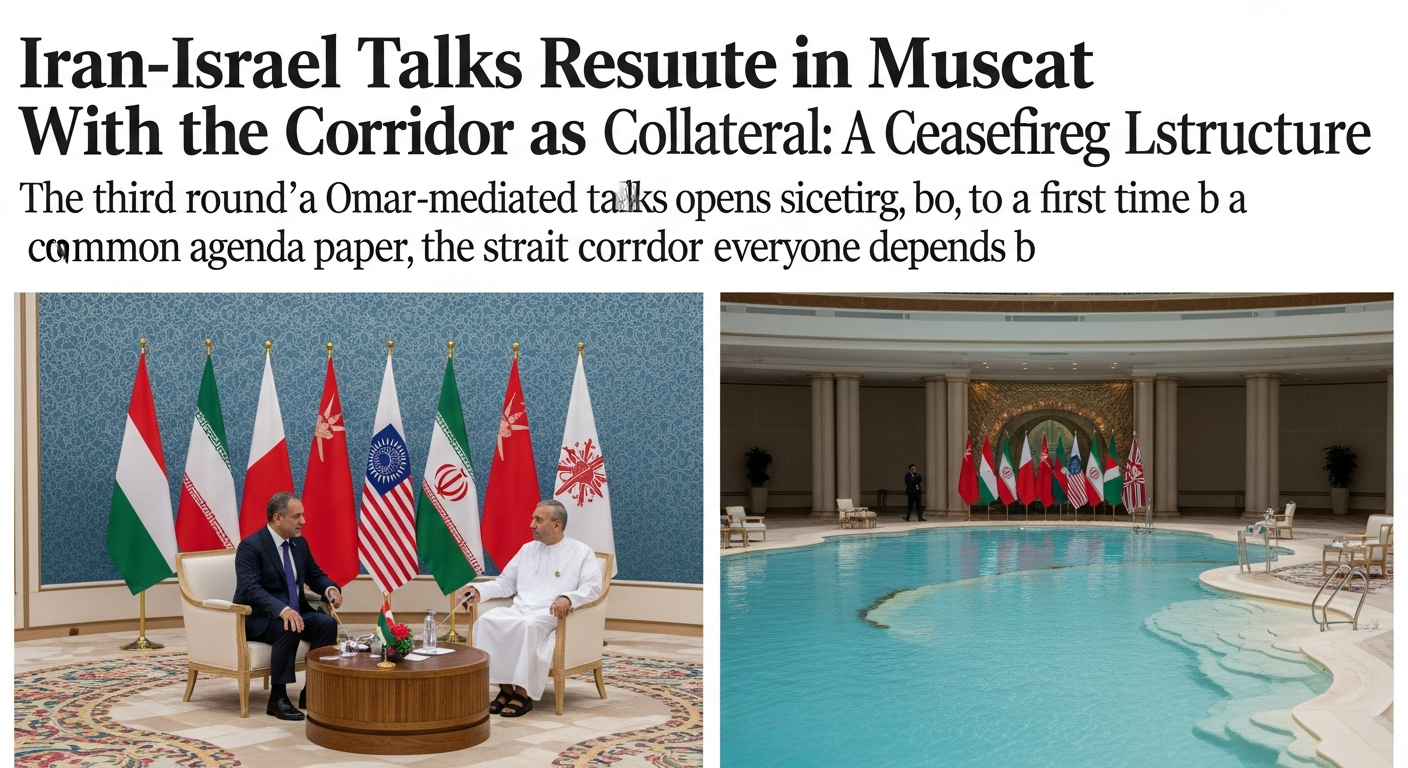
The third round of Omani-mediated talks between Iran and Israel opened in Muscat on Tuesday with a procedural first: both delegations accepted a common agenda paper, the modest-sounding milestone that separates talks about talks from negotiation. The five-item agenda, according to two diplomats briefed on it, covers the maritime corridor's permanence, mutual strike-cessation verification, the nuclear file's return to IAEA framework, sanctions sequencing, and — the item that nearly collapsed the paper — proxy-force limitations.
The February-to-April war that preceded this diplomacy killed an estimated 4,100 people across six countries, closed the Strait of Hormuz for six weeks, and ended in the exhaustion ceasefire that has now held, with three recorded violations, for eleven weeks. What it did not do is resolve any of the questions it was fought over — which is why the Muscat process matters and why its structure is so fragile.
The corridor is the process's paradox. The UN-administered lane through the strait is the ceasefire's one institutional achievement: a seven-nation escort operation with a Security Council mandate, 84 percent of pre-war traffic restored, and both belligerents formally committed to its inviolability. It is also the negotiation's hostage — every party understands that the corridor's December mandate renewal is the deadline that disciplines the talks, and Iranian negotiators have not been subtle about the linkage.
India's stake in Muscat is larger than its role, which is the familiar position of the middle power. Two Indian frigates sail in the escort rotation; sixty percent of India's cooking gas and half its crude transit the lane under negotiation; and the eight-million-strong diaspora west of the strait constitutes, as the March panic demonstrated, a domestic constituency for Gulf stability. New Delhi's diplomatic contribution has been characteristically quiet — technical support to the corridor's coordination cell and, per Gulf-based reporting, a discreet channel to Tehran on maritime insurance that helped unlock the corridor's first month.
The realistic ambition for this round, participants caution, is architecture rather than agreement: standing working groups on the five agenda items, a violations-review mechanism with teeth, and the corridor's renewal decoupled from the rest — the item everyone needs insulated from everything else.
The talks recess Friday. The war is over in the sense that matters least — the shooting — and unresolved in every sense that matters more. Muscat is where the region finds out which sense wins.