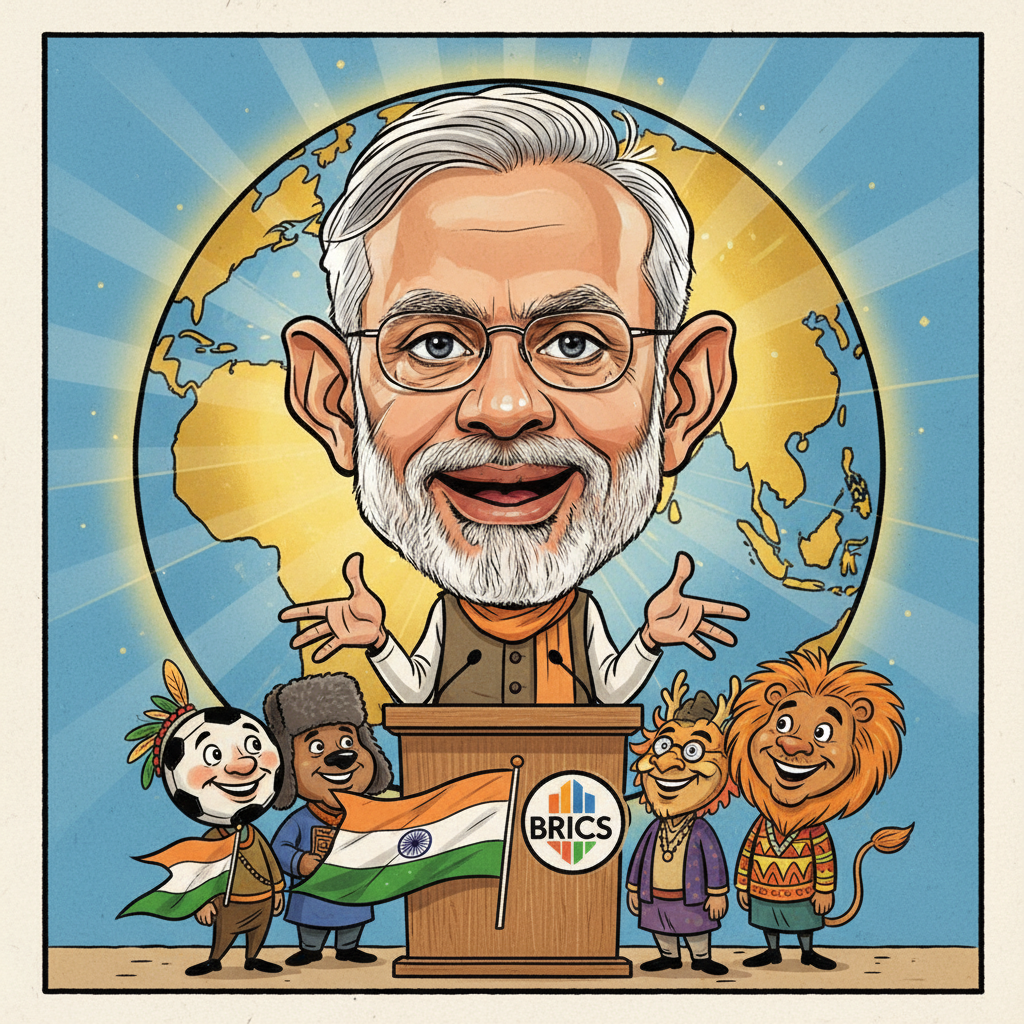
India has officially taken over the BRICS chairmanship on January 1, 2026, succeeding Brazil and paving the way for the 18th BRICS summit to be held on Indian soil later this year. This marks India's fourth term as chair, following successful tenures in 2012, 2016, and 2021, and presents a crucial opportunity to shape the BRICS agenda and further India's strategic interests within the grouping.
The BRICS nations – Brazil, Russia, India, China, and South Africa – represent a significant portion of the global population and economy. The bloc has become an increasingly important platform for cooperation on a range of issues, from economic development and trade to security and climate change. India's leadership comes at a critical juncture as the world grapples with geopolitical instability, economic uncertainty, and the urgent need for sustainable development.
KEY FACTS
- India assumed the BRICS chairmanship on January 1, 2026.
- India will host the 18th BRICS summit in 2026.
- The official logo and website for BRICS 2026 were launched on January 13, 2026.
- India previously held the BRICS Chairship in 2012, 2016, and 2021.
- The BRICS nations represent a significant portion of the global population and economy.
The theme for India's BRICS Chairship, “Building for Resilience, Innovation, Cooperation and Sustainability,” reflects the nation's commitment to addressing these challenges and fostering a more equitable and sustainable world order. This theme aligns closely with India's own development priorities and its vision for a Viksit Bharat (Developed India) by 2047. By focusing on resilience, India aims to strengthen the BRICS nations' ability to withstand economic shocks and geopolitical pressures. Innovation is seen as key to driving economic growth and creating new opportunities for cooperation. Cooperation among the BRICS nations is essential for addressing shared challenges and achieving common goals. And sustainability is crucial for ensuring that development is environmentally responsible and socially inclusive.
India's previous BRICS chairmanships have been marked by significant achievements. In 2012, India played a key role in establishing the BRICS Contingent Reserve Arrangement (CRA), a mechanism for providing financial support to member countries facing balance of payments difficulties. In 2016, India focused on enhancing intra-BRICS trade and investment, as well as promoting people-to-people exchanges. And in 2021, India prioritized cooperation on digital technologies, sustainable development, and multilateral reforms. Each of these chairmanships has contributed to strengthening the BRICS partnership and advancing the interests of the Global South.
The 18th BRICS summit in 2026 will provide an opportunity for India to build on these achievements and set the agenda for the next phase of BRICS cooperation. Key areas of focus are expected to include strengthening economic cooperation, promoting technological innovation, enhancing security cooperation, and addressing climate change. India is also likely to push for reforms of the international financial architecture to make it more representative of the needs of developing countries.
By The Numbers
One of the key challenges facing the BRICS nations is the growing geopolitical rivalry between the United States and China. India has sought to maintain a balanced approach, engaging with both countries while also pursuing its own strategic interests. This approach is reflected in India's active participation in both the BRICS and the Quad, a security grouping that includes the United States, Japan, and Australia. India's ability to navigate these complex geopolitical dynamics will be crucial for the success of its BRICS chairmanship.
Another challenge is the need to address internal divisions within the BRICS grouping. While the BRICS nations share a common interest in promoting a more multipolar world order, they also have differing perspectives on a range of issues, from trade to security. India will need to work closely with its BRICS partners to bridge these differences and forge a common agenda. This requires deft diplomacy and a commitment to finding common ground.
Despite these challenges, the BRICS grouping remains an important platform for India to advance its strategic interests and promote the interests of the Global South. The BRICS nations collectively represent a significant share of the world's population, economy, and trade. By working together, the BRICS nations can exert greater influence on global affairs and shape the international agenda.
India's focus on “Building for Resilience, Innovation, Cooperation and Sustainability” is particularly relevant in the current global context. The COVID-19 pandemic has exposed the vulnerabilities of global supply chains and the need for greater resilience. Innovation is essential for driving economic growth and creating new opportunities for development. Cooperation is crucial for addressing shared challenges such as climate change and terrorism. And sustainability is vital for ensuring that development is environmentally responsible and socially inclusive.
India's leadership of the BRICS in 2026 will also provide an opportunity to showcase its own development achievements. India has made significant progress in recent years in areas such as infrastructure development, digital technology, and renewable energy. By sharing its experiences with other BRICS nations, India can help to promote sustainable development and inclusive growth across the Global South.
The launch of the official logo and website for the BRICS 2026 presidency on January 13, 2026, signals India's readiness to take on this important role. The logo and website will serve as platforms for communicating India's priorities and engaging with stakeholders across the BRICS nations and beyond. This proactive approach demonstrates India's commitment to a successful and impactful BRICS chairmanship.
India's commitment to multilateralism and its strong relationships with other BRICS nations position it well to lead the grouping effectively. India's foreign policy has consistently emphasized the importance of international cooperation and the need for a more equitable and representative world order. This commitment is reflected in India's active participation in a wide range of multilateral forums, including the United Nations, the G20, and the BRICS.
The 18th BRICS summit in 2026 will be a significant event for India and for the BRICS grouping as a whole. It will provide an opportunity to assess the progress made in recent years and to set the agenda for the future. India's leadership will be crucial in ensuring that the BRICS remains a relevant and effective platform for cooperation among developing countries.
India's focus on strengthening economic cooperation within the BRICS is particularly important. Intra-BRICS trade and investment have been growing in recent years, but there is still significant potential for further expansion. India can play a key role in facilitating this expansion by promoting trade facilitation measures, reducing non-tariff barriers, and encouraging investment flows.
In addition to economic cooperation, India is also likely to prioritize security cooperation within the BRICS. The BRICS nations face a range of security challenges, including terrorism, cybercrime, and maritime security. By working together, the BRICS nations can enhance their ability to address these challenges and promote regional stability.
"Building for Resilience, Innovation, Cooperation and Sustainability" — India's BRICS Chairship Theme
India's leadership of the BRICS in 2026 will be a test of its diplomatic skills and its ability to forge consensus among diverse nations. However, India's strong track record of multilateral engagement and its commitment to the BRICS make it well-positioned to succeed. The summit presents a crucial opportunity to solidify India's position as a leading voice for the Global South and to shape the future of the BRICS grouping.
The success of India's BRICS chairmanship will depend on its ability to address the challenges facing the grouping and to capitalize on the opportunities that lie ahead. By focusing on resilience, innovation, cooperation, and sustainability, India can help to ensure that the BRICS remains a relevant and effective platform for promoting the interests of developing countries and shaping a more equitable and sustainable world order. The world will be watching closely as India takes the helm and guides the BRICS nations through this critical period.
The 18th BRICS summit in 2026, hosted by India, is poised to be a defining moment for the bloc, offering a platform to reaffirm its commitment to multilateralism and to address the pressing global challenges of our time. India's leadership, guided by its chosen theme, will be instrumental in shaping the future direction of the BRICS and solidifying its role as a key player in the evolving global landscape.



