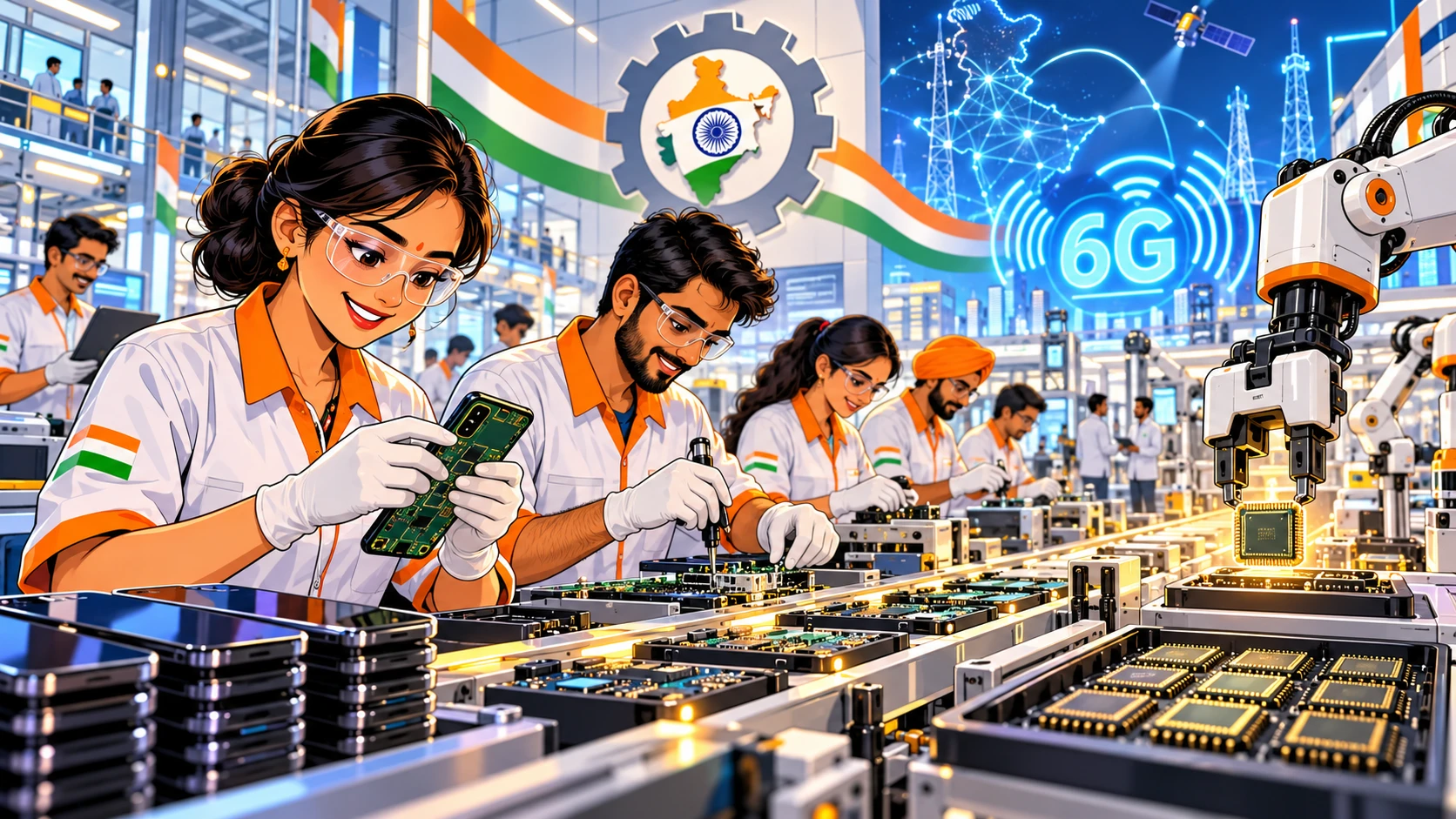
NEW DELHI — India has already won an argument it once seemed destined to lose. The smartphone in the average Indian hand is now, more often than not, assembled in India — the country is among the world's largest mobile manufacturers and, by the Economic Survey's reckoning, the third-largest electronics exporter. The next battle is harder, quieter and far more consequential: making not just the phone, but the chip inside it.
Beyond assembly
For years, critics dismissed India's electronics boom as "mere assembly" — screwing together parts made elsewhere. It was always a snapshot mistaken for a trajectory. Every manufacturing nation, from Japan to Korea to China, began exactly there and climbed. India is now climbing the same ladder, and the rungs above assembly are components and semiconductors — the parts where the real value, and the real strategic leverage, reside.
The semiconductor push
The centrepiece is the Semicon India programme, under which ten semiconductor units have already been approved, carrying cumulative investments of around ₹1.6 lakh crore. Chips are the hardest prize in all of electronics — capital-hungry, technologically brutal, dominated by a handful of firms and geographies. A country that can fabricate them, or even assemble and test them at scale, buys itself insurance against a world in which semiconductors have become instruments of coercion as much as commerce.
Alongside it runs the Electronics Component Manufacturing Scheme, notified last year with an outlay of nearly ₹22,919 crore, aimed at the unglamorous middle of the supply chain: the capacitors, connectors, displays and sub-assemblies that decide how much of a gadget's value actually stays in India. Assembly captures a sliver of a product's worth; components and chips capture the lion's share. Moving up that chain is the whole game.
Why it is a national-security story too
This is not only about exports and jobs, though there are plenty of both. A nation dependent on others for the chips in its phones, its networks, its missiles and its power grids is a nation that can be squeezed in a crisis — a lesson the pandemic and a decade of supply-chain weaponisation drove home. Atmanirbhar Bharat, in silicon, is not autarky; India will still trade, partner and import. It is resilience: the capacity to make at home the things that matter most when the world turns hostile.
The long game
None of this is finished, and honesty demands acknowledging the distance left to travel. Fabs take years to build and longer to run profitably; yields are unforgiving; the incumbents are formidable. India's semiconductor ambition will be measured not in announcements but in wafers shipped, a decade from now. But the direction is set, the money is committed, and the logic is sound. The country that taught the world it could assemble is now quietly insisting it can fabricate. If it succeeds, the chip in the next Indian phone will carry more than circuits — it will carry a nation's bet on building its own future.