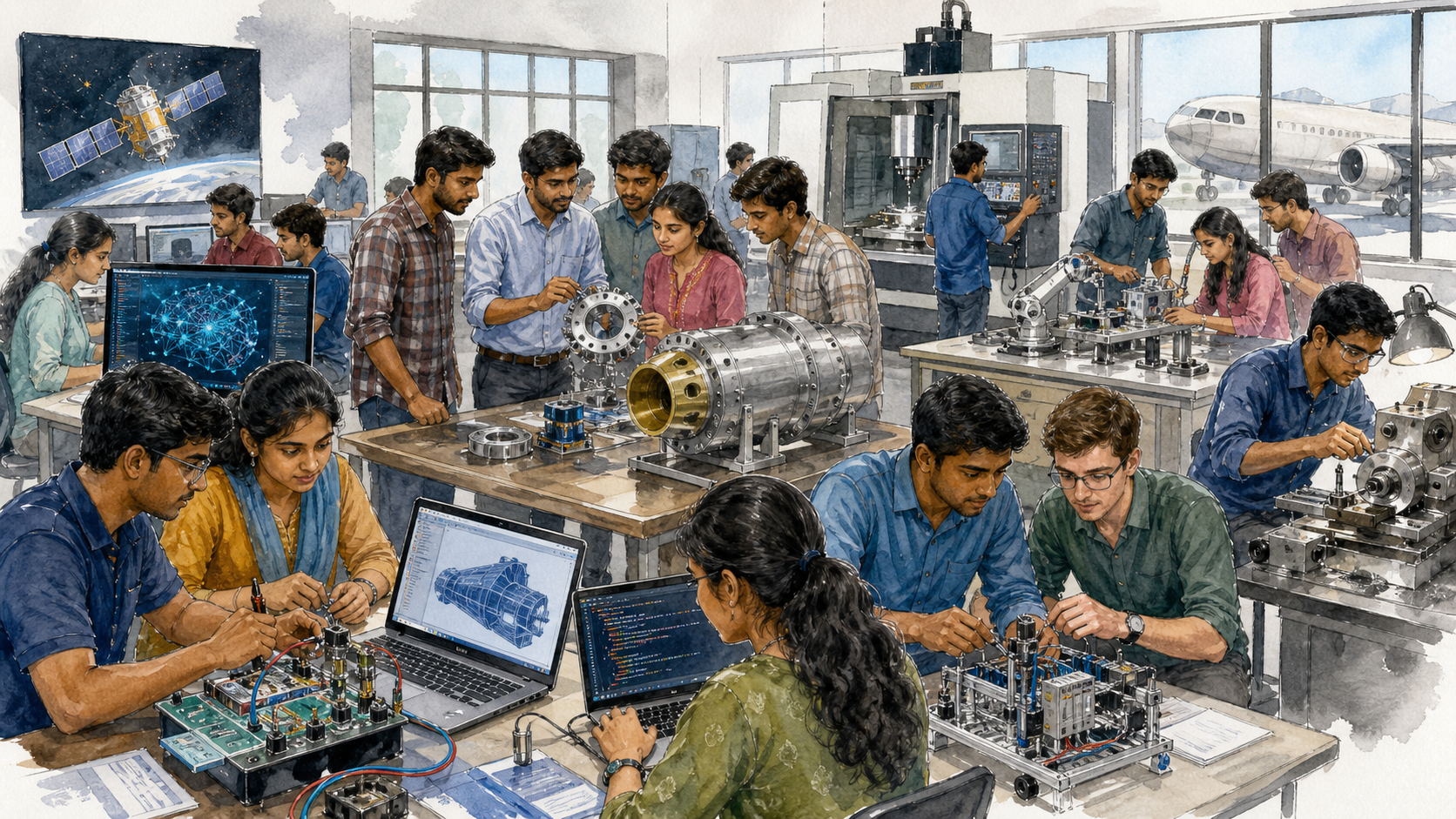
India does not lack engineering students. It often lacks enough places where students can work with industrial tools before their first job. The Central Tool Room and Training Centre in Bhubaneswar trained 8,083 students during a four-week summer internship in May and June 2026. Participants came from 22 states and Union Territories, with 26 international students from Sudan and Yemen. The scale makes the programme worth examining as a national skills model.
The MSME Ministry release lists 39 engineering and emerging-technology domains. Artificial intelligence drew 1,748 participants, PLC programming 1,000, AutoCAD 991, Python 413 and data analytics 392. Students attended from IITs, NITs, deemed universities, engineering colleges and polytechnics, spanning first year through final year.
Hands-on must mean more than software exposure
The strongest feature of a tool-room institution is the connection between digital design and physical production. AI and Python are useful, but engineers also need to understand tolerances, sensors, controllers, fixtures, materials and maintenance. A model designed on a laptop becomes valuable only when it can be manufactured, tested and repaired.
PLC training connects code to machines. CAD becomes more meaningful when a student sees how a drawing guides a CNC operation or tool. Data analytics becomes engineering when it detects a process drift or predicts a component failure. Programmes should therefore integrate domains rather than present 39 isolated short courses.
CTTC has production credibility
CTTC Bhubaneswar was established to meet tooling, manufacturing and training needs of MSMEs. Its services include press tools, moulds, dies, gauges, jigs, fixtures and precision components. The centre supplied 54,000 components of 437 types for the Chandrayaan-3 mission and contributed components for Aditya-L1. It has also supported aerospace and defence programmes, including the Light Combat Aircraft.
This record gives students something many internships lack: proximity to real quality requirements. Space and aerospace components demand documentation, repeatability and disciplined inspection. Even when interns do not work on mission hardware, exposure to those systems can change how they understand engineering responsibility.
Measure what students can do afterward
Participation is an input, not the final outcome. CTTC should assess whether students can complete a practical task independently at the end of four weeks. Follow-up surveys can track placements, projects, certifications and startup activity. Employers can report whether training reduced onboarding time or improved competence.
A credible skills certificate should describe demonstrated abilities, not merely attendance. Digital portfolios containing designs, code, test results and safety procedures would help employers judge candidates and give students evidence of work. Assessment rubrics should be consistent across cohorts.
Bring the model closer to colleges
Eight thousand places are substantial but small compared with India’s engineering population. CTTC can expand impact through instructor training, shared laboratory modules and partnerships with regional colleges. Portable industrial-control kits and remote simulation can prepare students before an intensive period on expensive equipment.
Access must include students from colleges with weaker laboratories. Transparent applications, affordable fees, hostel support and travel scholarships can prevent the programme from favouring those already studying at well-resourced institutions. Women’s participation and retention should be reported across technical domains.
Industry must help define the curriculum
MSMEs know which machine, quality and maintenance skills are scarce. A local advisory group can update modules each year, offer problems for capstone projects and identify apprenticeship openings. Industry input should shape practical requirements without turning training into instruction for one vendor’s product.
Safety, communication and documentation belong beside technical content. A capable engineer must read a drawing, explain a fault, record a change and work safely with others. These habits are difficult to teach through lectures and natural to teach in a well-run workshop.
A bridge India should replicate
The four-week internship cannot repair every weakness in an engineering degree. It can show students how theory behaves when confronted by a machine, deadline and quality standard. That encounter often clarifies both career direction and gaps in knowledge.
Replication should use a hub-and-spoke model rather than attempting to duplicate every expensive machine. Tool rooms can host advanced equipment, while partner colleges deliver foundational modules and supervised projects. Shared booking systems would let student teams reserve laboratory time after completing safety and theory requirements, increasing utilisation and reducing repetitive orientation.
Faculty immersion is also necessary. Lecturers who spend time inside tool rooms can redesign assignments around real manufacturing constraints and bring current practices back to campus. Industry professionals can co-teach short modules, while academic faculty contribute fundamentals that prevent training from becoming button-pushing.
This partnership would improve both teaching and employability.
CTTC Bhubaneswar’s achievement is not simply that 8,083 students entered its classrooms. It is that an institution built for MSME tooling connected young engineers to AI, controls, design and precision manufacturing under one roof. India needs more such bridges between campuses and production. Replication should preserve the element that makes this programme valuable: students learning by making, testing, correcting and trying again.