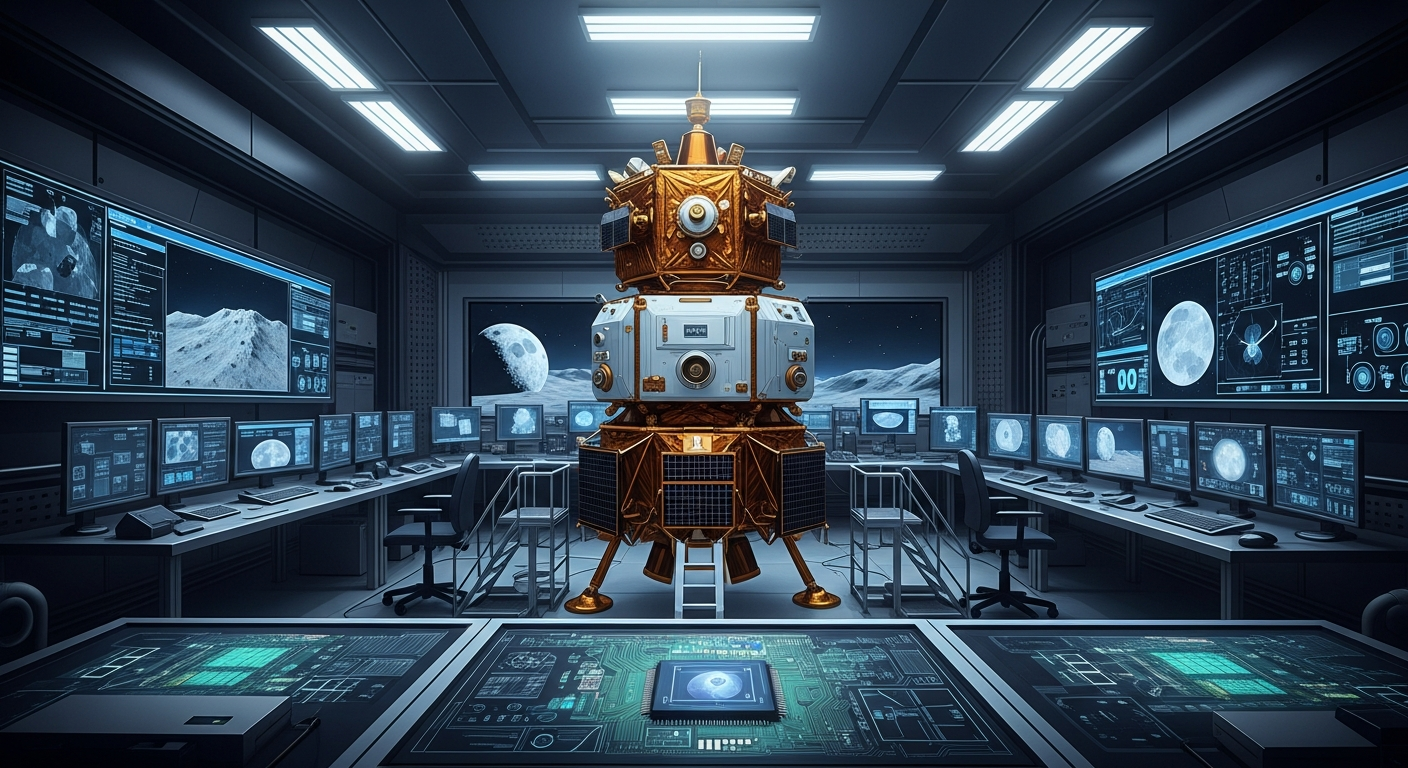
The integrated stack of Chandrayaan-4, India's first lunar sample-return mission, has cleared thermal-vacuum qualification at the U R Rao Satellite Centre in Bengaluru, ISRO said on Monday — the final environmental gate before the mission's modules move to integration trials.
Chandrayaan-4's architecture is the most complex ISRO has attempted: four modules across two launches, a lunar-orbit docking between the ascent and transfer modules, and a re-entry capsule designed to bring 3-4 kilograms of regolith from the Shiv Shakti point region — the southern high-latitude site Chandrayaan-3 made India's own.
The thermal-vacuum campaign subjected the stack to the 300-degree swing between lunar day and shadow, with the sample-transfer mechanism — the mission's most failure-intolerant element — cycled 400 times under vacuum.
The next gate is the one the programme's schedule actually turns on: the SPADEX-2 rendezvous and docking demonstration in lunar-representative conditions, slated for early 2027. The 2028 launch window announced by the government holds, ISRO's chairman said, 'with margins we are spending carefully'.
The mission's strategic weight has grown since its approval. Lunar sample return is the qualifying credential of the top tier of spacefaring states — a list of three. The programme that follows it, Bharatiya Antariksh Station's first module, is already in preliminary design review.