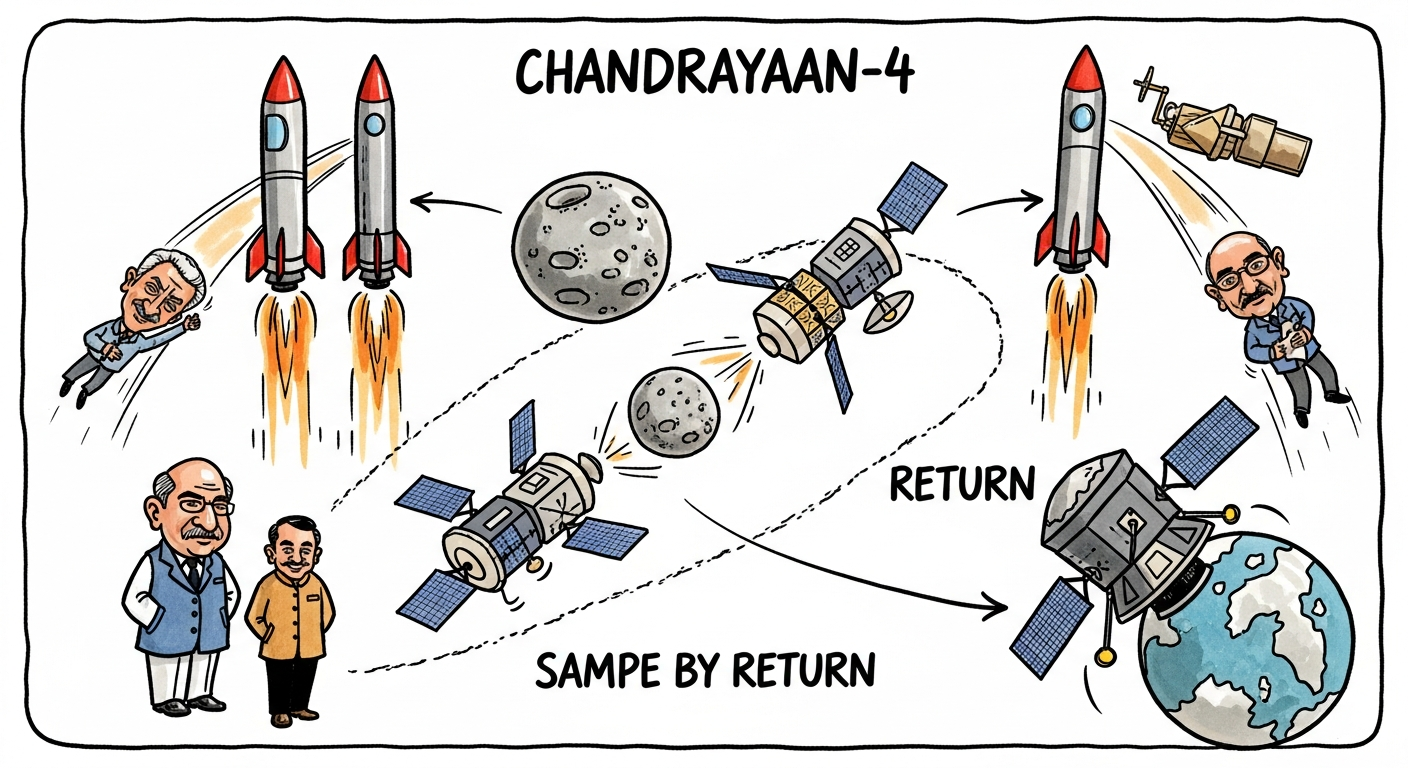
Bringing Moon rocks home is choreography: four modules, two launches, a lunar-orbit handoff and a re-entry at escape velocity. The stack that cleared thermal-vacuum testing this month makes the choreography hardware.
The sequence: launch one lifts the transfer and lander modules; launch two, the orbiter and return capsule. Descent to the south-pole region Chandrayaan-3 scouted; a robotic scoop and drill package seals samples; ascent module lifts to lunar orbit for the mission's hardest trick — an autonomous docking 380,000 km from mission control — then transfer, return cruise, and a capsule streaking into an Indian range.
The dates: integration reviews through winter, launch window opening 2027, samples on Indian soil targeted within the following year.
Why it matters beyond flags: docking, sample handling and high-speed re-entry are the exact competencies the human-spaceflight programme and the 2035 station roadmap require. Every subsystem is a rehearsal.
Thermal-vac is where missions historically discover their flaws; this stack exited clean. The countdown culture that delivered a ₹600-crore lunar landing now attempts its graduate thesis. Milestones tracked on our tech desk.



