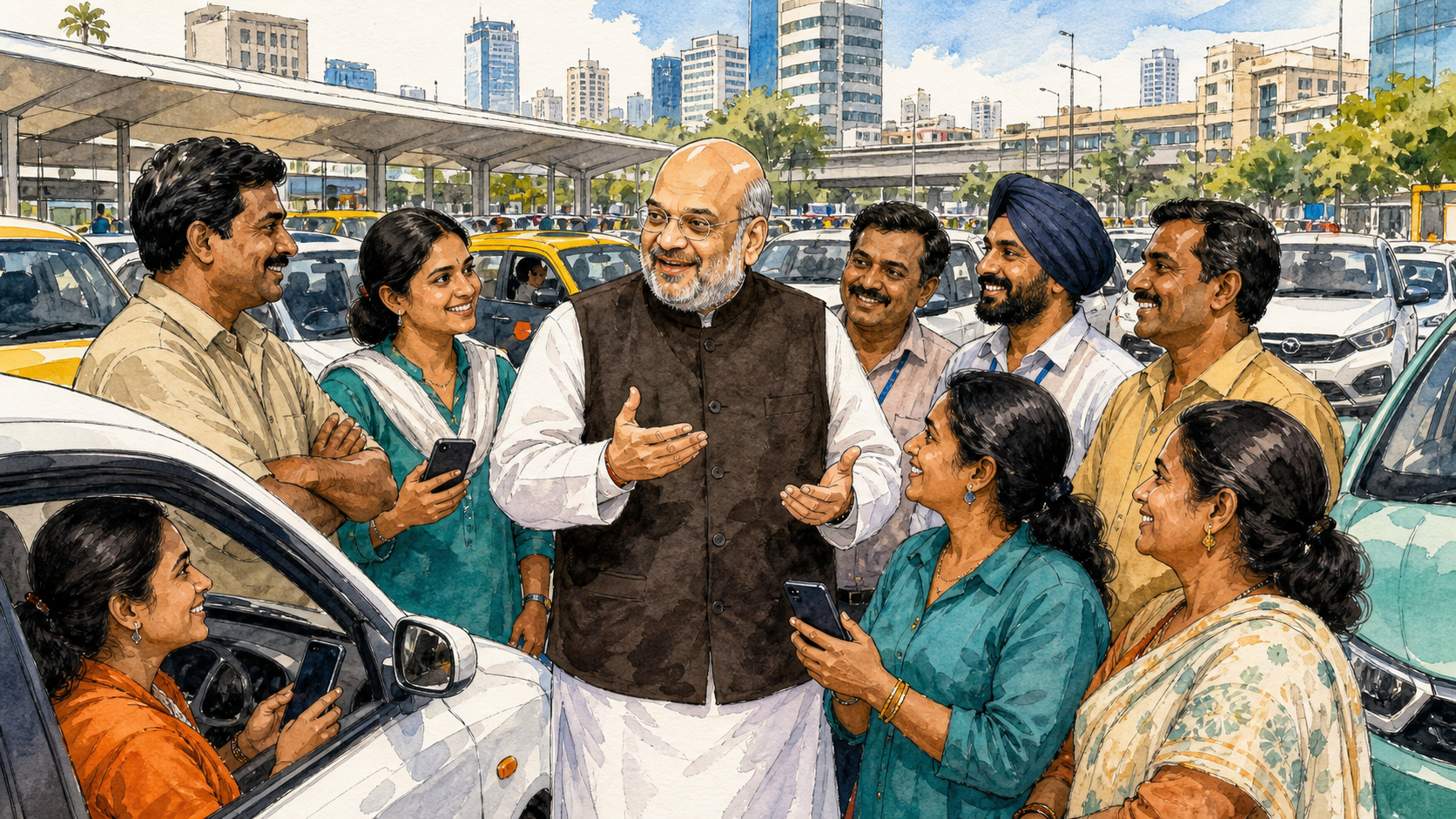
India's ride-hailing economy has made urban travel easier, but it has also produced a persistent argument over commissions, opaque incentives and the share of each fare that reaches the person behind the wheel. Bharat Taxi is attempting a different answer. Instead of treating drivers only as suppliers to a technology company, it places them inside a cooperative structure as member owners.
The platform was established under the Multi-State Cooperative Societies Act and is supported by national cooperative institutions. Its central promise is a zero-commission model under which registered Sarathis retain the fare they earn. The idea connects Union Cooperation Minister Amit Shah's wider “Sahkar se Samriddhi” agenda with a sector shaped by algorithms, smartphones and intense private competition.
Early scale is significant
Official figures show that Bharat Taxi had registered 8.48 lakh drivers and 44.27 lakh customers by 4 August 2026. It was facilitating 11,106 rides a day and had enabled cumulative driver earnings of Rs 83.70 crore. Delhi-NCR accounted for 5,574 daily rides, followed by Gujarat with 3,817, while operations were also developing in Lucknow, Chandigarh, Mumbai, Jaipur and Pune.
Those registration numbers demonstrate interest, but the gap between registered users and daily completed rides also defines the next challenge. A mobility platform becomes valuable when a passenger can reliably find a driver, receive a predictable fare and complete a safe journey at different hours and locations. Driver ownership is a strong institutional proposition; liquidity and service quality will decide whether customers make it a habit.
What zero commission can change
Commission-free work can improve a driver's economics, particularly when fuel, insurance, maintenance and loan repayments are rising. A higher share of the fare can reduce the pressure to work excessive hours or chase short-lived incentive slabs. Cooperative membership can also give drivers a voice in fare policy, dispute resolution and the long-term direction of the platform.
Zero commission, however, does not mean zero cost. Software, customer support, mapping, payment processing, safety systems and marketing require steady funding. Bharat Taxi will need a transparent model for meeting those costs without quietly recreating the same deductions it seeks to replace. Membership fees, service subscriptions or institutional support should be published clearly so every Sarthi understands the economics.
Technology must serve both sides
A competitive ride-hailing app needs accurate location matching, low cancellation rates, quick payments and support that works during emergencies. The design should not favour only technically confident users. Drivers and passengers need interfaces in Indian languages, assisted onboarding and simple explanations of fares, penalties and complaint outcomes.
Safety requires more than an emergency icon. Driver verification, trip sharing, number masking, incident escalation and coordination with local police must work as one system. Women-centric mobility initiatives can create more opportunities for women drivers and greater confidence for women passengers, but recruitment, safe working conditions and night-time response capacity need measurable standards.
Data governance is equally important. A cooperative platform should tell members what location, payment and performance information it collects, how long it retains that information and who may access it. Ownership must include meaningful control over the rules governing driver data, not merely a certificate of membership.
Cooperation across states
Bharat Taxi's rollout is being phased according to operational readiness and state approvals. Its memorandum of understanding with West Bengal's Yatri Sathi illustrates how separate public or cooperative mobility systems can collaborate without pretending to be the same platform. Shared driver welfare, outreach and enrolment can reduce duplication while preserving local requirements.
Expansion should prioritise corridors where demand can become dense enough to support quick matching. Airports, railway stations, business districts and major residential clusters offer natural starting points. The platform should publish city-level indicators for active drivers, completed rides, waiting times, cancellations and complaint resolution. That evidence would let drivers and customers judge progress honestly.
Driver welfare cannot remain a slogan
The cooperative model creates an opportunity to connect mobility work with insurance, pension access, accident support and skills. These benefits should be portable across cities and should not disappear when a driver temporarily becomes inactive. Partnerships with the e-Shram ecosystem, financial institutions and training bodies can help, provided enrolment is voluntary and terms remain clear.
Drivers also need representation that is genuinely democratic. Elections, board decisions, accounts and major technology contracts should be accessible to members. If a small managerial group controls the platform without effective scrutiny, cooperative branding alone will not deliver ownership.
A serious Indian alternative
Amit Shah's cooperation push has given Bharat Taxi institutional visibility and a national canvas. The platform now has to prove that an Indian cooperative can operate technology at commercial speed while distributing value more fairly. That requires professional management, accountable governance and relentless attention to passenger experience.
Bharat Taxi should not be judged only by how many registrations it announces. The decisive measures are active drivers, repeat passengers, stable earnings and safe completed rides. If those indicators rise together, India will have created more than another app. It will have built a credible model in which the people delivering a digital service also share ownership of its future.
