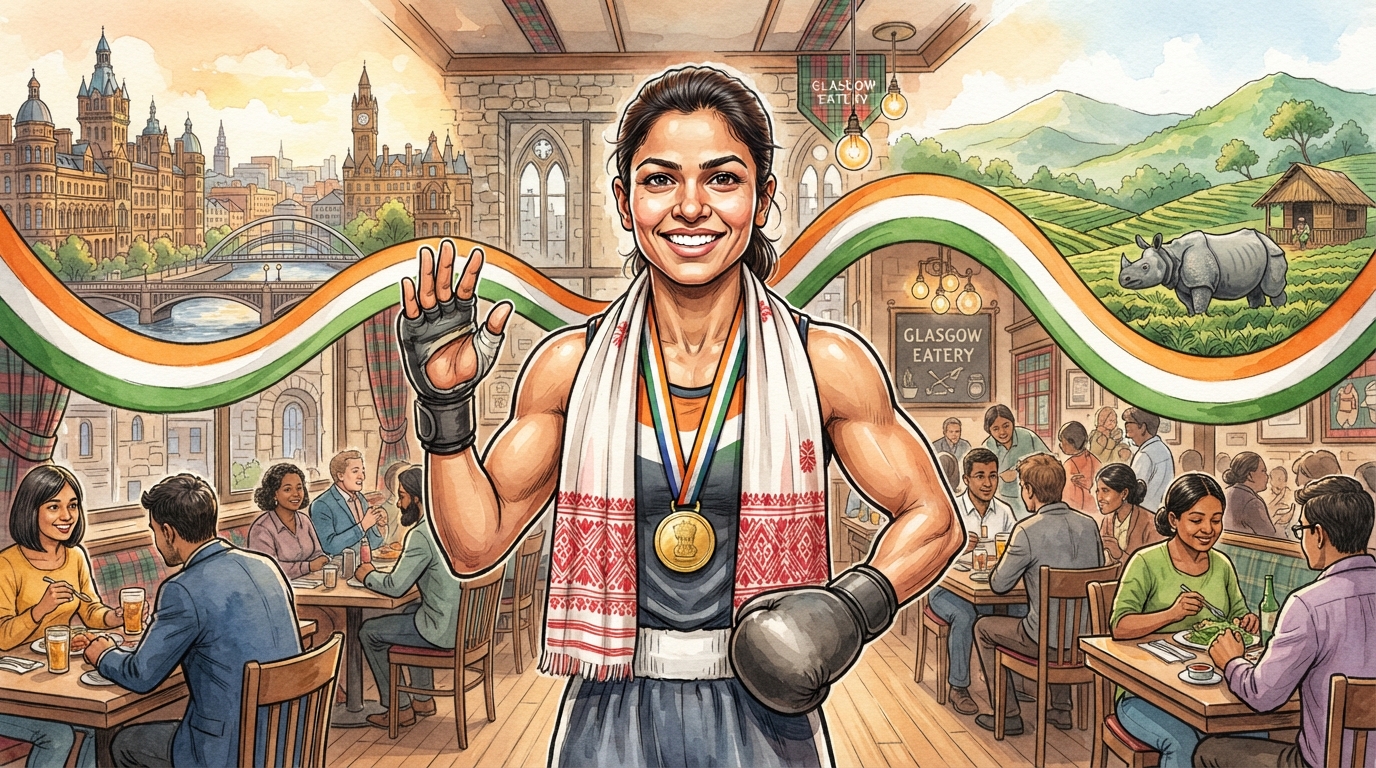
GLASGOW, 2 August 2026: A celebratory dinner after India’s record Commonwealth Games boxing campaign produced an unexpected lesson in representation. Olympic medallist Lovlina Borgohain noticed that maps displayed by a popular Indian restaurant in Glasgow omitted the Northeast. She raised the issue calmly, the management acknowledged the mistake and agreed to correct it.
The episode was confirmed by Boxing Federation of India president Ajay Singh in a Times of India report. Singh stressed that there was no confrontation. He and Lovlina pointed out the error, and the restaurant accepted that it needed correction.
A celebration interrupted by an incomplete map
The Indian boxing contingent had visited Mister Singh’s India, The Home of Curry, after finishing the Games with ten boxing medals: seven gold and three silver. Lovlina, who won silver in the women’s 75kg category, saw that the map printed on restaurant napkins and displayed outside did not include the Northeast.
In a video shared on social media, the Assamese boxer explained that the omission hurt because she came from the region. Her intervention was direct but courteous. It did not turn a cartographic error into a shouting match; it converted it into a correction.
Why such omissions are not minor
Maps are not decorative shapes alone. They communicate belonging, recognition and political geography. When the Northeast disappears from an image of India, eight states and millions of citizens are visually removed from the national frame. Repetition of such incomplete maps can reinforce the mistaken idea that the region is peripheral to India’s public imagination.
The Northeast is central to India’s sporting success. Lovlina is one of its most visible champions, Mirabai Chanu has built a historic weightlifting career, and athletes from Assam, Manipur and neighbouring states regularly represent India across boxing, football, weightlifting and other disciplines. A national celebration that includes their medals must also include their home on the map.
Correction without escalation
The strongest part of the episode was its resolution. Ajay Singh’s account makes clear that the restaurant did not defend the mistake or dismiss the concern. It agreed to correct the map. That is how institutions should respond when a legitimate representational error is identified: listen, verify and repair.
The distinction matters in a social-media environment where an error can rapidly become a contest in outrage. Lovlina’s approach protected the seriousness of the issue without personalising it. The restaurant’s response showed that acknowledgement is more useful than denial.
A champion speaking beyond the ring
Athletes are often asked to remain within the boundaries of competition. Yet their public standing also gives them the ability to identify exclusions that others overlook. Lovlina used that standing carefully. She did not claim malice, and the available report provides no basis for doing so. She simply insisted that India be represented completely.
The result is modest but meaningful: one restaurant will correct its map, and a larger audience has been reminded that the Northeast cannot be cropped out of the national story. India’s record boxing campaign was built in part by athletes from the region. Lovlina Borgohain ensured that the geography displayed during the celebration reflected the country for which they competed.



