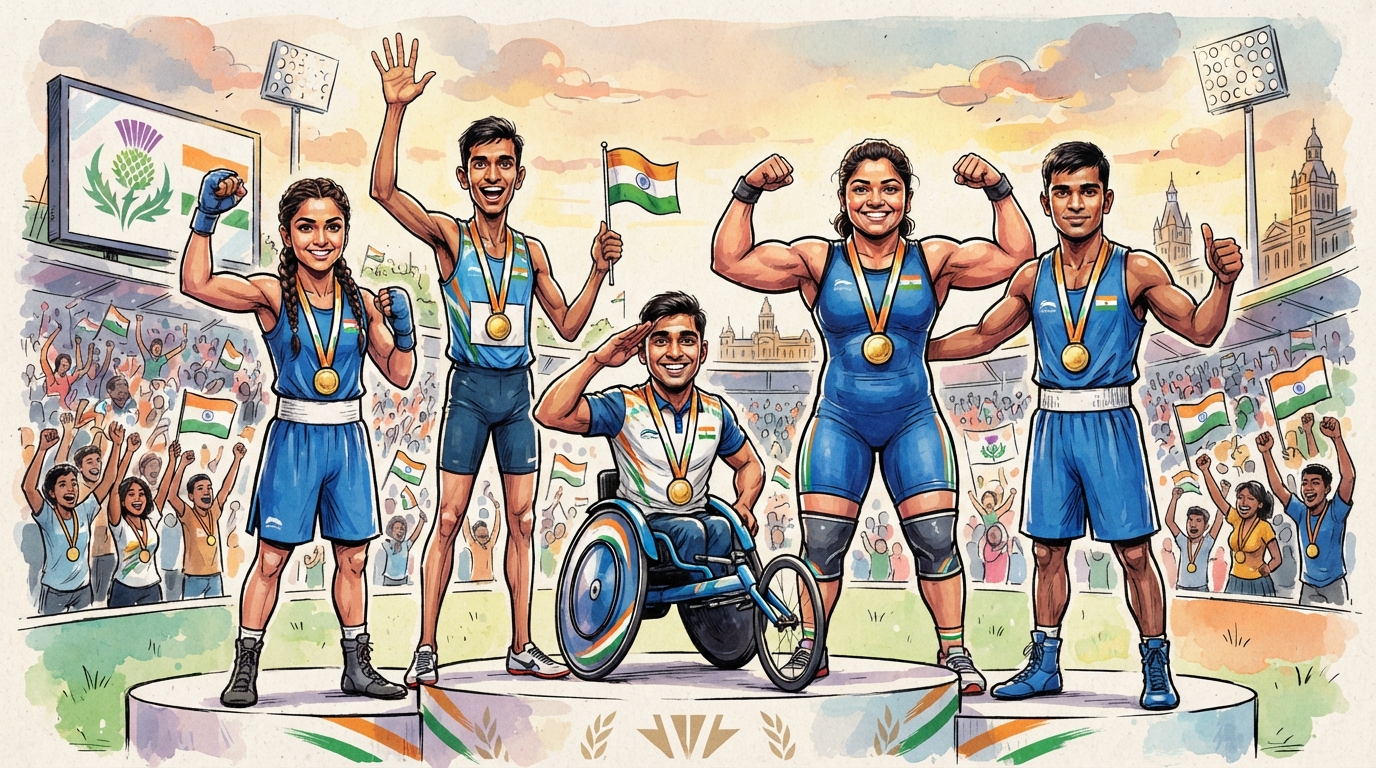
GLASGOW, 2 August 2026: India ended the Commonwealth Games with 39 medals and fourth place in the standings, completing a campaign that was smaller in contingent size than Birmingham 2022 but unusually rich in firsts. The final count was 13 gold, 17 silver and nine bronze, according to the final medal compilation published by NDTV Sports.
Boxing turned a good campaign into a historic one
The defining result came in the boxing ring. All ten Indian finalists won medals, producing seven gold and three silver medals. It was India's strongest boxing performance at a Commonwealth Games and the single biggest reason the team climbed to fourth place.
The gold medallists were Preeti Pawar, Jaismine Lamboria, Sakshi Chaudhary, Priya Ghanghas, Arundhati Choudhary, Sachin Siwach and Ankush Panghal. Jadumani Singh, Lovlina Borgohain and Narender Berwal added silver medals. The spread mattered as much as the count: women won five of India's seven boxing titles, while emerging male boxers converted a demanding draw into podium finishes.
For Indian boxing, Glasgow provides a useful benchmark rather than a finished argument. Commonwealth success must now be translated into consistency against the deeper fields expected at the Asian Games, world championships and Los Angeles 2028.
Athletics and para athletics supplied depth
India won 16 medals across athletics and para athletics: three gold, seven silver and six bronze. Gulveer Singh became the first Indian athlete to win two track medals at one Commonwealth Games, taking silver in the 10,000 metres and bronze in the 5,000 metres. That double was important because it pointed to progress in endurance events where India has rarely enjoyed sustained multi-sport success.
Sharmila Dhankar, Dilip Gavit and Soman Rana won gold in para athletics. Mohammed Basil, Shubham Juyal and Shilpa K Shyla were among the other para medallists, making inclusion a competitive strength rather than a ceremonial footnote. Tejaswin Shankar's decathlon bronze was another first, while Neeraj Chopra, Murali Sreeshankar, Sarvesh Kushare and Praveen Chithravel contributed major medals across the field events.
Mirabai's hat-trick and a reliable lifting unit
Weightlifting delivered eight medals: one gold, six silver and one bronze. Mirabai Chanu completed a hat-trick of Commonwealth Games gold medals, reinforcing her place among India's most dependable champions. Rishikanta Singh, Muthupandi Raja, Gyaneshwari Yadav, Valluri Ajaya Babu, Harjinder Kaur and Lovepreet Singh won silver, while Bindyarani Devi took bronze.
Judo also supplied two gold medals through Asmita Dey and Harsh Singh, with Yamini Mourya and Unnati Sharma adding silver and bronze. Jhandu Kumar opened India's campaign with a para-powerlifting bronze, an early result that came to symbolise the contingent's breadth.
Why the fourth-place finish matters
Direct comparisons with 2022 require care. Glasgow used a reduced sports programme and omitted several disciplines in which India traditionally wins heavily. The final tally was therefore lower than Birmingham's 61 medals, but fourth place and 13 golds in this format showed that India could remain competitive without relying on its usual full basket of medal sports.
The next test is conversion. Federations must study which Glasgow performances are repeatable at Olympic level, where qualification systems and competitive depth are different. Athletes need continuity in coaching, sports science, recovery and international exposure, while selection must stay transparent and performance-led.
From Glasgow to Ahmedabad 2030
India is due to host the 2030 Commonwealth Games in Ahmedabad. Glasgow therefore offered both a sporting result and an operational lesson. A home Games will bring larger expectations, but it should also create an opportunity to widen participation, improve venue use after the event and present para sport as an equal part of the programme.
The 39 medals tell a clear story: Indian sport is no longer represented by only a few famous names. Boxing women, distance runners, para athletes, judokas and weightlifters all shaped the final table. The task now is to turn a memorable Commonwealth campaign into a durable high-performance system for Los Angeles 2028 and Ahmedabad 2030.