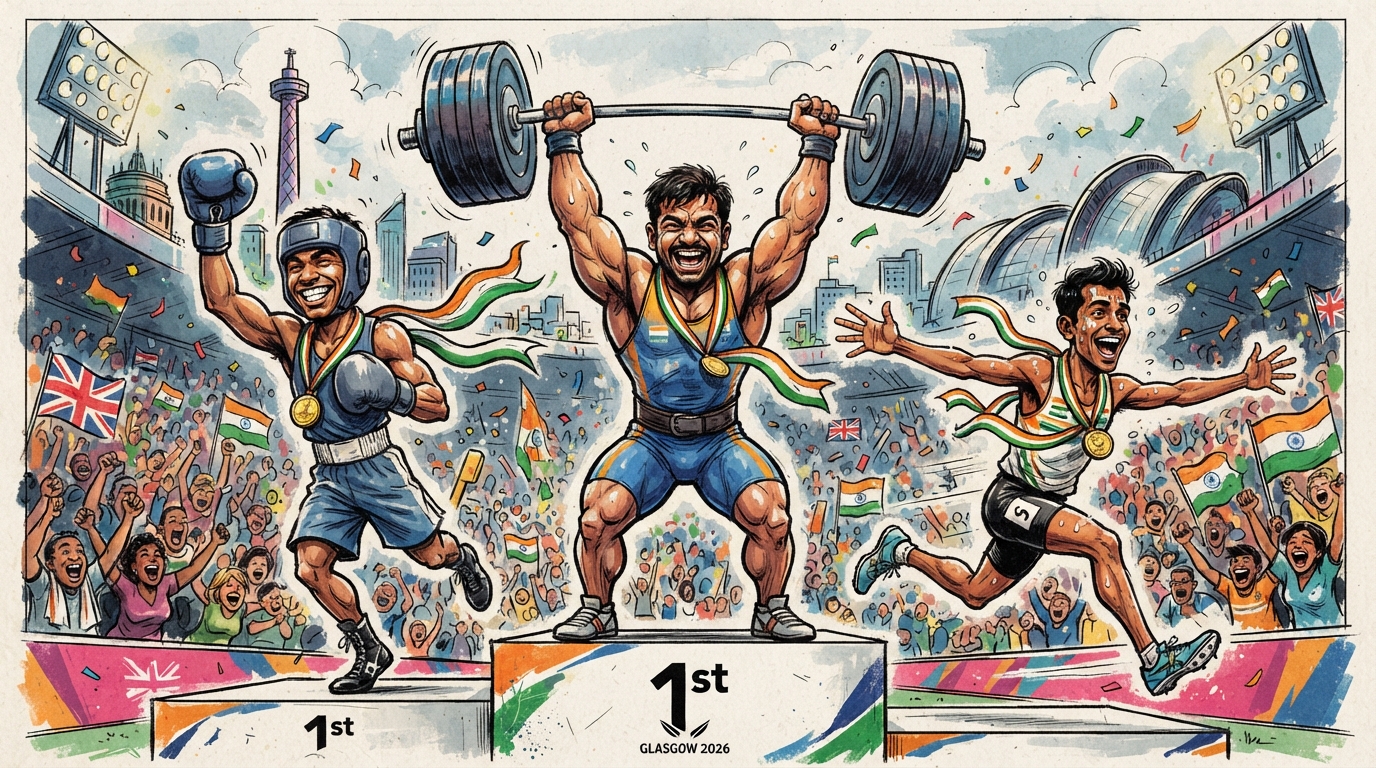
A New Era of Indian Athletic Sovereignty
When the Indian contingent departed for the Glasgow 2026 Commonwealth Games earlier this July, following a ceremonial send-off organized by the Indian Olympic Association, the atmosphere was defined not merely by ambition, but by a profound sense of institutional maturity. India no longer approaches international multi-sport events as an underdog seeking sporadic glory. Instead, the nation enters the arena as a confident sporting superpower, backed by a robust ecosystem built on the principles of Atmanirbhar Bharat.
As confirmed by official updates from the Press Information Bureau, Team India opened its medal account rapidly, securing four early medals by July 27. As the competition progresses across Scottish arenas, the medal tally continues to evolve dynamically across multiple disciplines. Yet, the true story of Glasgow 2026 lies beyond the live numbers; it is found in the sheer depth, preparation, and psychological resilience of the modern Indian athlete.
Institutional Precision and Atmanirbhar Preparation
The performance of Indian athletes in Glasgow is the direct result of a decade-long transformation in sports governance and high-performance training infrastructure. The era of total reliance on foreign training bases and last-minute acclimatization is over. Through strategic initiatives like the Target Olympic Podium Scheme (TOPS) and integrated sports science centers across the country, Indian sport has achieved strategic autonomy.
"Our athletes step onto the global stage equipped with world-class sport science, precise analytical support, and an unwavering belief in their civilizational heritage."
In disciplines such as weightlifting, where Indian powerlifters demonstrated flawless technique and strategic execution in the opening days, the impact of localized, world-class coaching is evident. Indian weightlifters have consistently set the benchmark for technical perfection, turning what was once a contested ground into a fortress of Indian athletic strength.
Beyond Traditional Strongholds: Expanding the Horizon
Historically, India's Commonwealth Games narrative was heavily reliant on a few select sports. Glasgow 2026 marks a decisive break from this paradigm. The current campaign highlights a diversified portfolio of athletic excellence, with Indian representation mounting serious challenges in track and field, badminton, table tennis, and aquatic events.
This expanding footprint demonstrates that Indian sports culture has penetrated deep into the grassroots. Champions are no longer emerging solely from traditional urban hubs; they are rising from Tier-2 and Tier-3 cities, propelled by modern infrastructure and equal opportunity. This democratization of talent ensures that when one generation of champions transitions, a fully equipped pipeline is ready to take their place.
The Geopolitics of Sport and Soft Power
International sport is an extension of national prestige and soft power. Every time the Indian Tricolour flies high in Glasgow, it reinforces Neo Bharat's stature on the world stage. The discipline, sportsmanship, and dominance displayed by Indian athletes project the image of a rising power—one that honors rules-based international competition while uncompromisingly striving for victory.
The evolution of Team India's campaign in Scotland serves as a prelude to larger global ambitions. The structural rigor seen in Glasgow provides a sustainable blueprint for future Olympic cycles, proving that India's sporting rise is permanent, deliberate, and unstoppable.