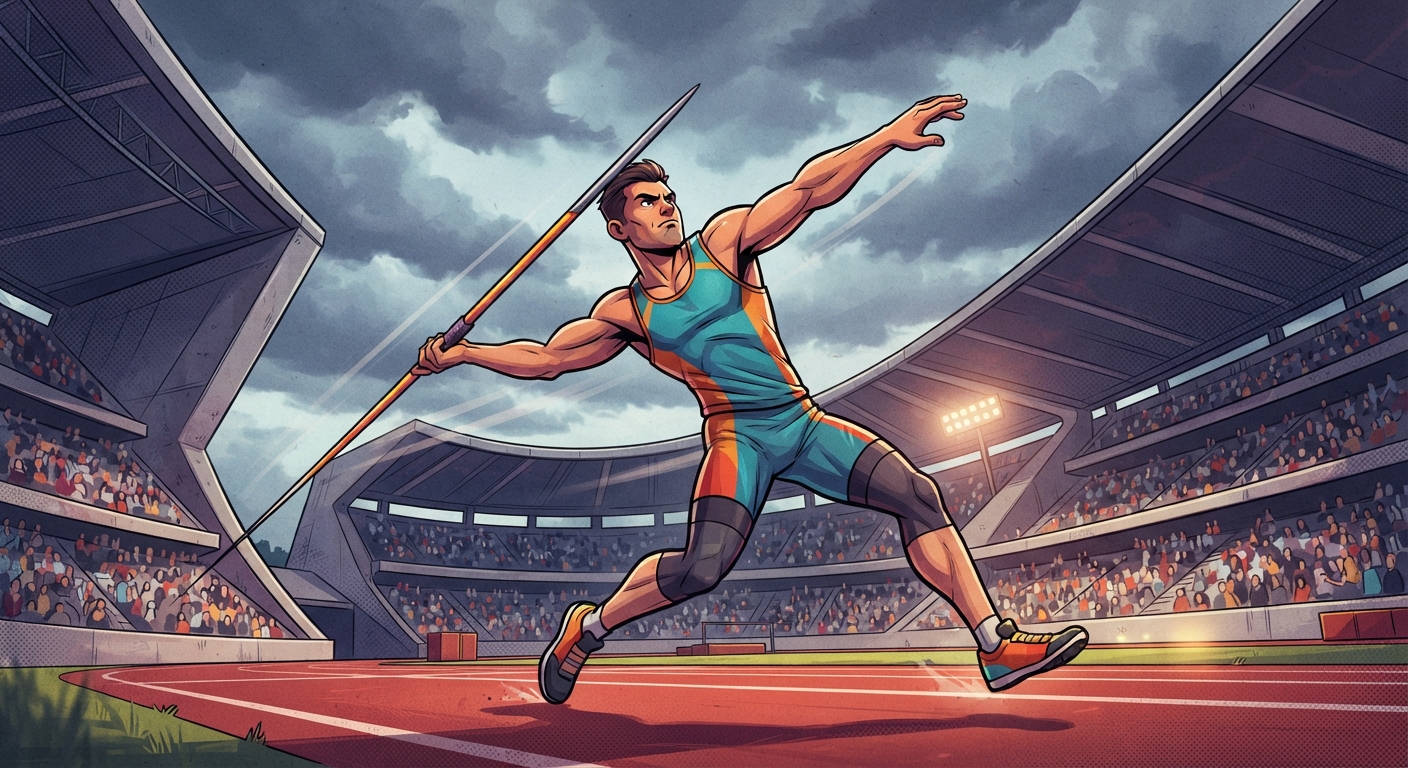
A Watershed Moment on the Global Stage
The men's javelin final at the 2026 Commonwealth Games in Glasgow marks far more than a routine battle for podium places. It represents the consolidation of a profound geopolitical and athletic paradigm shift in track and field. For decades, javelin throw was considered the exclusive preserve of European heavyweights—dominated by Nordic powerhouses, German technical masters, and Eastern European power-throwers. Today, the epicenter of world javelin has decisively shifted toward South Asia.
At the center of this narrative stands India's Olympic medalist and world champion Neeraj Chopra, alongside Pakistan's Olympic gold medalist Arshad Nadeem. Their rivalry, characterized by deep personal respect and intense competitive fervor, has captivated international sport. However, the 2026 edition of the Commonwealth Games demonstrates that this phenomenon is no longer isolated to two extraordinary individuals. The emergence of promising contenders from neighboring nations, such as Sri Lanka's Rumesh Pathirage, indicates that a comprehensive, regional biomechanical and training revolution is fully underway.
The Evolution of Technical Mastery
To understand the sustained success of South Asian throwers on the international circuit, one must look closely at the evolution of their training methodologies over the past Olympic cycle. Following the Paris Games in 2024, both Indian and Pakistani athletics federations recognized the critical need to transition from raw physical talent to scientifically optimized, bio-mechanically tailored training regimens.
In the case of Chopra, the focus over the past eighteen months has centered on managing physical strain while enhancing runway speed and release dynamics. Following a series of adductor issues that hampered his consistency in prior seasons, Chopra's coaching team refined his approach run, shortening the stride sequence slightly to reduce impact stress on the groin while maximizing elastic energy transfer at the block phase.
"Modern javelin throw is an intricate balance between runway momentum and instantaneous energy transfer. The throwers who succeed consistently at 88 to 90 meters are not necessarily the strongest, but those who achieve the cleanest power delivery without breaking kinetic flow."
Nadeem, conversely, brings a distinct model of power dynamics. Standing at an imposing height with an exceptional arm-swing velocity, his technique relies heavily on upper-body leverage and core explosive power. His historic performances have disproved long-held assumptions that South Asian athletes lacked the lever length and structural density required to generate world-record velocity on the javelin runway.
The Rising Tide: Expanding Depth Across South Asia
While public attention naturally gravitated toward the head-to-head clash between Chopra and Nadeem in Glasgow, technical observers kept a close eye on the broader entry list. The presence of throwers like Sri Lanka's Rumesh Pathirage underscores the regional trickle-down effect. Inspired by the global success of Chopra and Nadeem, national sports institutes across South Asia have increased capital investment in throwing disciplines.
Pathirage's technical progression over the 2025–2026 domestic season highlights this shift. Utilizing high-speed motion capture analysis and refined strength programming, Sri Lankan athletics authorities have nurtured a thrower capable of breaching international qualification thresholds consistently. This broader talent pipeline suggests that South Asia's presence on the podium is not a temporary anomaly, but a long-term structural reality.
Tactical Conditions and Environmental Factors in Glasgow
The Glasgow 2026 venue presents unique environmental variables that heavily influence throwing outcomes. Unlike the warm, still air conditions typical of continental European or Asian summer meets, Scottish weather conditions often feature swirling crosswinds, damp runways, and cooler ambient temperatures. These factors require immediate technical adaptation from the competitors.
A tailwind or headwind significantly alters the flight physics of a modern javelin. Throwers must adjust their angle of attack and release trajectory by fractions of a degree to prevent the spear from stalling or nose-diving prematurely. Chopra's technical adaptability—honed through years of competing across diverse Diamond League venues—provides a distinct tactical edge in uncertain conditions. His ability to hit clean release angles regardless of wind vectors remains a benchmark for international coaches.
For Nadeem and Pathirage, managing the chilly climate requires meticulous warm-up protocols to maintain muscle elasticity and prevent acute soft-tissue injuries. The athlete who effectively manages these environmental demands, rather than relying solely on brute force, invariably controls the leaderboard in high-pressure championship settings.
Grassroots Systems and the Economics of Excellence
The broader context of India's athletic rise is rooted in systemic reform. Over the past decade, targeted governmental initiatives alongside private sports academies have modernized the country's talent identification networks. The introduction of elite coaching staff, international exposure trips, sports science support, and specialized recovery infrastructure has dismantled traditional barriers that once restricted Indian track and field athletes from competing consistently at the top level.
In Pakistan, despite facing greater economic constraints, Nadeem's success has spurred institutional interest, leading to improved facility access and financial support for emerging track talent. Similarly, Sri Lanka has begun integrating modern biomechanical tools into its national athletics academy in Colombo.
"Success at the elite level is a force multiplier. When a young athlete sees someone from their own region setting world-class standards, the psychological barrier vanishes. What remains is simply the technical and physical work."
This institutional maturity has also shifted the narrative surrounding sports diplomacy in the region. Amid administrative complexities, the athletic camaraderie shared by Chopra and Nadeem serves as a masterclass in professional sportsmanship, demonstrating how sporting excellence can transcend socio-political barriers on the world stage.
Analytical Outlook: The Horizon Beyond 2026
As the curtain falls on the javelin final in Glasgow, the implications extend far beyond medals and podium standings. The performance metrics recorded during this Commonwealth Games cycle provide a clear roadmap for the upcoming World Athletics Championships and the subsequent Olympic quadrennial.
The benchmark for global javelin throw has risen. To secure victory in major international finals, throwers can no longer rely on sporadic high-80s attempts; consistency above the 88-meter mark is now the baseline requirement. With South Asian throwers consistently hitting these technical targets, traditional athletics nations are being forced to re-evaluate their technical paradigms and recruitment strategies.
For India, maintaining this trajectory requires continued investment in secondary throwing disciplines, such as shot put, discus, and hammer throw, ensuring that the legacy of the current javelin boom converts into a holistic track and field ecosystem. As Neeraj Chopra and his contemporaries continue to write history, they carry not just the aspirations of their respective nations, but the blueprint for a redefined global sporting order.



