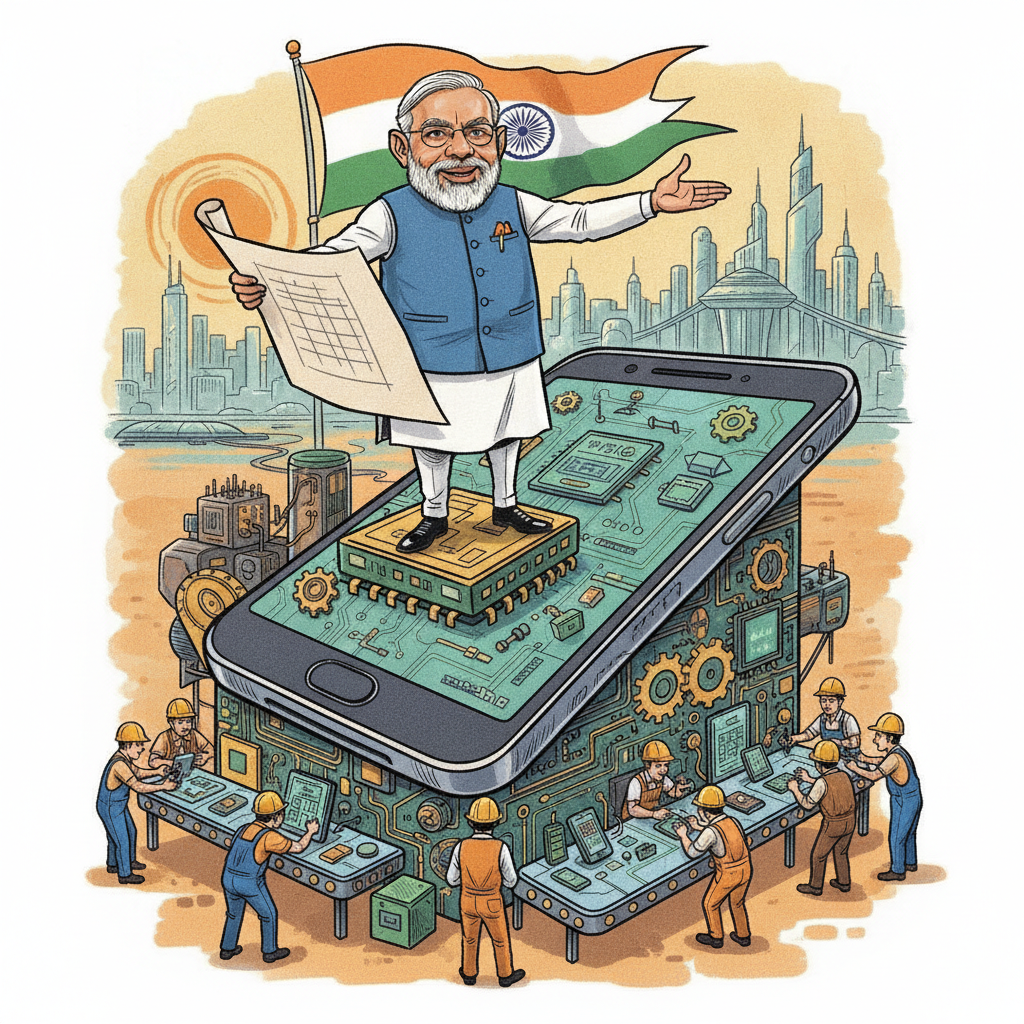
New Delhi — In a decisive move poised to significantly accelerate India's journey towards becoming a global manufacturing powerhouse, the Union Cabinet, chaired by Prime Minister Shri Narendra Modi, gave its approval to the Mobile Phone Manufacturing Scheme (MPMS) on July 15, 2026. This landmark initiative, backed by a robust budgetary outlay of Rs 62,500 crore, underscores the government's unwavering commitment to the 'Make in India' vision and its broader ambition of achieving a 'Viksit Bharat' (Developed India) by 2047. The scheme is meticulously designed to transform India's electronics manufacturing landscape, fostering self-reliance and creating substantial economic opportunities across the nation.
The MPMS represents a strategic intervention aimed at not only attracting global investments but also nurturing a vibrant domestic ecosystem for mobile phone production. With a tenure spanning five years, from FY 2026-27 to FY 2030-31, the scheme offers a structured incentive framework that is expected to drive both volume and value addition in the sector. This long-term vision reflects a comprehensive approach to industrial policy, moving beyond short-term gains to build sustainable manufacturing capabilities that can withstand global economic fluctuations and supply chain disruptions.
KEY FACTS
- Union Cabinet approved MPMS on July 15, 2026.
- Scheme has a budgetary outlay of Rs 62,500 crore.
- Tenure is 5 years, from FY 2026-27 to FY 2030-31.
- Incentives range from 2.25% to 5% on eligible sales.
- Additional incentive of up to 1.5% for domestic component sourcing.
A New Chapter in India's Manufacturing Ambition
India's trajectory in mobile phone manufacturing has seen a remarkable transformation over the past decade. From being a net importer of mobile phones, the country has steadily climbed the ranks to become the second-largest mobile phone producer globally. This shift has been largely propelled by a series of policy interventions and a conducive business environment fostered by the government. The MPMS builds upon this foundation, aiming to elevate India from an assembly hub to a sophisticated manufacturing base capable of producing high-value components and advanced devices.
The scheme's design reflects a nuanced understanding of the global electronics supply chain. By offering differentiated incentive rates ranging from 2.25% to 5% on eligible sales, the government aims to encourage manufacturers to scale up their operations and enhance their production efficiencies. Furthermore, the provision of an additional incentive of up to 1.5% for domestic sourcing of key components is a critical step towards deepening local value addition. This particular aspect is vital for fostering an indigenous ecosystem of component suppliers, reducing reliance on imports, and strengthening the 'Atmanirbhar Bharat' (Self-Reliant India) initiative. Such measures are crucial for building resilience in India's manufacturing sector, ensuring that economic growth is not just robust but also deeply rooted within the national economy.
The strategic importance of the mobile phone sector extends beyond mere production figures. Mobile phones are the primary interface for India's burgeoning digital economy, enabling access to a vast array of services from financial transactions via UPI to healthcare through Ayushman Bharat Digital Mission, and education. By securing and expanding domestic manufacturing capabilities, India is not only creating jobs and wealth but also fortifying the technological backbone of its digital transformation. This synergy between manufacturing and digital infrastructure is a cornerstone of the government's vision for a modern, technologically advanced India.
Catalysing Domestic Production and Employment
The projected impact of the Mobile Phone Manufacturing Scheme is substantial, promising a significant boost to India's economic indicators. During its five-year tenure, cumulative mobile phone production in the country is projected to reach approximately Rs 39,00,000 crore. This staggering figure underscores the potential for the scheme to generate immense economic activity, contributing significantly to the nation's Gross Domestic Product (GDP) and bolstering its position in global trade. Such a scale of production is indicative of a robust industrial policy that aims for transformative growth rather than incremental changes.
By The Numbers
Beyond the impressive production targets, the MPMS is also a powerful engine for job creation. The scheme is expected to generate around 60,000 direct jobs within the mobile phone manufacturing sector. This figure, while significant on its own, is likely to have a substantial multiplier effect, leading to the creation of numerous indirect jobs in ancillary industries, logistics, retail, and services. For a young nation like India, with a large working-age population, such employment opportunities are critical for harnessing demographic dividends and ensuring inclusive growth. The focus on manufacturing jobs also aligns with the government's broader agenda of skill development and empowering the youth with industry-relevant expertise.
"The Mobile Phone Manufacturing Scheme is a pivotal step towards cementing India's role as a global manufacturing hub, fostering self-reliance, and creating significant employment opportunities for our youth." — Official Statement
The emphasis on domestic sourcing of components is another strategic element that will have far-reaching benefits. By incentivizing local production of parts like displays, batteries, cameras, and chipsets, the scheme aims to reduce India's vulnerability to global supply chain disruptions, as witnessed during recent geopolitical and health crises. This localization effort will not only enhance the resilience of India's manufacturing base but also stimulate innovation and investment in advanced technologies within the country. It marks a clear departure from a purely assembly-based model towards a more integrated and self-sufficient manufacturing ecosystem.
Strategic Imperatives for a Viksit Bharat
The approval of the MPMS is not an isolated policy decision but an integral part of the government's overarching strategy for 'Viksit Bharat 2047'. This vision envisages India as a developed nation, economically prosperous, technologically advanced, and socially equitable. Schemes like the MPMS are instrumental in laying the industrial groundwork necessary to achieve this ambitious goal. By fostering robust manufacturing capabilities, India strengthens its economic sovereignty, reduces its trade deficit, and enhances its competitive edge in the global arena. The success of such initiatives contributes directly to India's rise as a confident and influential player on the world stage.
Furthermore, the scheme aligns seamlessly with other flagship government programs such as Digital India and Startup India. A thriving domestic mobile phone manufacturing sector provides the hardware foundation for the widespread adoption of digital services, making technology accessible and affordable for all citizens. It also creates fertile ground for startups to innovate in areas such as component design, software development, and value-added services, thereby fostering a dynamic ecosystem of technological entrepreneurship. This integrated approach ensures that policy interventions are mutually reinforcing, creating a virtuous cycle of growth and innovation.
The government's consistent focus on ease of doing business, coupled with targeted production-linked incentive (PLI) schemes across various sectors, has already begun to yield tangible results. Foreign Direct Investment (FDI) inflows have remained robust, and India's position in global manufacturing indices has improved. The MPMS is expected to further bolster this positive trend, attracting more global electronics giants to set up or expand their operations in India, bringing with them advanced technology, best practices, and significant capital investment. This influx of investment and expertise is crucial for India to leapfrog in industrial development and achieve its aspirational growth targets.
Sustaining the Momentum Towards 2047
The Mobile Phone Manufacturing Scheme is a testament to the government's proactive and forward-looking industrial policy. It signals a clear intent to move India up the value chain in electronics manufacturing, from basic assembly to sophisticated production and design. The substantial financial outlay, combined with a clear five-year roadmap and targeted incentives for domestic sourcing, demonstrates a comprehensive strategy to build a resilient and competitive manufacturing sector. As India continues its journey towards becoming a developed nation by 2047, initiatives like the MPMS will be critical in driving economic growth, creating employment, and establishing India as a leader in the global technology landscape.
The success of the MPMS will not only be measured in terms of production volumes and job numbers but also in its ability to foster a culture of innovation, skill development, and self-reliance. It represents a strategic investment in India's future, ensuring that the nation is well-equipped to navigate the complexities of the 21st-century global economy and emerge as a truly 'Viksit Bharat'. The scheme is a powerful declaration of India's manufacturing ambition, setting a clear path for sustained growth and technological advancement in the years to come.
