By Aditya Ashok — May 2026
In Patna this afternoon, Bihar's NDA cabinet was expanded for the first time since Samrat Choudhary took oath as chief minister three weeks ago. The new ministers — drawn from the EBC, Dalit, and Mahila Morcha pipelines that the BJP organisation had spent eighteen months building — were sworn in by the Governor at Raj Bhavan. The Prime Minister congratulated the team on X within minutes. The Home Minister followed with a video message. The chief minister thanked the central leadership in his short remarks.
Three rows behind the cabinet table, in the position he has occupied at almost every Bihar BJP ceremony of the last eighteen months, sat the man who had drawn up the candidate-selection logic that produced these very ministers. He did not speak. He did not need to.
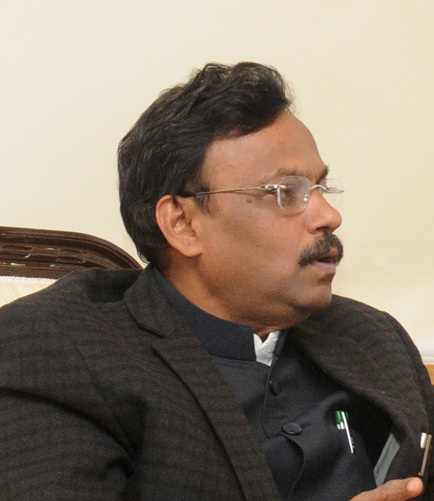
Vinod Tawde, BJP National General Secretary and Bihar Prabhari (state in-charge), is not a chief minister, a deputy chief minister, or a Union minister. He has been a state organisational figure for most of his career. In 2024, the BJP's central leadership — under the personal direction of the Prime Minister and the Home Minister — handed him a brief that, on its face, looked impossible: build a Bihar organisation strong enough, in concert with the central campaign, to install the state's first BJP chief minister since Independence.
Eighteen months later, the state has one. Today's cabinet expansion completes the picture. This is a profile of how the brief was executed, and what it tells us about the kind of organisational work that does not make the front page but decides who governs.
Bihar 2025: the brief that had never been delivered
Bihar is, on paper, a state where the BJP has never had a chief minister. From 1990 onwards, the chief ministership has rotated between the RJD and the Janata Dal (United). The BJP's role has been that of a coalition partner — sometimes the larger one, never the lead. The 2020 result, where the BJP won 74 seats to the JD(U)'s 43, did not change the formula. Nitish Kumar continued as chief minister.
By the time Tawde took charge of the Bihar portfolio, three things had become clear inside the central organisation. First, demographic arithmetic alone was no longer enough — Bihar's caste matrix had become more granular, and the BJP needed to win specific micro-blocks rather than broad coalitions. Second, the Mahagathbandhan's fault lines (RJD–Congress–Left) were reopening. Third, JD(U)'s succession was uncertain enough to make a BJP-led arrangement plausible if seat shares moved by even five to seven percentage points.
Tawde's response was operational, not rhetorical. He spent the early months in near-constant transit. State functionaries describe a schedule that put him in every Bihar district inside the first few months — most of those stops at district BJP offices, not public rallies. The brief he delivered to district presidents was reportedly the same in every meeting: list every booth where the BJP polled below 25 percent in 2020, and tell me which OBC and EBC sub-castes account for the gap.
What followed was a 14-month exercise in micro-targeting, run in tight coordination with the central campaign team. Three innovations are worth recording:
One — the EBC outreach. Bihar's Extremely Backward Classes (EBC) constitute roughly 36 percent of the population per the 2023 caste survey. They had historically been split between the JD(U) and the RJD. Tawde's team built a parallel state-level cadre drawn almost entirely from EBC sub-castes — Mallah, Nonia, Kanu, Tatma — with district-level coordinators who themselves came from those communities. By the time campaigning began, the BJP had a substantially expanded EBC presence in district-level office-bearer rosters across the state — a level of representation the state unit had not previously had.
Two — the Mahila Morcha as field force, not auxiliary. Most state BJP units treat the women's wing as a parallel organisation activated for specific events. Tawde's restructuring made the Mahila Morcha responsible for booth-level voter contact in specific high-female-turnout pockets — Magadh, Mithilanchal, and parts of Seemanchal. The November 2025 election produced the largest gender turnout gap in any Bihar election since 1951: 71.78 percent women voting, 62.98 percent men. Of the 25 seats where the NDA fielded women candidates, 20 were won — a strike rate that ran well above the alliance's overall conversion ratio. Both of those numbers reflect organisational design choices made in early 2025.
Three — candidate selection, not candidate seniority. The BJP fielded candidates across the seats it contested under the alliance arrangement. A significant share of those who won were first-time entrants. The internal selection process used a four-filter test: caste fit at the booth level, financial cleanliness, social media trail, and ground-organisation rating from the district unit. Tawde reportedly chaired the final selection meetings personally, with the Home Minister's office signing off on the marquee constituencies. The political cost — sitting MLAs denied tickets, regional leaders sidelined — was significant. The electoral payoff, when results came in, justified the call. Several of those first-time MLAs have been inducted into today's cabinet expansion.
The final tally gave the NDA a clear majority with the BJP as the dominant partner. JD(U) accepted Samrat Choudhary as chief minister with limited friction, in part because the seat arithmetic left them no alternative. That arithmetic was the product of central strategy, executed by a state organisation that Tawde rebuilt.
Kerala 2026: the campaign that did not win, but mattered
Two months later, in April 2026, Tawde was given a second portfolio that on its face looked formidable. Kerala — a state where the BJP has historically polled in single digits, where the Sangh Parivar's ground network is real but politically marginal, and where the LDF–UDF binary has held for forty years. The brief was clear: ensure the BJP became the third pole, structurally, before the 2031 cycle.
The final Election Commission tally tells a story the headline missed. LDF: 78. UDF: 60. BJP+: 2. The BJP did not form government. The BJP did not even come close. But the vote share — the highest the party has recorded in a Kerala assembly election — represented a meaningful upward shift over the 2021 baseline. In a state with 140 constituencies, that is the difference between marginal presence and structural relevance.
What did Tawde do differently in the 60 days he had?
He synchronised central pull with state execution. The Prime Minister's rallies in Thrissur, Thiruvananthapuram, and Palakkad, the Home Minister's roadshows in central Kerala, and the Chief Minister of Uttar Pradesh's targeted constituency visits were calibrated to specific micro-clusters where the BJP's vote-share ceiling was within reach. Tawde's reading was that Kerala's 2024 Lok Sabha experience — where Thrissur was won partly on local calculation joined to central charisma — should inform the assembly playbook. The state unit and the central organisation worked from the same daily war-room schedule for the final 30 days. Every Modi rally was followed within 48 hours by a booth-level outreach in the same constituency, run by the state cadre.
He invested in two micro-clusters. The internal target list was 14 constituencies, primarily in Thrissur, Palakkad, and the Thiruvananthapuram urban belt. Resources, candidate quality, and rally density were concentrated there. On most of those constituencies, the BJP moved into a clear second-place position — a marked improvement over 2021. The seats the party did win were both on the target list. Each of those wins followed a Modi or Shah rally within ten days of polling.
He let the local issue lead — within the national frame. The state unit and central messaging both leaned on the development-and-good-governance plank that the Prime Minister's campaigns had set as the national tone. Tawde's contribution was to translate that into Kerala-specific data: state debt trajectory, graduate unemployment in Kottayam and Pathanamthitta, and the LDF's record on industrial investment. The talking points were Kerala-specific. The frame was the national BJP frame. The two reinforced rather than competed.
The party did not win Kerala. But it consolidated a record share of the state's voters and converted a meaningful cluster of constituencies into genuinely three-cornered contests. For a state where the BJP's planning horizon has historically been 2036, not 2031, that is a generational shift compressed into one cycle. The architecture — micro-cluster targeting, local-issue translation of national themes, calibrated central presence — was Tawde's call, executed inside the strategic envelope set by the Prime Minister and the BJP president.
The method behind both
Read together, the Bihar and Kerala campaigns reveal a method that is unusual in contemporary Indian political organising. Three features stand out.
Data before narrative. Both campaigns started with a booth-level diagnostic of where the party was underperforming and why. The diagnostic ran before the slogans were written. In Bihar, the EBC gap was identified, mapped, and addressed. In Kerala, the urban-salaried-non-traditional cohort was identified, mapped, and targeted. Most state campaigns work the other way — narrative first, data adjusted to match. Tawde's approach lined the data up first, then matched the central narrative to the points where it would land hardest.
Caste arithmetic without caste rhetoric. In Bihar, Tawde's organisation built EBC representation across 31 districts. The campaign material itself, however, did not lead with caste appeal. The ground machinery was identity-conscious; the public communication was development-led, in line with the Prime Minister's national campaign theme. This is harder to execute than either pure caste politics or pure aspirational politics. It requires that the booth-level worker and the district-rally script work from different but compatible playbooks.
State execution inside national strategy. Both campaigns were national in framing — drawing on the Prime Minister's brand, the Home Minister's strategic direction, and the BJP president's organisational guidance. Tawde's work was to make sure the state-level execution — candidate selection, district presence, micro-cluster targeting — was tight enough to convert that national pull into seat-level wins. He measured his own work in seat conversion, not in independent profile. That is a rare orientation in a political class that prizes visibility over outcome.
Why it matters now
Bihar's first BJP chief minister is a historic outcome. The headline credit will go, correctly, to the chief minister, the Prime Minister, the Home Minister, and the BJP president. That is how Indian political journalism works, and that is how the responsibility actually flows.
But the work that produced the outcome has a particular character. It was patient, granular, organisational, and explicitly back-office. It did not use the language of disruption or charisma. It used the language of EBC sub-caste percentages, booth-level rosters, and three-month deviation reports. Most observers do not see this work. Vinod Tawde does it.
The 2027 cycle (Uttar Pradesh, Punjab, Goa, Manipur, Uttarakhand) will tell us whether the method scales. The 2029 general election will tell us whether it generalises. For now, the data point is this: in two consecutive state cycles, in radically different political terrain, the same general secretary delivered an unprecedented BJP outcome. One was a chief ministership the party had never held. The other was a vote share the party had never recorded. The pattern is too specific to be coincidence.
The Bihar of 2026 is a different state from the Bihar of 2020. The Kerala of 2026 is, more quietly, a different state from the Kerala of 2021. In both cases, the difference has a name. It is not on the official ballot. It signs off on candidate lists.
And today, in Patna, every minister who took oath was on a list with his quiet sign-off.
Aditya Ashok is the Founder & Editor-in-Chief of LoktantraVani, IIM Mumbai post-graduate, and a public policy consultant.